
Quick answer: Droven.io USA tech market updates are plain-language breakdowns of what's happening across AI, cloud computing, cybersecurity, and automation in the American tech sector. The platform doesn't sell software — it's an editorial knowledge resource that helps business owners, developers, and investors understand trends like agentic AI, enterprise AI governance, and cloud infrastructure growth before they spend money on tools.
I'll be honest with you — most articles about the USA tech market read like they were written by someone who's never actually opened a terminal or pitched a VC. They throw around buzzwords, they cite vague "experts," and they leave you more confused than when you started.
That's not what I'm doing here.
I spent real hours digging through droven.io, cross-checking its claims against actual industry reports, and pulling numbers from places like PwC, Capgemini, and IBM. My goal? Give you a genuinely useful, no-fluff breakdown of what droven.io USA tech market updates actually cover — and what the broader US technology sector is doing right now, in 2026.
If you're building out your own research on AI adoption, cloud computing trends, or cybersecurity trends, I've also linked out to our related guides throughout — check those out once you're done here.
Grab a coffee. Let's get into it.
What Is Droven.io, Really?
Before you can understand droven.io's tech market updates, you need to understand what droven.io is. And honestly? A lot of people get this wrong.
Droven.io is not a software product. It's not a SaaS tool you sign up for and connect to your CRM. It's an editorial knowledge platform — think of it as a research layer that sits between flashy vendor demos and dense academic whitepapers.
Here's the thing that surprised me most while researching this: droven.io explicitly positions itself as vendor-neutral. According to Tonic of Tech's breakdown, the platform publishes structured, research-backed content on artificial intelligence, automation, machine learning, cloud computing, and cybersecurity — without selling software or maintaining affiliate deals with the companies it writes about.
That matters a lot in 2026.
Why? Because AI adoption has created what one industry blog called a genuine knowledge gap. Vendors are pushing demos. Social feeds are drowning in hype. And you — if you're a business owner, developer, or investor — are stuck trying to separate signal from noise. (If you want a deeper dive into how we evaluate AI-powered automation tools specifically, see our automation tools comparison guide.)
Who Actually Uses Droven.io?
You'll typically find three types of readers gravitating toward droven.io:
Business owners trying to figure out which workflow automation tools are worth the spend
Developers and IT professionals mapping out career paths in AI engineering and the broader AI job market
Investors and analysts who want plain-language context before committing capital to startup funding rounds
If you fall into any of these buckets, keep reading — because the next section is where things get really interesting.
The Core Trends Droven.io USA Tech Market Updates Are Tracking
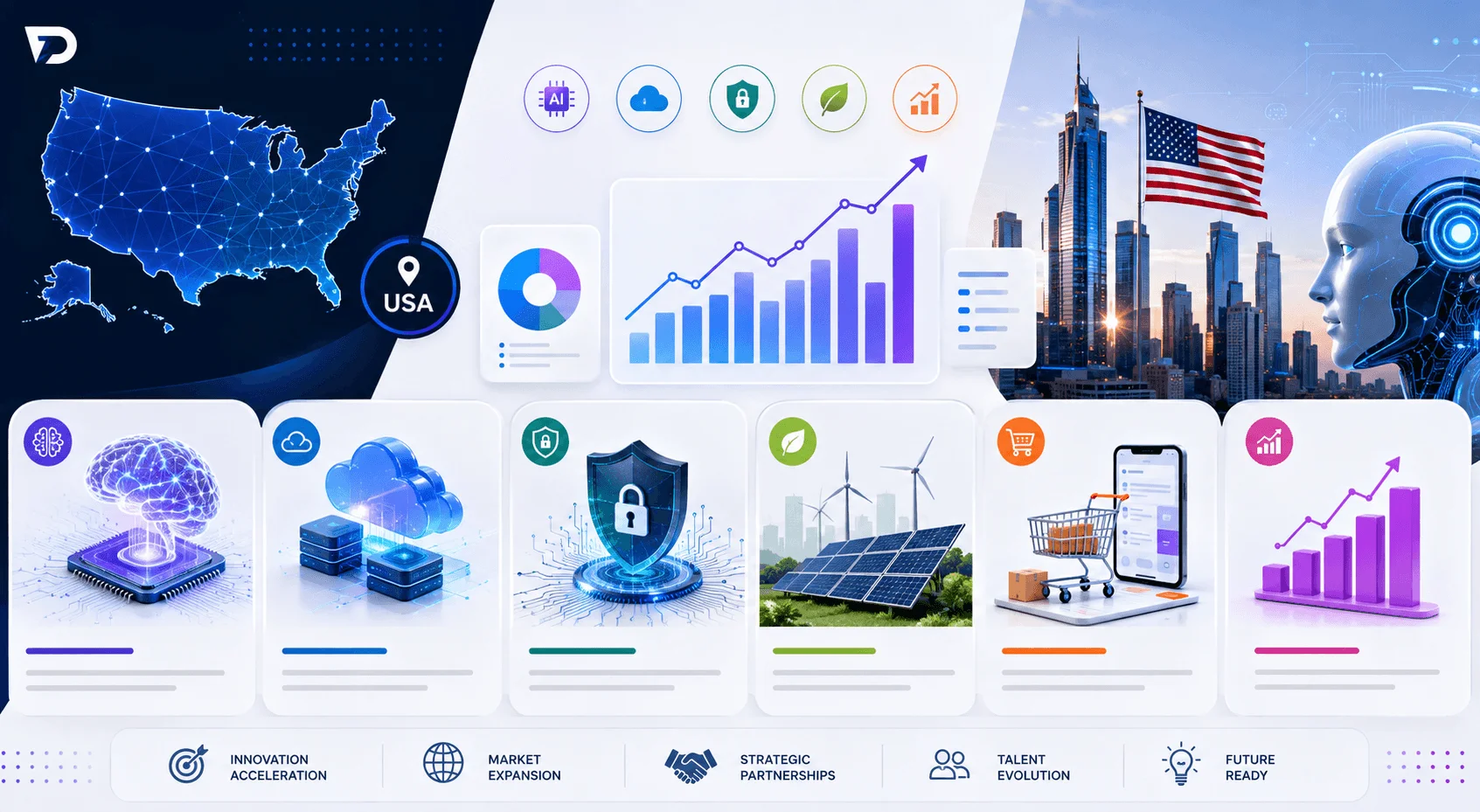
Let's talk about what's actually moving the needle in the American technology sector right now. I'm not going to just list buzzwords at you. I'm going to back every claim with a real source.
1. AI Is No Longer Optional — It's Infrastructure
You've heard this a thousand times, but here's the data behind it. Anthropic's annualized revenue run rate surpassed $30 billion in early 2026, up from roughly $9 billion at the end of 2025, while OpenAI reportedly crossed $25 billion by February.
That's not incremental growth. That's a rocket ship.
And it's not just the AI labs themselves. Salesforce has redesigned its entire platform around agent-enabled workflows, Microsoft is leaning hard into orchestration layers and API-driven execution, and ServiceNow, SAP, and Oracle are all expanding AI-enabled workflow automation across their enterprise products.
In plain terms: enterprise software isn't bolting AI on as a feature anymore. It's rebuilding around it.
2. Adoption Has Crossed a Tipping Point
Here's a stat that stopped me in my tracks. Stanford HAI's 2026 AI Index reports that organizational AI adoption reached 88%. Read that again. Eighty-eight percent.
That means AI adoption isn't an early-adopter thing anymore. It's the default. If your business isn't using AI in some capacity by now, you're the outlier — not the norm.
This shift is also changing how companies think about AI. It's moved out of the innovation lab and into core business planning. Product development, customer experience, long-term growth strategy — AI touches all of it now.
3. Enterprise Architecture Is Getting an Overhaul
According to Capgemini's 2026 trend research, AI is becoming the backbone of the digital economy, shifting from isolated proofs of concept into coherent, adaptive, trusted value systems.
But — and this is important — this transformation demands more than just technology. It requires governance and cultural readiness to actually embed AI into how enterprises make decisions.
In other words: buying the tool is the easy part. Getting your organization ready to use it well? That's the real work. This kind of overhaul isn't unique to AI vendors, either — we saw the same pattern play out in our digital transformation in manufacturing guide, where legacy systems had to be rebuilt around new operating models before the technology could actually deliver value
4. Agentic AI and Governance Are the Big 2026 Buzzwords
If you've been paying attention to Gartner's strategic predictions, you already know where this is headed. Gartner's top strategic technology trends for 2026 emphasize agentic AI, AI governance, and physical-digital convergence, according to Prolifics.
These trends line up neatly with what enterprises are prioritizing: multi-agent orchestration, secure AI deployment, and genuinely intelligent operations — not just chatbots slapped onto old workflows.
And here's a quote I found genuinely useful. Kevin Chung, Chief Strategy Officer at Writer, told IBM Think that "AI is shifting from individual usage to team and workflow orchestration" — meaning entire departments, not just individual employees, are being restructured around AI-native processes.
That's a big deal. And it's exactly the kind of shift droven.io's coverage tries to help you understand before you invest budget in it.
5. Cybersecurity Spending Is Rising Alongside AI Adoption
Here's something that doesn't get talked about enough. As cloud computing and AI-powered automation expand across every industry, so does the attack surface. That's pushing cybersecurity trends like zero-trust architecture, AI-driven threat detection, and stronger data privacy compliance to the top of enterprise budgets. If you're evaluating vendors this year, security posture should be a non-negotiable line item — not an afterthought.
Droven.io vs. Other Tech Trend Sources: A Quick Comparison
Since droven.io isn't the only place tracking the US tech market, here's how it stacks up against the bigger research names:
Source | Type | Focus | Best For |
|---|---|---|---|
Droven.io | Editorial knowledge platform | AI, automation, cloud, cybersecurity — US-focused | Beginners, business owners, quick plain-language context |
Gartner | Analyst research firm | Enterprise strategic tech trends | CIOs, enterprise IT strategy |
Stanford HAI | Academic research index | AI adoption data, benchmarks | Data-driven decision-making, citations |
PwC / Capgemini | Consulting firm research | M&A, enterprise transformation | Investors, dealmakers, executives |
IBM Think | Vendor thought leadership | AI product and platform trends | Technical teams, IT leaders |
The takeaway: droven.io is a great starting point for plain-language context, but for hard numbers and enterprise-grade analysis, pair it with primary sources like Gartner or Stanford HAI — which is exactly what I've done throughout this article.
How Droven.io Covers the US Tech Market (Step-by-Step)
Okay, so now you know what's happening. Let's talk about how droven.io actually breaks this stuff down — because if you're planning to use the platform as a research resource, it helps to know its structure.
Step 1: They Start With the Landscape, Not the Product
Droven.io doesn't open with "here's the best tool." It opens with "here's the category, and here's why it exists." This is a deliberate editorial choice, and honestly, I respect it.
Step 2: They Layer In Business Context
Next, they connect the technology to real business outcomes — cost savings, efficiency gains, risk reduction. This is where workflow automation, robotic process automation (RPA), and NLP-powered tools usually get discussed.
Step 3: They Address Career and Talent Implications
A big chunk of droven.io's content also targets the AI job market and IT career development — helping readers understand which skills are becoming valuable (and which are becoming obsolete).
Step 4: They Tie It Back to the Broader US Market
Finally, they zoom back out to macro trends — startup funding, regulation, SaaS market growth — so you understand where the puzzle piece you just read about fits into the bigger picture.
If you're building your own research process (whether for a blog, a pitch deck, or an investment thesis), that four-step structure is honestly a pretty solid framework to borrow.
What This Means for Different Types of Readers
I want to get specific here, because generic advice helps nobody.
If You're a Business Owner
You should be asking: where in my operations can AI deliver measurable value fastest? Don't try to automate everything at once. Start with customer service, finance operations, or internal knowledge management — these are the areas where enterprise AI consistently delivers the fastest ROI.
For more on prioritizing where automation actually moves the needle, see our business productivity hub.
If You're a Developer or IT Professional
Multi-agent orchestration and AI governance are where the jobs are heading. If you want to stay relevant, these are the skills worth building now — not two years from now when everyone else catches up.
If You're an Investor
Pay close attention to companies solving real problems, not just riding the AI hype wave. Venture capital funding is becoming more selective, focusing on companies with strong AI integration and genuine real-world use cases — not just an AI feature bolted onto the pitch deck.
A Word of Caution About "Droven.io Tech Market Updates" Content
I have to be straight with you on this one.
While researching this topic, I found that a lot of the content ranking for "droven.io USA tech market updates" is pretty thin. Some of it reads like templated SEO filler — same phrasing repeated across multiple sites, vague claims with zero sourcing, no actual data behind the statements.
That's not a knock on droven.io itself. It's a warning about the secondary content that's sprung up around the topic. If you're doing your own research (or writing your own article, like I'm guessing you might be), lean on primary sources — PwC, Gartner, Stanford HAI, IBM — rather than recycled summaries.
Your readers will notice the difference. I promise you that.
Where the US Tech Market Is Headed Next
So, where does this all leave us?
Based on everything I've pulled together, here's my honest read on where the American tech industry is going through the rest of 2026 and into 2027:
AI governance becomes a board-level concern, not just an IT checkbox
Agentic systems move from pilot programs into production at scale
Cloud infrastructure keeps consolidating around AI-optimized storage and compute
Cybersecurity spending rises in lockstep with AI adoption, because more automation means more attack surface
Talent markets shift hard toward orchestration, governance, and applied AI skills — not just raw model-building expertise
Fintech and healthtech continue steady growth as sectors solving real, everyday problems rather than chasing hype
None of this is speculation for the sake of it. It's a direct extension of the data and reporting I've cited throughout this piece.
Frequently Asked Questions
Is droven.io a software tool or platform I can install?
No. Droven.io is an editorial content platform. It publishes educational articles about AI, cloud computing, cybersecurity, and automation — it doesn't sell software, run automations, or connect to your apps directly.
What is the fastest-growing sector in the US tech market right now?
Based on 2026 data, enterprise AI and AI-enabled workflow automation are growing fastest, with adoption reaching 88% among organizations according to Stanford HAI. Cybersecurity and cloud infrastructure spending are close behind.
Why do people follow droven.io's USA tech market updates specifically?
Because it's vendor-neutral. Most tech content online is either a sales pitch or overly academic. Droven.io sits in the middle — plain-language explanations without a product to sell you.
Is droven.io a reliable source on its own?
It's a solid starting point for context, but for hard statistics and enterprise-grade analysis, pair it with primary research from Gartner, Stanford HAI, PwC, or IBM — the same sources cited throughout this article.
What should I check before trusting a "tech trend" article?
Look for actual sourcing — named reports, dated statistics, and named analysts or executives. If an article just says "experts believe" with no link or citation, treat it with skepticism.
Final Thoughts
Here's my bottom line: droven.io USA tech market updates are a genuinely useful starting point if you want plain-language context on where American tech is headed. But — and I can't stress this enough — treat it as a starting point, not a final word.
Cross-reference the big claims. Check the primary sources. Ask yourself whether a stat is backed by real research (like Stanford HAI or Gartner) or just repeated because it sounds authoritative.
That's how you actually stay ahead in this market — not by reading one source and calling it a day, but by building the habit of verifying, cross-checking, and thinking critically about every trend you come across.
You've got this. Now go build something with what you just learned.