
What Is a Heap: A heap is a complete binary tree that keeps its largest value (max heap) or smallest value (min heap) at the root. It powers priority queues, heapsort and algorithms like Dijkstra's. Peeking at the top is O(1), and insert and delete take O(log n).
Now the longer version. When I first met the word heap, I pictured a messy pile of data. Wrong! It's one of the smartest tools in computer science, and I'll show you exactly how it works, step by step. Stick with me, and you'll be ready for interviews and real projects.
What Is a Heap?
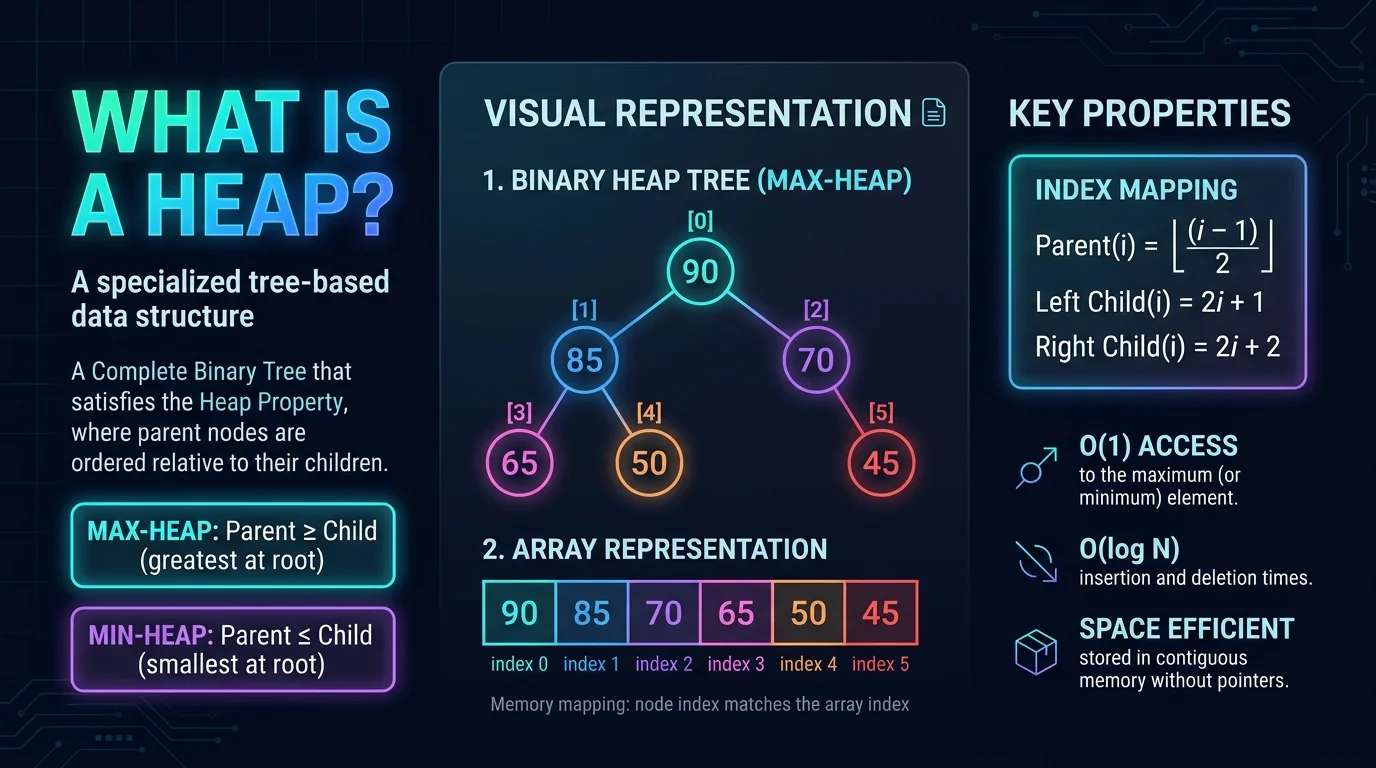
Let's start with the definition, because everything else builds on it. A heap is a tree based data structure that follows one strict rule, called the heap property. Every parent node is ordered against its children in the same direction, all the way down.
It is not a fully sorted list, though. It's partially ordered, and that's exactly why it's so fast. The most important item always sits at the root node.
By the way, priority queues are often called "heaps" regardless of how they're implemented. The heap is simply the most popular way to build one.
Min Heap vs Max Heap
There are two flavors, and they're easy to tell apart. In a min heap, every parent is smaller than or equal to its children. In a max heap, every parent is bigger than or equal to its children.
So the smallest value (min heap) or the largest value (max heap) is always on top. Here's a tiny min heap, shown as a tree and as an array:
        1
       / \
      2   9
     /
    5

Array: [1, 2, 9, 5]
Min heap tree with root 1 beside its array representation 1, 2, 9, 5
How a Heap Is Stored in an Array
Here's where it gets clever. Most heaps are binary heaps, stored as a complete binary tree: every level is full except possibly the last, which fills from the left. Because there are no gaps, you can pack the whole tree into an array representation and skip pointers entirely.
For a zero indexed array, use these parent and child index formulas:
Parent of i: (i − 1) / 2, rounded down
Left child of i: 2i + 1
Right child of i: 2i + 2
Why Heaps Are So Fast: Heap Time Complexity
Speed is the whole point of a heap. A normal queue needs Θ(n) time to find the highest priority item, as OpenDSA explains. A heap shrinks that cost dramatically, because the tree's height grows only logarithmically.
J. W. J. Williams introduced the binary heap in 1964 for heapsort, and it has stayed popular ever since. Here are the numbers, based on the binary heap reference:
Operation | Time complexity | In plain English |
|---|---|---|
Find min / peek | O(1) | The answer is always at the root |
Insert | O(log n) worst, O(1) average | Add at the end, then sift up |
Extract min / delete root | O(log n) | Swap, remove, then sift down |
Build heap | O(n) | Faster than n separate inserts |
Space | O(n) | One array slot per item |
Why Build Heap Is O(n)
This surprises almost everyone. You'd expect O(n log n), right? However, bottom up construction wins because most nodes sit near the bottom and barely move. Half the nodes are leaves, so they need no work at all.
Heap vs Sorted Array vs BST
Which structure should you pick? It depends on what you do most often. Compare them side by side:
Structure | Insert | Find min | Extract min | Best for |
|---|---|---|---|---|
Heap | O(log n) | O(1) | O(log n) | Repeatedly grabbing the top item |
Sorted array | O(n) | O(1) | O(1) at the front end | Mostly reading, rarely inserting |
Balanced BST | O(log n) | O(log n) | O(log n) | Searching and ordered traversal |
In short, a heap gives up full ordering to stay fast and simple. Look at these JHU lecture notes for the deeper comparison.
Heap Data Structure vs Heap Memory
Quick detour, because this trips up nearly every beginner. The heap data structure and heap memory are two unrelated things that share a name. Even university lecture notes warn you about the mix up, and the Rosalind glossary notes the term originally described only the data structure.
Heap memory is the region of RAM used for dynamic memory allocation. You request space at runtime, then free it later, or a garbage collection system does it for you.
Heap Memory vs Stack Memory: What's the Difference?
Here's the comparison, drawing on phoenixNAP and the Computer Science Wiki:
Feature | Stack memory | Heap memory |
|---|---|---|
Allocation | Automatic, last in first out | Explicit, at any time |
Speed | Faster | Slower |
Size | Smaller, limited | Larger, flexible |
Main risks | Stack overflow | Memory leaks, fragmentation |
How to Build and Use a Heap, Step by Step
Reading is fine, but doing is where it clicks. These two moves show up in interviews constantly, so pay attention.
How to Insert an Item (Sift Up)
Follow these steps:
Add the new value at the end of the array.
Compare it with its parent.
If it breaks the heap property, swap them.
Repeat until it fits.
A Worked Example
Take the min heap [2, 5, 9] and insert 1. It lands at the end: [2, 5, 9, 1]. Its parent is 5, so swap: [2, 1, 9, 5]. Its new parent is 2, so swap again: [1, 2, 9, 5]. Done in two swaps!
How to Extract the Root (Sift Down)
Next, removing the top:
Save the root, because that's your answer.
Move the last item into the root spot.
Compare it with its children.
Swap with the smaller child (in a min heap) until order returns.
Both moves cost O(log n) and need no extra memory. Want to see it live? Try VisuAlgo's heap visualization.
A Quick Python Example
In practice, you rarely write a heap from scratch. Python's built in heapq module is a min heap:
python
import heapq

h = []
for x in [5, 2, 9, 1]:
    heapq.heappush(h, x)

print(heapq.heappop(h))  # 1
print(heapq.heappop(h))  # 2
Java offers PriorityQueue, and C++ has std::priority_queue. All of them are heap backed.
Common Heap Mistakes to Avoid
I've seen these trip up students again and again. Fix them early and you'll save hours.
Confusing a heap with a BST. A heap only orders parent against child. Siblings can be in any order.
Expecting a sorted array. Reading the array left to right does not give sorted output.
Building by repeated insertion. Use heapify instead (sift down from index n/2 − 1). It's O(n) instead of O(n log n).
Searching for arbitrary values. Finding a specific item in a heap takes O(n), so use another structure for that.
Where Heaps Are Used in the Real World
Heaps aren't just homework. They quietly power software you use every day:
Heapsort: a dependable O(n log n) sort that works in place.
Dijkstra's algorithm: finds shortest paths with a priority queue.
A* search and Kruskal's algorithm: both rely on heaps for speed.
CPU task scheduling: the OS runs the highest priority job first.
Huffman coding: a classic compression technique.
K-way merge: merges many sorted streams into one.
Kth largest element: finds top k results efficiently.
Top k selection also shows up constantly in data work, such as ranking and recommendation tasks. If you want the wider picture, read our beginner explainer on what is machine learning. And since those queries run on stored data, our guide to what is a data lake shows where all that data lives at scale.
Heap Variants Worth Knowing
Once binary heaps feel comfortable, explore the family: d-ary heap, binomial heap, pairing heap and Fibonacci heap. They trade simplicity for faster decrease key or merge operations.
For deeper study, read Chapter 6 of Introduction to Algorithms (CLRS, 4th ed., 2022), the Hawaii ICS 311 notes, or the MIT OpenCourseWare 6.006 readings. Researchers have even pushed the limits: this paper on "ultimate" binary heaps shows O(1) amortized insert.
Frequently Asked Questions
What is a heap in simple terms?
A heap is a tree where every parent is ordered against its children, so the biggest or smallest item is always at the top. It's stored in an array, which makes it compact and fast. Think of it as a smart waiting line where the most important item always goes first.
Is a heap the same as a priority queue?
Not exactly. A priority queue is an abstract data type, which means it's a set of behaviors. A heap is one concrete way to build it. Many people use the words interchangeably, but a priority queue could also use a balanced tree or a sorted list instead.
Is a heap sorted?
No. A heap is only partially ordered. The root holds the min or max, and each parent beats its children, but siblings and cousins have no guaranteed order. To get fully sorted output, you repeatedly extract the root, which is exactly what heapsort does.
What is the difference between heap and stack memory?
Stack memory is automatic, fast and small, and it follows last in first out order. Heap memory is larger and flexible, but you must allocate and free it yourself, or rely on garbage collection. It's also slower and can suffer from leaks and fragmentation.
Why is build heap O(n) and not O(n log n)?
Most nodes sit near the bottom of the tree, where sifting down costs almost nothing. Half the nodes are leaves and need no work. Summing the work across all levels gives a linear total, which beats inserting n items one at a time.
When should I use a heap instead of a BST?
Use a heap when you repeatedly need the min or max and don't care about full ordering. Choose a balanced BST when you need fast searching, range queries or sorted traversal. Heaps are simpler and use less memory, so they win for priority queues.
Ready to Master Heaps for Real?
Here's what I've learned from years of teaching this. One blog post won't make heaps stick. Practice will.
You need a guided path, real exercises and clear visuals, or you'll waste weeks bouncing between random tutorials. That's exactly why I built [Your Product Name].
Inside, you get:
Step by step lessons on heaps, priority queues and heapsort
Hands on coding challenges with instant feedback
Interview style practice for [your proof point, e.g. "2,000+ students"]
It's the fastest route I know from "what is a heap?" to "I've got this." So don't let another week slip by while you stay confused.