
A data lake is a low cost storage environment built to hold massive amounts of raw data in any format. That includes structured, semi structured and unstructured data. You decide how to structure it later, when you actually query it. It's the backbone of modern big data analytics, machine learning and AI.
Let me be honest with you.
Plenty of teams spend big on "data platforms" that nobody ends up using.
So in this guide, I'll show you what a lake really is, how to build one, and how to avoid the mess.
What Is a Data Lake, Exactly?
Let's start with the basics. Plenty of articles bury the definition under jargon. I won't. You'll get a clear definition, the origin story, and the types of data a lake holds. After this section, you'll be able to explain it to your boss, your client, or your confused cousin.
James Dixon, then CTO of Pentaho, coined the term "data lake" and saw it as an alternative to the data warehouse. His original 2010 blog post used a simple water analogy. A data mart is bottled water: cleaned and packaged. A lake is a big body of water in its natural state.
Pretty clever, right?
A lake can hold:
Structured data like database tables
Semi structured data like JSON, CSV and logs
Unstructured data like emails, PDFs, images, audio and video
You can run it on premises or in the cloud. Wikipedia's overview covers the history well, and Red Hat explains the schema on read idea nicely.
How Does a Data Lake Work?
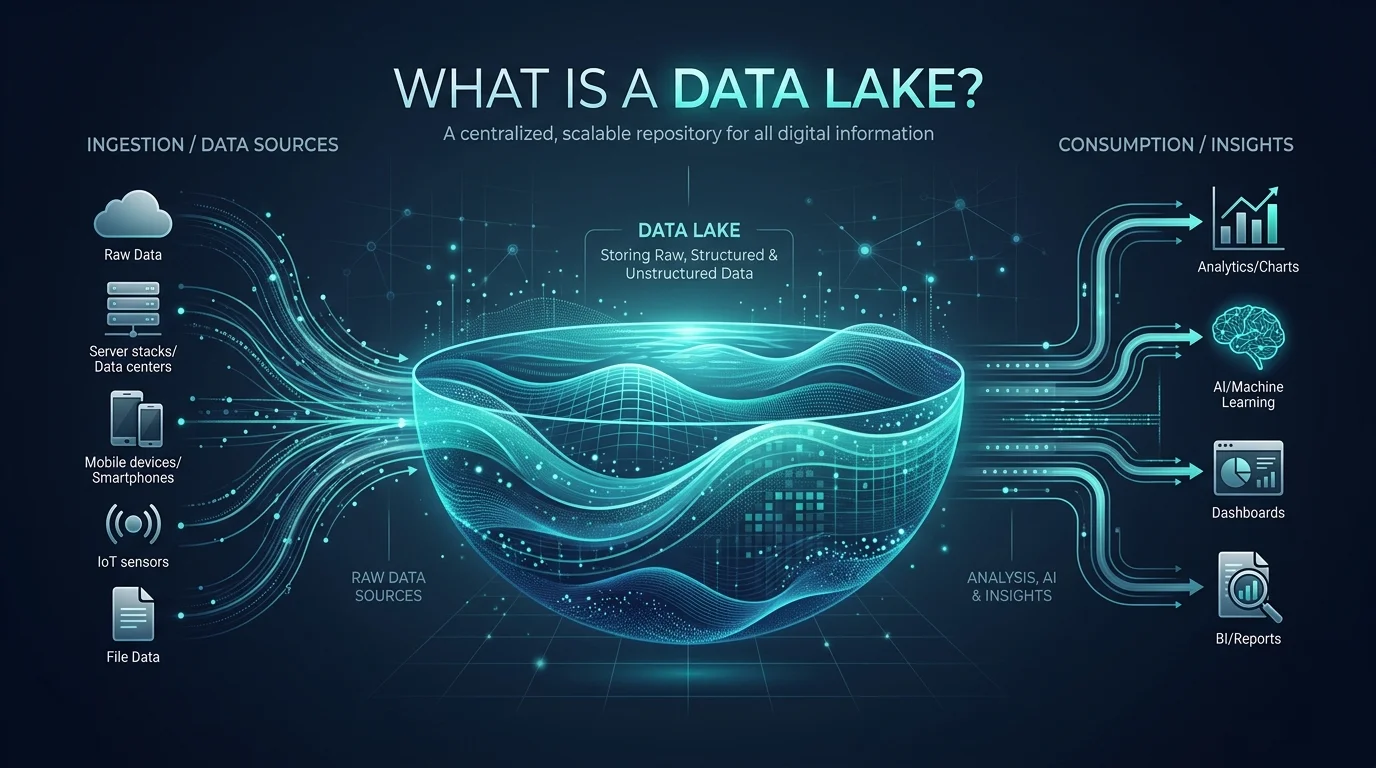
Here's where most beginners get lost. A lake isn't one product. It's a set of layers working together, and I'll walk you through each one. Once you see the flow from source to insight, the whole data lake architecture clicks into place.
Storage and compute are separate in a lake, so analysis happens through integrated compute engines. That's a big deal for scalability and cost efficiency.
The typical layers, per IBM's data lake guide:
Ingestion layer: pulls in data from databases, apps, IoT devices and sensors
Storage layer: usually cloud object storage like Amazon S3, Azure Data Lake Storage or Google Cloud Storage
Catalog and metadata layer: metadata management helps people find and understand data
Processing layer: engines like Apache Spark run ETL/ELT jobs
Access layer: where analysts, data scientists and BI tools query the data
Many teams also organize data into medallion architecture zones (bronze, silver, gold), as Estuary's architecture guide explains.
Running sensors on a factory floor? Then your lake is the natural landing zone for that stream. Our guide to digital transformation in manufacturing shows where that fits in a bigger plan.
Data Lake vs. Data Warehouse vs. Lakehouse
Confused about which one you need? You're not alone. This is the question that stalls most projects. Below is a side by side comparison so you can decide fast. After the table, I'll tell you what I'd pick today.
Feature | Data Warehouse | Data Lake | Data Lakehouse |
|---|---|---|---|
Data types | Structured | All types | All types |
Schema | Schema on write | Schema on read | Both |
Best for | BI and reporting | ML and data science | BI plus ML on one copy |
ACID transactions | Yes | Not by default | Yes |
Cost | Higher | Lower | Lower |
Alation's comparison quotes Gartner as saying the warehouse and lake are converging into the data lakehouse, a single architecture that unifies both. You can read more in Alation's comparison and DataCamp's breakdown.
My take? If you're starting fresh in 2026, plan for a lakehouse from day one.
Open Table Formats: Iceberg, Delta Lake and Hudi
Wondering how a lake gets warehouse style reliability? Through open table formats. They add a metadata layer on top of your files, bringing ACID transactions, schema evolution and time travel.
By 2026, the industry has largely converged on Apache Iceberg as its interoperability standard, with Snowflake and Databricks both reading and writing it natively. Delta Lake dominates Databricks centered stacks, and Apache Hudi shines for CDC workloads. See RisingWave's comparison for details.
How to Build a Data Lake: Step by Step
Ready to get your hands dirty? Good. This is the part nobody explains clearly. Follow these six steps in order, and you'll skip the most expensive mistakes. Take it one step at a time.
Define business goals first. Know your use cases before you touch a tool.
Pick your storage. Choose cloud object storage that fits your cloud.
Set up ingestion. Use batch ingestion or data streaming pipelines.
Choose a table format. Iceberg is the safe default.
Add a data catalog and governance. Include data lineage, access control and data quality checks.
Connect your analytics tools. Hook up SQL engines, BI dashboards and ML platforms.
Big Data Boutique's guide agrees: cataloging, lineage and quality aren't optional.
Stuck with old systems that can't feed a lake? That's a common blocker, and legacy application modernization services can clear the path before you migrate.
Why Data Lakes Turn Into Data Swamps
Here's the ugly truth. Most failed lakes don't fail because of the technology. They fail because nobody owns them. I'll show you the warning signs and the fixes, so yours doesn't become a digital junk drawer.
Without governance, catalogs and clear ownership, a lake becomes a dumping ground where nothing is documented or trusted. That's a data swamp. The CIO.com guide to avoiding data swamps is worth a read.
Your fixes:
Assign data stewards
Enforce data governance policies
Automate data quality monitoring
Lock down data security and compliance, since Palo Alto Networks flags security as a major lake challenge
Why You Should Invest in a Data Lake Solution Today
So, is it worth it? Absolutely. You've seen the architecture, the pitfalls and the steps. Now let me tell you why waiting costs you more than acting. Your competitors are already feeding generative AI with their raw data.
A modern lake gives you:
One home for every data source, ending data silos
Cheap, scalable storage
Fuel for predictive analytics and AI
A clear Customer 360 view
Google Cloud notes that lakes now support both analytics and AI at any scale.
Ready to stop guessing? [Your Product Name] gives you governed, lakehouse ready infrastructure out of the box. Start your free trial today and get your first pipeline live this week.
Data Lake FAQs
Got questions? I've got quick answers. These are the ones people ask most. Each answer is short, so you can skim and move on.
What is a data lake in simple terms?
It's a big storage space for raw data in any format. You organize it only when you need it.
Who invented the term "data lake"?
James Dixon of Pentaho, in a blog post dated October 14, 2010.
Is Amazon S3 a data lake?
Not by itself. S3 is a storage component you can use inside a lake architecture.
What's the difference between a data lake and a data warehouse?
A warehouse stores processed, structured data. A lake stores raw data of every type.
What is a data lakehouse?
It combines lake flexibility with warehouse reliability, including ACID transactions.