
Digital transformation in manufacturing is the process of integrating real-time data, connected sensors, and automation software into every stage of production — from the shop floor to the supply chain — so decisions get made on facts, not guesswork. It's not a single software purchase. It's a shift in how a factory thinks and reacts.
I've spent the last few weeks buried in reports from McKinsey, Deloitte, and the World Economic Forum.
And here's what I found: most factories are still running like it's 2015.
Not because leaders don't want to change. Because nobody's handed them a clear roadmap.
That's exactly what this guide is.
By the time you finish reading, you'll know what digital transformation in manufacturing actually means, which technologies are worth your time, and the precise steps I'd take if I were running your plant floor tomorrow morning.
Let's get into it.
What Is Digital Transformation in Manufacturing?
Simple question. Confusing answers everywhere else online.
So let me clear it up in one sentence: digital transformation in manufacturing is the process of weaving data, connectivity, and automation into every part of how you make things.
It's not "buy a fancier machine."
It's rewiring how decisions actually get made.
Think sensors that talk to software. Software that talks to your supply chain. And people who finally get real-time answers instead of gut-feel guesses at 2 a.m.
That shift is happening right now. With you or without you.
Why This Matters More in 2026 Than Ever
Here's the uncomfortable truth: waiting has become the most expensive option on the table.
I know that sounds dramatic. But the numbers back it up, and I'll name every source so you can check my math yourself.
According to Deloitte's 2025 Smart Manufacturing and Operations Survey, 92% of manufacturing executives now believe smart manufacturing will be the single biggest driver of competitiveness over the next three years.
Ninety-two percent. That's not a trend anymore. That's a consensus.
The Numbers Don't Lie
Here's a quick gut-check, and this time every stat has a name attached to it:
McKinsey's Global Lighthouse Network research links digitally mature factories to 30–50% reductions in machine downtime
Labor productivity climbs by 15–30% in the same McKinsey analysis
Deloitte's survey found forecasting accuracy improvements of up to 85% among digital leaders
Yet only around 10% of manufacturers report being fully digitized, according to independent benchmarking research
That last stat should keep you up at night, honestly.
It means the gap between leaders and everyone else isn't closing. It's widening.
The Core Technologies Powering Every Smart Factory
You don't need all of these on day one. But you do need to understand what they do.
Here's my honest breakdown of what's actually moving the needle right now — not hype, just what works.
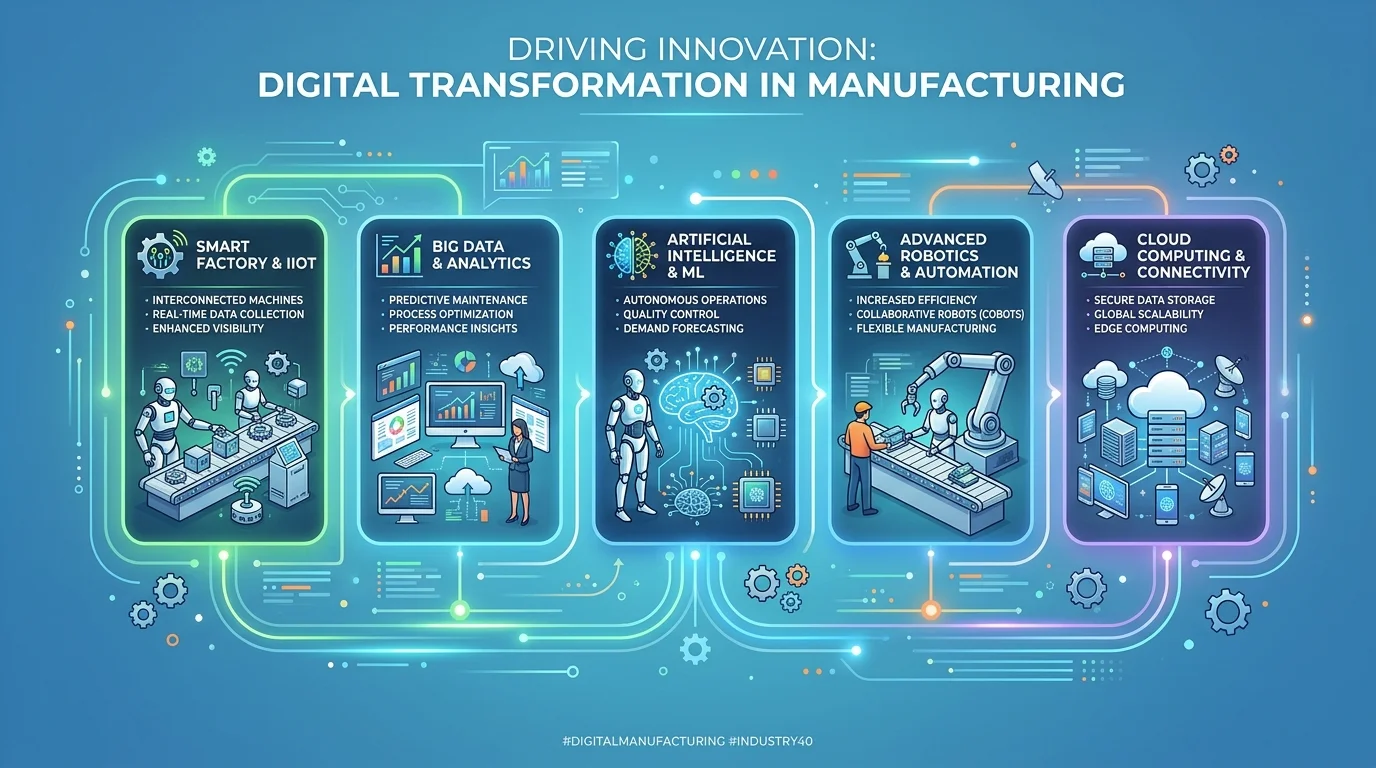
Industrial Internet of Things (IIoT) connects your machines and sensors so they share data in real time. Translation: you stop finding out about a problem after it's already cost you money.
Predictive maintenance flips the old model on its head. Instead of fixing machines after they break, you fix them before they do. It's the difference between a scheduled five-minute pause and an unplanned five-day shutdown.
Industrial robotics and automation aren't coming for every job. But they're absolutely coming for the repetitive, dangerous, error-prone ones. Honestly? That's good news for your people, not a threat to them.
Cloud manufacturing ties it all together. None of the above matters if your data lives in ten disconnected systems. Cloud platforms give you one source of truth — accessible from the floor, the boardroom, or your phone.
Digital Twin Technology Deserves Its Own Spotlight
A digital twin is a living, virtual replica of your physical production line.
One peer-reviewed case study on an automotive production line, published in the journal Sensors, found digital twin implementation delivered a 6% jump in production efficiency — and an 87.56% improvement in downtime performance.
Read that again. Eighty-seven percent. That's not a marketing number. That's a peer-reviewed one.
Which Technology Should You Start With?
Here's a side-by-side so you're not guessing:
Technology | What It Solves | Best For | Implementation Speed | Typical ROI Window |
|---|---|---|---|---|
IIoT | Disconnected machines, delayed problem detection | Real-time plant visibility | Fast (weeks) | 6–12 months |
Digital Twin | Costly trial-and-error on the physical line | Simulating changes before you build them | Moderate (months) | 12–18 months |
Predictive Maintenance | Unplanned downtime, reactive repairs | Extending equipment life | Moderate (months) | 6–12 months |
Industrial Robotics | Repetitive, error-prone manual tasks | High-volume, precision lines | Slower (months–year) | 18–24 months |
Cloud Manufacturing | Data silos across systems and sites | Unifying data into one source of truth | Fast (weeks–months) | 6–12 months |
If you only pick one thing to start with, pick whichever row matches your biggest current headache. That's it. That's the whole decision.
A Step-by-Step Guide to Kickstart Your Digital Transformation
Ready for the part you actually came here for?
Here's exactly how I'd sequence this if I were leading your transformation, starting Monday morning.
Step 1: Audit Where You Actually Stand
Before you buy anything, map what you already have.
Which machines are connected? Which aren't? Where does your data get stuck? A good first move is documenting your current processes clearly — our standard operating procedure template is a solid starting framework for this.
Step 2: Pick One High-Impact Pilot
Don't try to boil the ocean.
Choose one production line and one measurable outcome — downtime, quality, or throughput. Nail that first.
Step 3: Build Your Data Foundation
This is the unglamorous step everyone tries to skip. Please don't.
Clean, connected data is the fuel every other technology on this list runs on.
Step 4: Scale What Actually Works
Once your pilot proves itself, expand it — line by line, plant by plant.
This mirrors exactly what Gartner's top strategic technology trends for 2026 recommend: moving organizations from small-scale experimentation to enterprise-wide adoption with built-in agility.
Step 5: Lock Down Industrial Cybersecurity
More connected devices mean more entry points for attackers.
Industrial cybersecurity isn't optional anymore. It's simply the cost of playing this game.
Real Proof This Actually Works
Still skeptical? Fair enough. I was too, until I found this.
The World Economic Forum's Global Lighthouse Network now includes 238 of the most advanced factories on the planet.
These aren't theoretical case studies dreamed up in a boardroom. They're real plants, hitting real numbers, using the exact technologies I just walked you through — including a growing share of generative AI use cases. Siemens made a similar case at Automate 2026, pointing to roughly $1.6 trillion in annual revenue growth currently lost to labor shortages, supply chain disruption, and outdated systems.
As the Forum put it, these manufacturers are no longer just optimizing individual processes. They're reimagining entire operating systems from the ground up.
That's the bar now. And it's closer than you think.
Mistakes That Kill Digital Transformation Before It Starts
I'll be blunt here, because most articles won't be.
Buying technology before fixing broken processes
Treating this as an IT project instead of a leadership one
Ignoring the workforce skills gap until it becomes a crisis
Skipping industrial cybersecurity because it "slows things down"
Avoid these four traps, and you're already ahead of most of the industry.
Frequently Asked Questions
What is digital transformation in manufacturing?
Digital transformation in manufacturing is the integration of connected sensors, real-time data, cloud software, and automation into production and supply chain operations. It replaces manual, siloed processes with connected systems that let you spot and fix problems as they happen, not weeks later.
How much does digital transformation cost for a manufacturing plant?
Cost varies widely based on plant size and starting point, but most companies start with a single pilot line rather than a full-facility rollout. Starting small typically costs a fraction of a full enterprise deployment, letting you prove ROI before scaling further.
How long does it take to see ROI from digital transformation?
Most manufacturers see measurable results within 6 to 12 months on a focused pilot, based on the technology comparison table above. Full-scale, multi-plant rollouts typically take 18 to 24 months to fully mature.
What's the difference between Industry 4.0 and digital transformation?
Industry 4.0 refers to the broader technological shift toward connected, intelligent factories, while digital transformation is the practical process a specific company undergoes to get there. Think of Industry 4.0 as the destination and digital transformation as the journey.
Is digital transformation only for large manufacturers?
No — smaller manufacturers often move faster because they have fewer legacy systems to untangle. A single-line pilot, like the one outlined in Step 2 above, is realistic at almost any plant size.
What technology should I implement first?
Start with whichever row in the comparison table matches your biggest current problem — usually IIoT for visibility or predictive maintenance for downtime. Trying to implement everything at once is the fastest way to stall the whole project.
How does digital transformation affect the manufacturing workforce?
It shifts workers away from repetitive, manual tasks and toward monitoring, decision-making, and skilled technical roles. Deloitte's research found human capital readiness is currently the lowest-maturity area across smart manufacturing categories, so workforce upskilling should be planned alongside any technology rollout — including how you structure project teams responsible for the rollout.
The Bottom Line
Digital transformation in manufacturing isn't a buzzword anymore.
It's the line separating the factories thriving in 2026 from the ones scrambling to catch up in 2027.
You don't need to transform everything overnight. Nobody does.
You just need to start — one honest audit, one focused pilot, one small win at a time.
Read more: Legacy Application Modernization Services: Costs & 7 Rs