
You just finished 20 interviews. Now you're staring at hundreds of pages of raw text — and wondering where on earth to begin. Learning how to analyze interview transcripts doesn't have to feel overwhelming. This 2026 guide breaks the entire process down in plain, simple English. Whether you're a UX researcher, academic, or market analyst, you'll find a clear, practical system right here. We cover everything from audio transcription and thematic content analysis to AI-powered tools and intercoder reliability checks. You'll also discover how qualitative research methods have evolved this year. By the end, you'll know exactly what to do — and in what order.
What Is Qualitative Interview Analysis and Why Does It Matter?
Qualitative interview analysis is the process of making sense of what people say in interviews. Think of it like detective work — but with words instead of fingerprints. You're looking for patterns, meanings, and stories hidden inside your data. It's not about counting numbers. It's about understanding human experience deeply and honestly.
This matters more than ever in 2026. AI is flooding research pipelines with data. Institutions are demanding higher standards. Qualitative research methods are now used everywhere — from hospital policy decisions to app redesigns. If you don't analyze your transcripts properly, your entire study loses credibility. Good analysis is the backbone of trustworthy research.
Definition and Purpose
Qualitative interview analysis means systematically examining interview responses to find themes, patterns, and meanings. Unlike quantitative research, you're not crunching numbers. You're interpreting human stories. Thematic content analysis is the most widely used method. It helps you organize complex human responses into clear, meaningful categories.
Role in Academic, UX, and Market Research
In academia, solid interview data analysis shapes published research and policy. In UX, it reveals what users truly feel — not just what they click. Market researchers use it to understand consumer behavior beneath the surface. Each field uses the same core process but applies findings differently.
Why 2026 Demands More Rigorous Approaches
Research standards are rising fast. American journals now scrutinize methods more carefully than ever. AI-assisted qualitative analysis is powerful but risky without human oversight. IRB committees are asking tougher questions about data handling. Researchers who master rigorous analysis in 2026 will simply outperform those who don't.
How to Transcribe a Qualitative Interview (Before Analysis Begins)
Here's a hard truth. You cannot analyze what you cannot clearly read. Audio transcription is the foundation of everything that follows. A poor transcript leads to poor analysis — every single time. Think of transcription as building the floor before you furnish a room. Get it wrong and the whole structure wobbles dangerously.
The good news? You have more options today than ever before. AI transcription tools like Rev, Otter.ai, and MAXQDA Transcription have transformed the field. Video transcription is now just as seamless as audio. But tools alone don't guarantee accuracy. Your recording quality, speaker clarity, and formatting choices all shape the final result significantly. If you're working on a mobile device, our guide on how to transcribe audio on iPhone walks you through the full setup process step by step.
Manual vs. AI-Assisted Transcription
Manual transcription gives you full control. You hear every pause, every laugh, every hesitation. But it's brutally slow — one hour of audio takes roughly four to six hours to transcribe manually. AI transcription tools cut that down to minutes. The tradeoff is occasional errors, especially with accents, technical jargon, or overlapping speakers.
Method | Speed | Accuracy | Cost | Best For |
|---|---|---|---|---|
Manual | Slow | Very High | High | Technical or sensitive research |
AI-Assisted | Fast | High (85–99%) | Low–Medium | Large datasets, tight deadlines |
Hybrid | Medium | Very High | Medium | Most research projects in 2026 |
Tools and Best Practices
The Rev transcription service delivers up to 99% accuracy — even with heavy accents. Otter.ai works brilliantly for live interviews. MAXQDA interview analysis includes a built-in transcription module that syncs text directly to your audio timeline. Always use speaker tags and time marks — they save enormous time during analysis later. For Android users running fieldwork interviews on the go, our how to transcribe audio on Android guide covers the best free and paid options available right now.
Formatting Conventions (Verbatim, Clean, Intelligent)
Verbatim transcription captures every "um," pause, and false start. It's essential for conversation analysis or linguistic studies. Clean transcription removes filler words for easier readability. Intelligent transcription edits lightly for grammar while preserving meaning. Choose your format based on your analysis method — not just your personal preference.
How to Organize and Prepare Your Transcripts for Analysis
Imagine doing a jigsaw puzzle with pieces from five different boxes mixed together. That's what disorganized transcripts feel like. Transcript review and proper organization before analysis saves you days of frustrating backtracking. Most researchers skip this step. Don't be most researchers.
Research transcripts need a home before they need a highlighter. Create a clear folder system, naming convention, and inventory spreadsheet before you open a single file for coding. Data categorization starts here — not in your software. A well-organized workspace clears mental space for deeper analytical thinking throughout your project. If your recordings are saved as MP3 files, you can quickly convert them using our MP3 to text converter before importing into your QDA software.
File Naming, Versioning, and Storage
Use a consistent naming convention from day one. A reliable format looks like this: "2026.ParticipantID.Topic.v1." Always version your files — v1, v2, v3 — so you never lose earlier work. Store everything on encrypted cloud platforms like Google Drive, Dropbox, or your institution's secure server. Qualitative data collection integrity depends on secure, organized storage.
Importing Into Analysis Software (MAXQDA, NVivo, Atlas.ti)
MAXQDA interview analysis lets you drag files directly into the Document System window. NVivo qualitative coding uses a Sources folder for clean import. Atlas.ti transcript analysis manages files through its Primary Document Manager. All three tools support transcript import and organization with timestamps intact — making the leap from raw file to ready-for-coding document genuinely painless.
Software | Import Method | Timestamp Support | AI Features |
|---|---|---|---|
MAXQDA | Drag-and-drop | Yes | Yes (MAXQDA Transcription) |
NVivo | Sources folder | Yes | Yes (Auto-code themes) |
Atlas.ti | Primary Doc Manager | Yes | Yes (AI coding assistant) |
Creating a Data Inventory
Build a master spreadsheet tracking participant ID, interview date, duration, topic, and audio quality rating. Flag incomplete or unusable recordings early. Link your inventory to your codebook so everything stays connected. This single spreadsheet becomes your research command center throughout the entire iterative coding qualitative workflow.
Choosing Your Analytical Approach: Inductive vs. Deductive
Think of choosing your analysis approach like choosing a GPS route. Inductive coding is exploring without a preset map — you discover the road as you drive. Deductive coding means following a route you planned before leaving home. Neither is superior. The right choice depends entirely on your research question and what you already know going in.
Most experienced researchers in 2026 don't pick just one approach. They blend them. Hybrid frameworks are becoming the standard in American academic journals and UX research teams alike. Understanding all three approaches — inductive, deductive, and abductive — puts you miles ahead of researchers who only know one method.
Inductive (Bottom-Up) Coding
Inductive coding lets themes emerge naturally from your data. You enter the analysis without assumptions. This approach suits exploratory research perfectly. For example, a UX team studying reactions to a brand-new product would use inductive coding — because they genuinely don't know what users will say. Inductive theme generation produces richer, more surprising findings than any theory-first approach.
Deductive (Theory-Driven) Coding
Deductive coding starts with an existing framework or theory. You build your code system before touching the data. This works brilliantly for hypothesis-testing studies. Imagine coding health interview responses against the World Health Organization's social determinants framework. You know what you're looking for — and you're checking whether the data confirms, challenges, or extends that existing knowledge base.
Abductive and Hybrid Frameworks
Abductive reasoning moves back and forth between data and theory fluidly. You start with an observation, form a hypothesis, then test it against your data. Hybrid frameworks blend inductive and deductive methods for richer findings. Mixed methods research increasingly demands this flexibility. The 2025 Child Trends case study on reproductive health interviews used exactly this hybrid approach — and produced notably stronger results than either pure method alone.
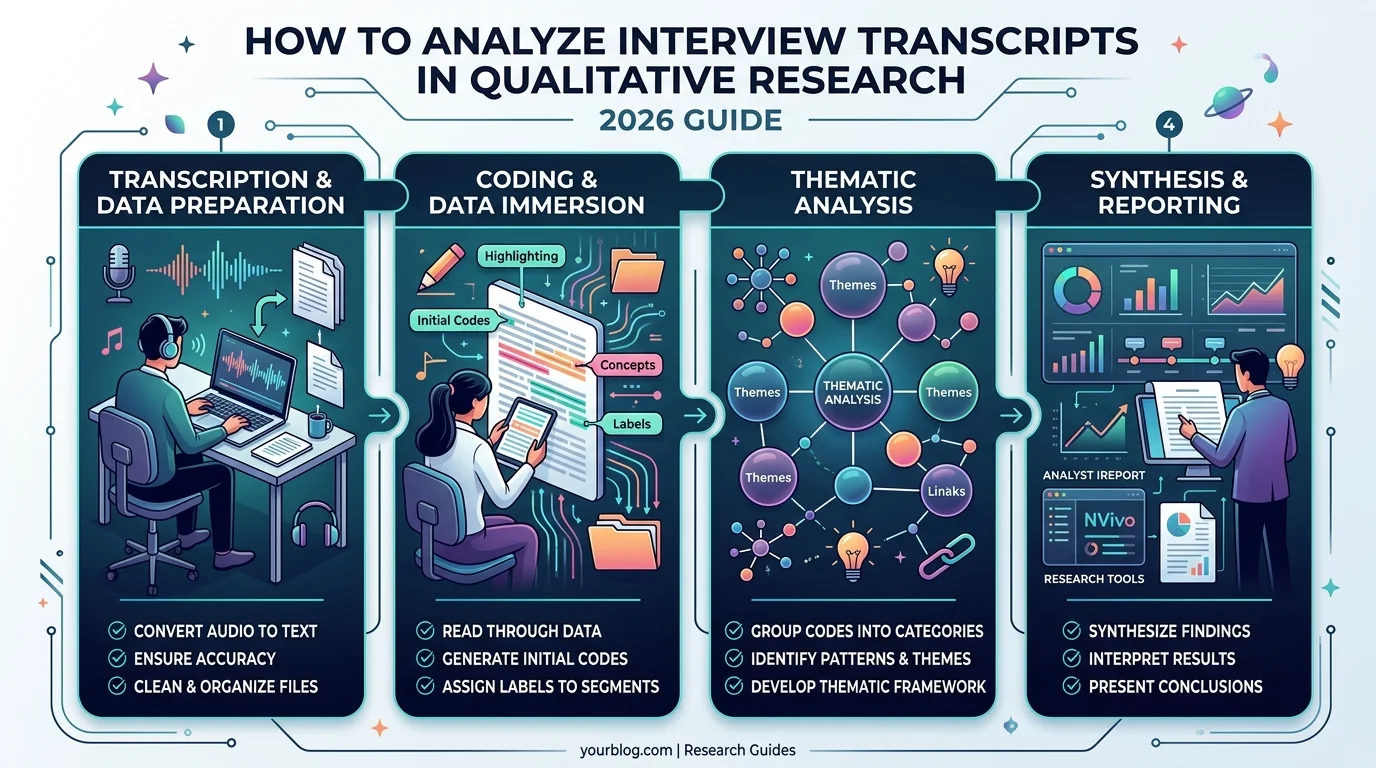
The Step-by-Step Process to Analyze Interview Transcripts
Here's a mistake almost every new researcher makes. They skip straight to coding without reading their transcripts first. That's like trying to edit a film you've never watched. The steps of thematic analysis are sequential for a reason — each one builds directly on what came before it. Rush any step and you'll pay for it later with weak, unconvincing findings.
Coding qualitative data is not the whole process. It's one critical part of a much larger analytical journey. From first read to final write-up, every phase shapes the quality of your conclusions. This six-step process works equally well for academic dissertations, UX research reports, and corporate market research projects across the United States.
Step 1 — Read and Immerse Yourself in the Data
Read every single transcript twice before you touch a code. On your first read, just absorb. Notice what surprises you. Notice what bores you. Both reactions are data. On your second read, start jotting informal notes in the margins. Researcher bias sneaks in early — acknowledging your preconceptions now protects your analysis later. Don't highlight yet. Just listen to what your participants are telling you.
Step 2 — Annotate and Memo-Write
Annotating transcripts means labeling meaningful words, phrases, and passages with short descriptive tags. Write memos alongside your annotations — short notes capturing your thinking in the moment. Memos are your analytical diary. They document why you made certain coding decisions and help you stay consistent across dozens of transcripts. MAXQDA, NVivo, and Atlas.ti all have excellent built-in memo features worth using from the very beginning.
Step 3 — Develop and Apply a Code System
Code system creation starts with open coding — labeling everything that seems remotely significant. Then you refine. Collapse similar codes. Rename vague ones. Build a codebook with a clear definition and example quote for every code. Avoid lazy code names like "positive experience." Be specific: "trust in provider" or "frustration with wait times" tells a much clearer analytical story and makes your qualitative findings dramatically easier to interpret.
Step 4 — Segment and Categorize Coded Data
Data segmentation means grouping related codes into broader categories. Use color-coding or software tags to make visual patterns obvious. Build a matrix spreadsheet — participants across the top, categories down the side. Mark which participants mentioned which categories. This simple table transforms hundreds of coded fragments into a clear, structured overview of your entire dataset at a glance.
Step 5 — Identify Patterns, Themes, and Relationships
Now the real analytical magic happens. Look across your categories and ask: what connects these? A theme isn't just a topic — it's a meaningful insight about human experience. Word frequency analysis can hint at what matters most. Concept maps qualitative data tools help you visualize relationships between themes spatially. MAXQDA's MAXMaps feature is particularly powerful for this step. Look for patterns that appear across multiple participants — those are your strongest, most defensible themes.
Step 6 — Write Up and Interpret Findings
Your analysis is done. Now translate it into compelling narrative. Use direct participant quotes to anchor each theme — they bring your findings to life far better than paraphrase alone. Always contextualize your results within existing literature. What do your findings confirm? What do they challenge? Maintain a neutral, objective voice throughout. Academic research reporting demands this balance between rich description and scholarly restraint.
How to Use AI and Software Tools to Analyze Interview Data in 2026
Let's be clear about something important. AI didn't kill qualitative research — it supercharged it. AI-assisted qualitative analysis is transforming how American researchers handle large datasets. What once took months now takes weeks. What took weeks sometimes takes days. But — and this is critical — AI is a powerful assistant, not a replacement for human analytical judgment.
Large language models qualitative research applications are evolving rapidly. Google Gemini, Claude, and ChatGPT are all being tested in research workflows right now. The 2025 Child Trends case study found that human-in-the-loop qualitative analysis consistently produced more accurate, nuanced findings than AI working alone. The researchers who thrive in 2026 will be those who use AI strategically — not blindly. You can explore the latest developments in this space through our AI news and updates blog.
AI-Assisted Thematic Analysis (ChatGPT, Claude, Dovetail, etc.)
ChatGPT and Claude work brilliantly for generating initial theme ideas from short, focused quote segments. Feed them single responses — not full transcripts — for better accuracy. The Dovetail UX research tool is purpose-built for tagging interview data and building highlight reels stakeholder reporting decks. AILYZE offers specialized coding and frequency analysis. Google Gemini qualitative coding showed particular promise in the Child Trends 2025 study for inductive theme generation across large interview datasets.
Dedicated QDA Software Features
MAXQDA interview analysis offers Smart Coding, word cloud transcript analysis, and the powerful MAXMaps concept mapping tool. NVivo qualitative coding provides matrix coding, cluster analysis, and automated theme suggestion. Atlas.ti transcript analysis features network views and an AI coding assistant that suggests codes based on your existing codebook. All three platforms support LLM-in-the-loop research workflows through API integrations and AI-assisted auto-coding functions.
Validating AI Outputs and Avoiding False Negatives
Never trust AI output without checking it. AI hallucinations qualitative research is a real and documented problem — models sometimes generate confident but completely incorrect interpretations. Always manually review at least 15–20% of AI-coded segments. Use smaller, focused AI prompt for qualitative coding inputs rather than dumping entire transcripts into a model at once. The Child Trends team found that single-quote prompts dramatically reduced hallucinations compared to full-transcript inputs.
"Making smaller, more focused AI requests reduced hallucinations and improved accuracy. We observed fewer factual errors when we asked the AI to analyze short, specific inputs — particularly single quotes." — Child Trends AI Case Study, 2025
Ensuring Rigor, Reliability, and Validity in Your Analysis
Rigorous analysis isn't just about being thorough. It's about being trustworthy. Intercoder reliability and validity are the twin pillars of credible qualitative research. American academic journals are increasingly requiring detailed methods sections that prove your analysis was systematic, transparent, and defensible. Skipping rigor checks is the fastest way to get your paper rejected or your research report questioned.
Qualitative findings earn their authority through process transparency. Lincoln and Guba's trustworthiness framework — credibility, transferability, dependability, and confirmability — remains the gold standard for US qualitative researchers in 2026. Build these checks into your process from day one rather than scrambling to justify your methods after the fact.
Intercoder Reliability and Peer Debriefing
Have two independent coders work through 15–20% of your transcripts separately. Then compare results using Cohen's Kappa coefficient or simple percentage agreement. A Kappa score above 0.70 is generally considered acceptable in published research. Intercoder reliability meetings should happen regularly — not just at the end. Schedule weekly debriefs to catch disagreements early and keep your iterative coding qualitative workflow consistent and defensible across your entire team.
Member Checking
Member checking means sharing your preliminary findings with the participants who gave you the data. Ask them: does this accurately reflect what you meant? This single step dramatically strengthens credibility. It catches researcher misinterpretations before they make it into your final report. It's especially important in health, education, and social science research — fields where misrepresenting participant voices carries serious ethical consequences for US-based researchers.
Reflexivity and Audit Trails
Researcher bias is not a flaw — it's a human reality. Reflexivity means acknowledging openly how your background, assumptions, and experiences shape your interpretation. Write a reflexivity statement for your methods section. Alongside this, maintain an audit trail — a documented record of every analytical decision you made. Future peer reviewers should be able to follow your thinking step by step without ever needing to ask you a single clarifying question.
Common Mistakes to Avoid When Analyzing Interview Transcripts
Even experienced researchers make these errors. Knowing them in advance puts you miles ahead of the competition. Coding qualitative data incorrectly is surprisingly easy to do — especially under deadline pressure. The good news? Every mistake on this list is entirely preventable once you know what to watch for throughout your analytical process.
These aren't hypothetical errors. They show up constantly in peer review feedback and rejected research reports across US institutions. The thematic analysis steps are designed specifically to prevent these pitfalls — but only if you follow them faithfully and resist the very human urge to cut corners when time feels short.
Over-Coding or Under-Coding
Over-coding means creating so many granular codes that you lose the big picture entirely. Under-coding means painting everything with such a broad brush that nuance disappears completely. For a medium-sized study of 15–25 interviews, aim for 20–35 initial open codes before you begin refining. Data segmentation works best when your codes are specific enough to be meaningful but broad enough to group naturally into coherent themes.
Ignoring Disconfirming Evidence
This is the most dangerous mistake in qualitative research. Cherry-picking data that supports your hypothesis destroys the integrity of your entire study. Disconfirming evidence — the participant who said the opposite of everyone else — is often your most valuable data point. It signals a deeper complexity worth exploring honestly. One outlier view frequently reveals an assumption your whole study was quietly making without realizing it.
Conflating Themes With Categories
Categories describe what is in your data. Themes interpret what it means. A category might be "communication with providers." A theme built from that category might be "patients feel empowered when providers use plain language." See the difference? Qualitative research methods training often glosses over this distinction — but it's fundamental. A theme always answers the "so what?" question. A category simply describes the "what" without reaching for deeper meaning.
How to Visualize and Present Qualitative Interview Findings
A brilliant analysis buried in dense academic prose helps nobody. Data visualization qualitative research has become an essential skill — not an optional extra. In 2026, US industry clients, university boards, and journal editors all expect visual evidence alongside narrative findings. Think of visuals not as decoration but as translation tools for non-researcher audiences who need to act on your insights.
Quantitative evaluation of themes adds a powerful mixed-methods layer to your qualitative work. When you can show that 18 out of 22 participants mentioned "trust" as a core theme, that number carries weight even in a qualitative study. Visuals and light quantification work together to make your findings undeniably clear, accessible, and persuasive to audiences across every professional context.
Word Clouds, Thematic Maps, and Matrices
Word cloud transcript analysis gives you an instant visual frequency snapshot of your data. It's a starting point — not a conclusion. Thematic maps show how themes relate to each other spatially and conceptually. Matrices compare theme presence across different participant groups side by side. Concept maps qualitative data tools in MAXQDA's MAXMaps let you build interactive relationship diagrams directly linked to your coded transcript segments for seamless, evidence-anchored visualization.
Quantitative Evaluation of Themes
Count how many participants mentioned each theme. Build a simple frequency table. This doesn't make your study quantitative — it makes your qualitative findings more convincing and transparent. Word frequency analysis tools in MAXQDA and NVivo automate much of this process. The resulting tables work beautifully in both academic methods sections and corporate stakeholder decks where decision-makers want to see evidence that your themes are grounded in real participant data.
Theme | Participants Mentioning It | Percentage |
|---|---|---|
Trust in provider | 18/22 | 82% |
Communication clarity | 15/22 | 68% |
Wait time frustration | 12/22 | 55% |
Emotional support | 10/22 | 45% |
Environment comfort | 8/22 | 36% |
Reporting Standards for Academic and Industry Audiences
Academic reporting follows APA 7th edition, requires thick description, and demands detailed methods transparency. Industry reporting prioritizes executive summaries, visual highlight reels stakeholder reporting decks, and clear action recommendations. The Dovetail UX research tool and Looppanel both excel at building industry-ready presentation outputs. Whatever your audience, always anchor every theme to direct participant quotes — they humanize your data and make your findings impossible to dismiss.
Frequently Asked Questions
Still have questions? You're absolutely not alone. These are the most commonly searched questions by US researchers working through qualitative data collection and analysis projects right now. There's rarely one perfect answer — context always matters. But these responses give you a solid, evidence-based starting point for making smart decisions in your own unique research situation.
Semi-structured interviews generate rich, complex data that raises a lot of legitimate questions about process, timeline, and tools. The answers below draw from current best practices across academic research, UX research, and market research contexts in the United States. Adapt them to your project — and remember that flexibility is one of qualitative research's greatest strengths. If you want to skip the signup process and get started fast, check out our free audio to text converter with no signup required to process your interview recordings instantly.
How Long Does Qualitative Analysis Take?
Timelines vary enormously based on project size and team experience.
Study Size | Interviews | Estimated Analysis Time |
|---|---|---|
Small | 5–10 | 2–4 weeks |
Medium | 15–25 | 6–10 weeks |
Large | 30–50 | 3–6 months |
AI-Assisted | Any size | 30–50% faster |
AI-assisted qualitative analysis can compress timelines significantly — but never eliminate the human review phases that protect your findings' integrity and credibility.
How Many Interviews Are Enough?
Saturation is your target — not a specific number. Saturation means you're no longer hearing genuinely new themes from new participants. For most qualitative studies, 12–20 interviews reach saturation comfortably. UX researchers typically find that 5–8 interviews per user segment reveal the core patterns they need. Qualitative research methods experts consistently emphasize that depth beats volume every single time. Twenty rich, probing interviews will always outperform fifty shallow ones in analytical value.
Can AI Fully Replace Manual Coding?
No. Not in 2026. Probably not ever — entirely. Human-in-the-loop qualitative analysis remains essential because AI cannot detect emotional subtext, cultural nuance, or the meaning behind a long pause mid-sentence. The child trends AI case study from 2025 confirmed this clearly. AI generates initial themes efficiently. Humans verify, refine, interpret, and contextualize. That combination — LLM-in-the-loop research plus rigorous human oversight — is the gold standard for qualitative analysis in the United States right now.
Conclusion
You now have a complete, practical roadmap for how to analyze interview transcripts in qualitative research in 2026. From raw audio to polished findings — every step is mapped out clearly. The process is demanding. But it's also genuinely rewarding when done right. Your data has stories inside it. Your job is to surface them honestly, rigorously, and compellingly.
Start with good transcription. Organize before you code. Choose your analytical approach intentionally. Use AI as a powerful assistant — never as a replacement for human judgment. Check your rigor at every stage. And present your findings in ways that actually reach the people who need to act on them.
Read more: Project Manager Interview Questions: Complete 2026 Guide