


A welcome to the team message is a short, personal note sent to a new employee on or before their first day to make them feel valued and confident about their decision to join. It can be delivered over email, Slack, a handwritten card, or video — and it plays a direct role in how quickly a new hire settles in, engages, and stays. This guide breaks down exactly how to write one, with examples, a step-by-step framework, and real onboarding data to back it up.
I remember my first day at a new job like it was yesterday. I sat at my desk, nervous, wondering if I'd made the right choice. Then a Slack notification popped up. It was my manager, welcoming me with genuine warmth. That single message changed everything for me.
Here's the thing — you can't afford to treat this as an afterthought. Let me show you exactly how to get it right.
Why Your Welcome Message Matters More Than You Think
You might be thinking, "It's just a quick note — how much impact can it really have?" A lot, actually.
According to AIHR's 2026 onboarding research, 70% of new hires decide if a job is the right fit within the first month, and nearly a third make up their minds within the first week. That's a razor-thin window to make an impression.
And here's the kicker: companies with a strong onboarding experience see retention jump dramatically. FirstHR's research found that organizations with structured onboarding improve new hire retention by up to 82%.
So no, your welcome message isn't fluff. It's a retention tool disguised as a friendly hello.
The Ingredients of a Message That Actually Works
Most welcome messages fail for the same reason — they're generic, robotic, and clearly copy-pasted. A message that lands has three things:
Genuine enthusiasm — not corporate-speak, real excitement
Specific details — their name, their role, why they were chosen
A clear next step — so they're not left guessing what happens next
Welcome Messages By Tone
Not every welcome message should sound the same. Your company culture dictates the tone — here's how to match it.
The Formal Welcome Message
Use this when you're in a traditional, buttoned-up environment — think law firms, finance, or healthcare. Open with a warm but professional greeting, state their job title and start date, briefly mention what excites you about them joining, then close with an invitation to reach out. Terryberry's message guide has dozens of formal examples if you want more inspiration.
The Casual Welcome Message
If your workplace culture leans relaxed — startups, agencies, remote-first teams — drop the stiff language. Make it sound like you're genuinely excited a friend is joining. Polly's blog on welcome messages points out that phrases like "we're so glad you're here" do a lot of emotional heavy lifting, even in a casual tone.
Formal vs. Casual vs. Remote — Quick Comparison
Message Type | Best For | Tone | Sample Opening Line |
|---|---|---|---|
Formal | Law, finance, healthcare | Professional, warm | "Welcome to [Company], [Name]. We're delighted to have you join us as [Title]." |
Casual | Startups, agencies, remote-first teams | Friendly, informal | "Hey [Name]! So glad you're here — welcome to the crew!" |
Remote/Hybrid | Distributed teams | Personal, extra reassuring | "Welcome aboard, [Name]! We know remote can feel distant, so here's how we'll stay connected." |
Leadership/CEO | Any company, added weight | Brief, sincere | "Welcome, [Name]. I'm glad you've joined us — I know you'll make a real impact." |
Step-by-Step: How to Write Your Own Welcome Message
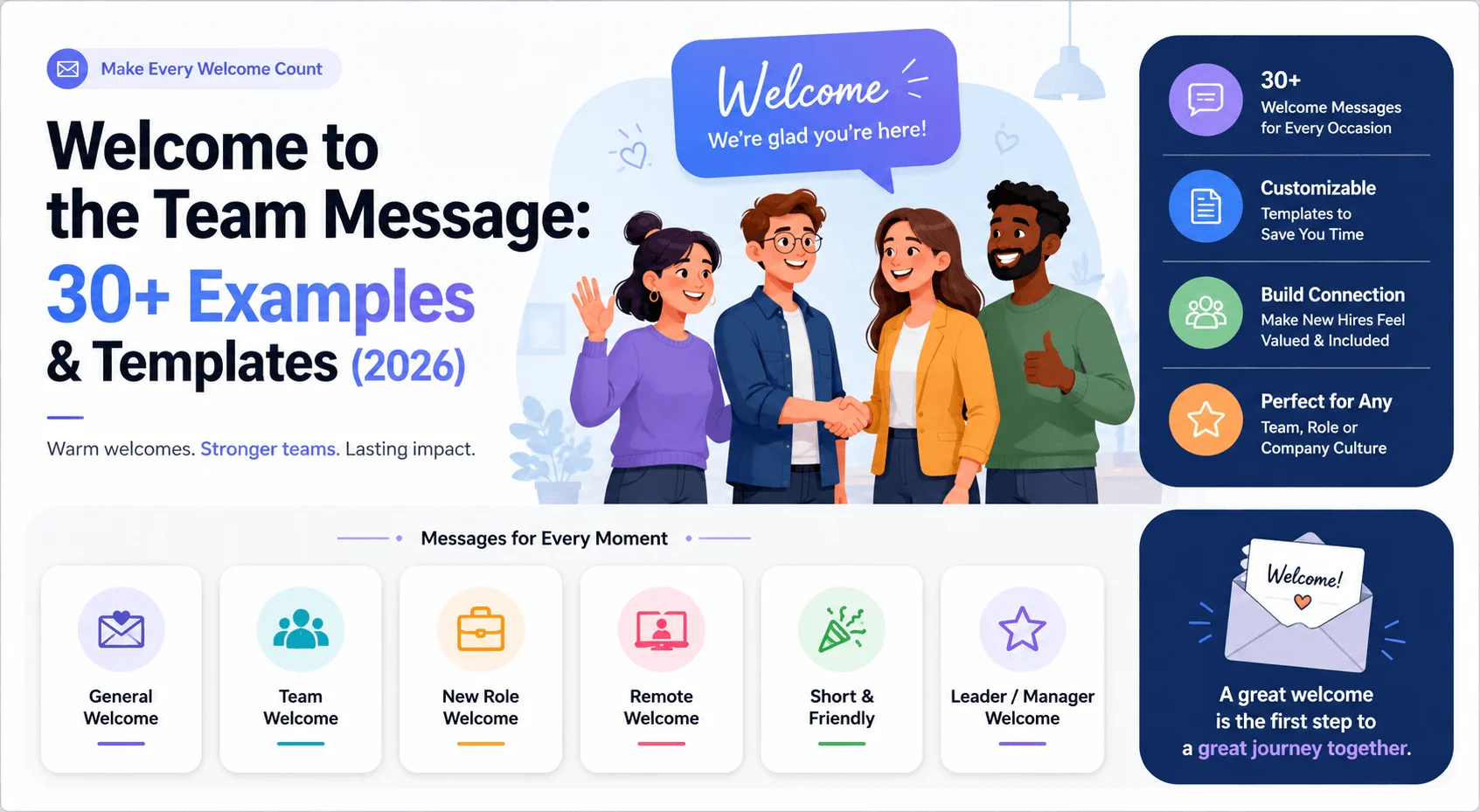
Here's exactly how I'd approach this if I were writing one right now.
Step 1: Pick your channel. Slack should feel snappy. Email can carry more detail.
Step 2: Open with their name. Sounds obvious, but plenty of welcome messages skip this. Personalization is everything.
Step 3: Say why you're excited — specifically. "We can't wait to see what you bring to our design process" beats "welcome aboard" every time.
Step 4: Set expectations. Tell them what their first day or week looks like. This reduces anxiety fast.
Step 5: Invite connection. Close with something like "Reach out anytime — my door (or DMs) is always open."
Who Should Send It
From the manager: Carries the most weight. Mention specifics about their role and what success looks like in the first 90 days.
From the team: Encourage teammates to jump in with their own quick hellos. Achievers' collection of welcome messages notes that peer-to-peer welcomes feel more authentic because they come without hierarchy.
From leadership: Even a short note from a CEO tells the new hire, "You matter enough that leadership noticed."
Remote and Hybrid Welcome Messages
If your new hire won't be walking into a physical office, your welcome message needs to work harder. Gable's guide on welcome messages found that 75% of employees onboarded through a hybrid approach reported satisfaction with their experience — compared to just 71% for fully remote hires.
For remote onboarding, I'd recommend:
A video welcome message, not just text
A virtual meet-and-greet scheduled within the first 48 hours
A digital welcome kit with team bios and photos
In practice, the companies that get this right treat the welcome message as day zero of onboarding — not a throwaway line before the "real" training starts. That single shift in mindset is often what separates a new hire who feels instantly at home from one who spends their first two weeks quietly wondering if they made the right call.
Common Mistakes to Avoid
Being too generic. "Welcome to the team!" with nothing else feels lazy.
Overloading with information. Save deep onboarding details for later.
Forgetting to CC the team. New hires want to feel the whole group is excited, not just one person.
Calendly's welcome message guide makes a great point — every word in your welcome message shapes how the new hire perceives your company culture from the very first interaction.
FAQ: Welcome to the Team Messages
How long should a welcome to the team message be?
Two to four sentences is usually enough. Keep it warm and specific rather than long — a short, sincere message beats a lengthy generic one every time.
Should I send the welcome message before or after day one?
Before, if possible. Data shows new hires who start onboarding before their official first day report significantly higher satisfaction than those who don't.
What's the best channel to send a welcome message?
It depends on your team's communication style — Slack works well for fast-moving teams, email suits more formal companies, and a handwritten card adds a personal touch for smaller teams.
Should the whole team send individual messages, or just the manager?
Both, ideally. A manager's message sets the tone, but individual notes from teammates make the new hire feel like the whole group is genuinely glad they joined.
Is it okay to use emojis in a welcome message?
Yes, if it matches your workplace culture. Casual, remote-first, or creative teams can lean into it; more formal industries should keep it minimal or skip it.
What should I avoid saying in a welcome message?
Avoid vague, copy-paste phrases like "welcome aboard!" with nothing else attached. Skip overloading the new hire with policy details — save that for the onboarding docs.
Does a welcome message actually affect retention?
Yes. Structured onboarding — which a genuine welcome message kicks off — has been linked to up to 82% better new hire retention.
Wrapping This Up
Writing a great welcome to the team message isn't complicated, but it does require intention. Skip the copy-paste template, add specific details, and make your new hire feel like their arrival genuinely matters.
Do this well, and you're not just sending a nice message — you're setting the foundation for stronger employee engagement, better retention, and a new hire who feels like they belong from day one.
Read more: Test com Product Documentation Features Guide.

![What Is a Telephoto Lens? The Complete 2026 Guide | [Brand]](https://contiocdn.com/efdc9a99-5ac4-4f75-be3a-ed43de859d76/blog-covers/1787138653893-ru50banq-what-is-a-telephoto-lens--the-complete-2026-guide-.webp)