
Good product documentation should feel effortless to use, but most of it isn't. If you've ever dug through pages of unclear instructions just to find one simple answer, you already understand why test.com product documentation features matter so much. This guide breaks everything down in plain language, covering what strong documentation actually looks like, why it directly affects user trust and support costs, and how smart teams test it before publishing. You'll learn the core structure behind a solid feature object, why version control prevents outdated instructions from confusing readers, and how usability testing methods catch problems before real users ever do. If you want more practical guides like this one, visit the Audiototextify homepage or browse our full blog library for related reading.
What Is Product Documentation?
Product documentation is the written material that explains how a product works. It includes guides, references, tutorials, and troubleshooting pages. Think of it as the bridge between a complex system and a confused user. Without it, even a great product feels frustrating to use. This is exactly why test.com product documentation features deserve a closer look. They show how a modern documentation system should be built from the ground up.
Good docs share a few things in common. They stay accurate. They stay easy to search. And they never leave the reader guessing. Technical documentation in particular needs to balance depth with simplicity, since readers range from beginners to seasoned developers. A page that nails this balance saves support teams hours of repetitive work every single week. For more resources on this exact subject, check out our documentation and knowledge management guides.
Definition and Purpose
At its core, documentation exists to answer questions before they get asked. It captures how a feature object behaves, what a function returns, and how a workflow should run. Companies like SmartBear, the team behind TestComplete, structure their docs around this exact idea. Every page has a clear job: teach the reader something specific, then get out of the way.
The purpose is simple, but the execution is not. Teams need a plan for how content gets written, reviewed, and updated. This is often called the documentation lifecycle. It covers everything from the first draft to the final published version, and it never really ends.
Key Components of Product Documentation
Every strong documentation page tends to follow a pattern. There is a short description at the top. Then comes a breakdown of properties or members. After that, a working example shows the concept in action. Finally, a "see also" section links to related material.
This pattern shows up again and again across the industry, and for good reason. It mirrors how a feature file in BDD (Behavior-Driven Development) gets documented, where a scenarios object and a tags object each get their own clear section. Consistency like this builds trust. Readers know exactly where to look, every single time.
Why Strong Product Documentation Matters
Some teams treat documentation like an afterthought. That is a costly mistake. Strong docs directly affect how happy your users feel and how much money your support team spends. Documentation testing exists precisely because the stakes are this high. A single wrong instruction can send hundreds of users down the wrong path.
Consider the ripple effect. A confusing paragraph creates a support ticket. That ticket takes staff time to resolve. Multiply that across thousands of users, and suddenly weak documentation is bleeding your budget dry. This is why test.com product documentation features should never be treated as a "nice to have." They are a business necessity.
Impact on User Experience
Readers do not want to work hard to find an answer. If your navigation and search tools fail them, they leave frustrated. Worse, they may assume your entire product is unreliable, even if the actual software works fine. Documentation shapes the emotional experience just as much as the interface itself does.
Clear writing, sensible structure, and honest content accuracy all combine to build user confidence. When someone finds their answer in under a minute, they trust your brand a little more. That small win adds up over time into genuine customer loyalty. The same principle applies when working with recorded information, which is why our guide on analyzing interview transcripts for qualitative research covers similar accuracy checks.
Impact on Support and Onboarding Costs
Support teams live and die by the quality of the docs behind them. Good product documentation deflects tickets before they are ever opened. Poor documentation does the opposite. It creates a flood of repetitive questions that drain time and morale from support staff.
Onboarding suffers too. New users forming their first impression of a product often lean hard on the help center. If those early pages are outdated or vague, adoption drops fast. Strong docs, on the other hand, quietly do the work of a full-time trainer, at a fraction of the cost.
Role in Product Adoption
Nobody sticks with a tool they cannot understand. Documentation acts as the on-ramp that turns curious signups into loyal, long-term users. This matters even more for technical products, where a missing example or unclear parameter can stop a developer cold.
Companies that invest early in documentation quality tend to see it pay off later through retention. A well-documented product feels finished. An undocumented one feels abandoned, even when the underlying code is solid.
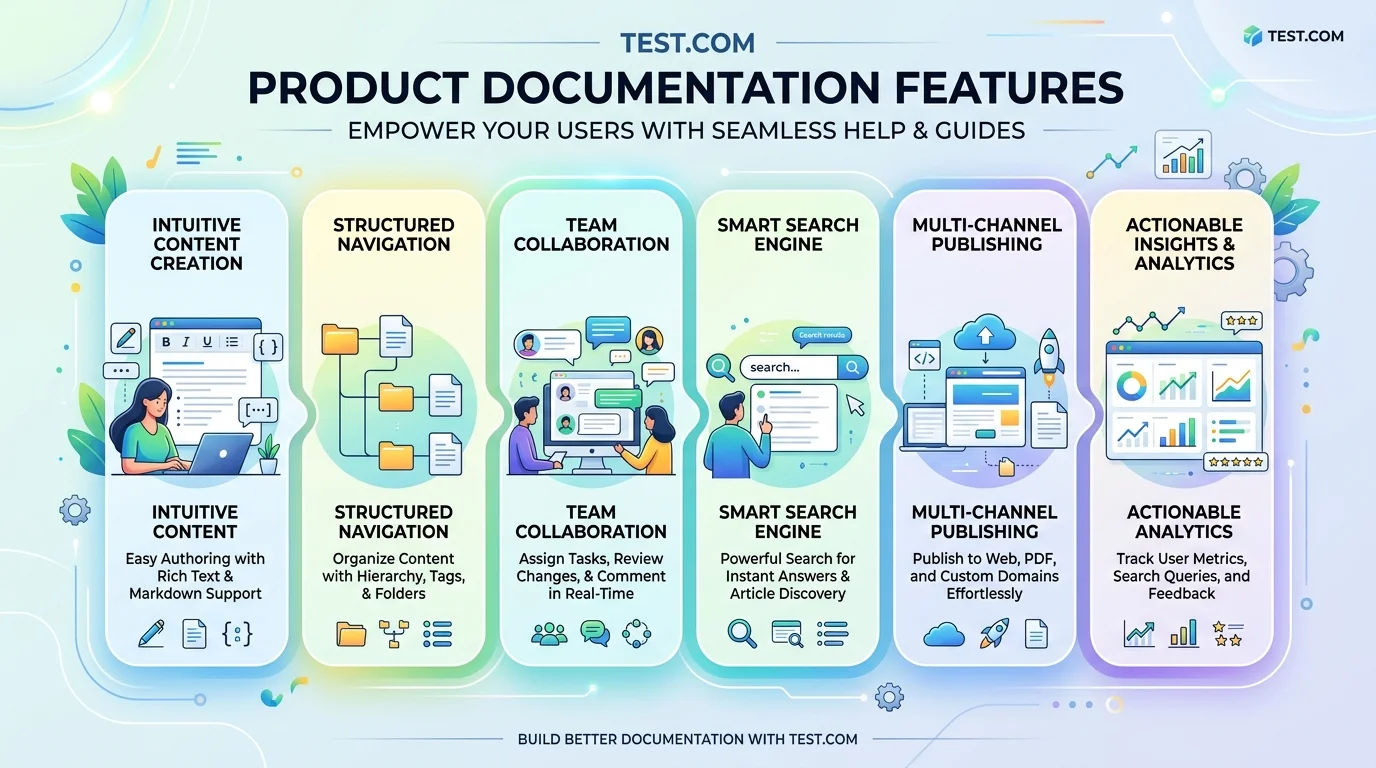
Core Features Every Product Documentation Page Should Have
This is where test.com product documentation features really shine, and where most competitors fall short. A great documentation page is not just well written. It is well structured, technically sound, and built to survive updates without falling apart.
Below is a quick snapshot of the essential building blocks, and what each one actually does for the reader.
Feature | What It Does |
|---|---|
Feature Object | Groups description, members, and examples in one place |
Version Control | Keeps historical and current content separate and accurate |
Navigation and Search | Helps readers find answers fast, without digging |
Glossary | Defines terms consistently across the whole site |
Feature Object (Description, Members, Example, See Also)
A feature object is one of the most useful documentation patterns around. It typically includes a description explaining what the feature does, a list of members detailing its properties and methods, a worked example showing real usage, and a "see also" list pointing to related material.
This structure works because it respects the reader's time. Someone in a hurry can skim the description. Someone debugging code can jump straight to the example. This layered approach, often seen in tools built around a scripting interface, turns a wall of text into something genuinely useful.
Version Control
Software changes constantly, and documentation has to keep pace. Without proper version control, readers might follow instructions meant for an old release, only to find nothing works as described. This mismatch is sometimes called documentation drift, and it quietly destroys user trust over time.
The fix is straightforward, even if it takes discipline. Every major release should trigger a documentation review. Old versions should stay archived and clearly labeled, so readers on legacy systems are not left stranded.
Navigation and Search
A brilliant page buried three clicks deep might as well not exist. Navigation and search determine whether your documentation actually gets used. Search needs to tolerate typos and different phrasing, since users rarely type the exact words a writer chose.
Good navigation groups related topics logically, not alphabetically. A table of contents should feel like a map, not a maze. When both search and navigation work well together, readers stop feeling lost and start feeling capable.
Glossary and Terminology
Every product develops its own vocabulary over time. A shared glossary keeps that vocabulary consistent, so a term means the same thing on page one as it does on page fifty. Without this, readers start second-guessing whether two different words describe the same concept.
This matters even more in technical fields. A precise glossary paired with a clear branding/style guide prevents confusion between similar-sounding terms, which is a small detail that saves enormous frustration down the line.
Documentation Content Checklist
Before publishing anything, smart teams run through a checklist. This is not busywork. It is quality control, plain and simple. A solid test documentation checklist catches small mistakes before they become public embarrassments. For more structured checklists and walkthroughs, our how-to guides section covers similar step-by-step approaches.
Below is a breakdown of what belongs on that checklist, and why each item earns its place.
Checklist Item | Why It Matters |
|---|---|
Product Name and Branding | Keeps terminology consistent across every page |
Content Accuracy | Confirms instructions actually match the product |
Technical Specifications | Gives advanced users the detail they need |
Readability | Ensures content is easy to follow for all skill levels |
Table of Contents Structure | Makes long documents scannable and navigable |
Product Name and Branding Consistency
Nothing undermines credibility faster than inconsistent naming. If your product is called one thing in the interface and something slightly different in the docs, readers notice. A shared branding guide solves this before it starts, keeping every writer aligned on tone and terminology.
Content Accuracy
Content accuracy is non-negotiable. If a documented step produces a different result than promised, users lose faith fast. Regular audits, ideally tied to every release cycle, keep this risk low and keep readers confident in what they are reading.
Technical Specifications
Advanced users often want the fine print. Listing clear technical specifications gives them exactly that, without cluttering the main explanation for casual readers. This section acts as a reference layer sitting quietly beneath the friendlier main content.
Readability Standards
Short sentences beat long ones. Simple words beat jargon, whenever a simpler option exists. Readability standards keep documentation approachable, even when the underlying subject matter is genuinely complex and technical. Our own audio transcription guide follows this same plain-language approach when explaining technical steps.
Table of Contents Structure
A messy table of contents frustrates readers before they even start reading. It should mirror the logical flow of the product itself, so readers can predict where information lives just by scanning the outline.
How to Test the Usability of Your Product Documentation
Writing documentation is only half the job. The other half is proving it actually works. This is where usability testing comes in, and it deserves just as much attention as writing the content itself.
Three methods stand out as the most reliable, each measuring something slightly different.
Method | What It Measures | Best Used For |
|---|---|---|
Paraphrase Testing | Whether readers truly understand the content | Complex explanations |
Plus-Minus Testing | Emotional reaction to specific sections | Identifying confusing pages |
Task-Based Testing | Whether users can complete real tasks | Step-by-step guides |
Paraphrase Testing
Paraphrase testing asks readers to explain a section back in their own words. If they struggle, the content is too dense or unclear. This method exposes hidden assumptions that writers often do not realize they made.
Plus-Minus Testing
Plus-minus testing has readers mark sections with a plus or a minus, based on how the reading experience felt. It is quick, visual, and surprisingly effective at spotting weak sections that need a rewrite.
Task-Based Testing
Task-based testing watches whether real users can complete a specific goal using only the documentation. It mirrors real-world use far better than a simple read-through, and it often reveals gaps that other methods miss entirely.
Best Practices for Testing and Maintaining Documentation
Testing documentation once is not enough. It needs ongoing care, much like the software it describes. Test strategy and test plan thinking, borrowed straight from software test documentation, apply just as well to written content as they do to code.
A few habits separate teams that maintain great documentation from teams that let it slowly rot.
Test with Real Users
Insiders know too much. They fill in gaps automatically, without noticing they are doing it. Real, external users expose problems that internal reviewers simply cannot see, because they are not carrying the same background knowledge.
Leave Enough Time for Testing
Rushed launches skip documentation testing first, and that is a mistake. Exploratory testing of the docs, done alongside product testing, should be treated as part of the actual release schedule, not an optional extra step.
Analyze Your Results
Collecting feedback means nothing without analysis. Patterns matter more than isolated complaints. Look for the sections that repeatedly confuse readers, then prioritize fixing those first.
Set Clear Goals Before You Start
Testing without a goal produces vague, unusable results. Decide in advance what "success" looks like, whether that is faster task completion or fewer support tickets, before a single test begins.
Is It Common for Testers to Write Product Documentation?
This question comes up constantly in testing communities, and the answer is genuinely mixed. On the Ministry of Testing community forum, tester Wren Garverick asked whether writing product documentation is a normal responsibility for manual QA testers. The responses revealed a real divide in opinion.
Andrew Kelly argued strongly against testers becoming the default documentation writers, warning it can distract from core testing work and reduce how the wider organization perceives QA's value. Conrad Braam offered a middle path, suggesting developers write the first draft, since building something forces clearer thinking, while someone with hands-on product experience refines it later.
The Tester's Role in Documentation
Testers often understand a product's edge cases better than anyone else on the team. That knowledge is valuable. But subject matter experts warn that being too close to a feature can make writers blind to what a new user actually needs explained.
Community Perspectives and Discussion
The broader consensus leans toward shared ownership. A documentation team, a developer, and a tester each bring something different to the table. No single role should carry the entire burden alone, and healthy teams tend to rotate the responsibility rather than assign it permanently to one group.
Related Software Testing Documentation Terms
Documentation and testing overlap more than people realize. Understanding the vocabulary helps everything else click into place, especially for anyone new to quality assurance (QA).
Software Test Documentation Basics
Software test documentation refers to the full set of records created during a testing cycle. It captures strategy, results, and decisions, giving teams a clear paper trail from the first plan to the final release.
Key Components
A complete set typically includes a test strategy, a test plan, detailed test scenarios, individual test cases, supporting test scripts, sample test data, thorough defect reports, a traceability matrix, and a final test summary report. Together, these form the backbone of any serious test case management process.
Related Terms and Definitions
Beyond the core artifacts, a few extra terms come up often. Test execution reports track what actually ran during testing. Functional testing and mobile testing describe testing scope. Keyword testing and script tests describe specific automation techniques, often used in tools that rely on a structured scripting interface.
Tools to Centralize and Search Your Documentation
Scattered documentation helps nobody. Centralizing everything into one searchable hub solves this instantly, and several established platforms make it possible. Document360, for instance, focuses heavily on searchable knowledge bases with built-in version tracking and a broken link checker to catch dead references before readers do. If you are comparing tools in a similar space, our breakdown of the best free transcription software online walks through a similar evaluation process, and our Audiototextify vs Otter.ai comparison shows how we approach head-to-head tool reviews.
Other tools serve more specialized needs. SmartBear's TestComplete documents concepts like the Feature Object, Features Object, Scenario Object, Name Mapping, and Network Suite for testers working with BDD and automated testing. Swagger and ReadyAPI/SoapUI handle API-focused documentation, while BugSnag and Zephyr Enterprise support error tracking and structured test management respectively. Companies like TestMatick, based in New York with a secondary office in Ukraine, define related terms such as Software Test Documentation for testers across the USA and beyond. Writers like Kingson S, Selvaraaju Murugesan, and Catherine Heath have each published widely on these exact topics, giving teams plenty of expert perspective to draw from.
Frequently Asked Questions
Is documentation a mandatory requirement in testing and product release phase?
Not always legally mandatory, but it's considered a best practice essential for quality release cycles.
What are test features?
Test features are the documented properties, methods, and behaviors of a specific functionality being tested or described.
How to make a product documentation?
Start with a clear description, list core components, add working examples, then test it with real users before publishing.
What type of documentation is the most necessary for testing?
Test plans and test cases are generally considered the most critical, since they guide execution and validation directly.
Wrapping Up: Building a Documentation Feature Checklist
Great documentation is not an accident. It comes from deliberate structure, honest testing, and constant upkeep. The test.com product documentation features covered in this guide, from the feature object pattern to version control and usability testing, all work together toward one goal: helping readers find answers fast, without friction.
Building your own checklist starts small. Confirm accuracy, test with real readers, and keep your glossary and table of contents current. Do that consistently, and your documentation will earn the same trust that any well-built product deserves
Read more: Recent Innovative Marketing Campaigns 2026 (Examples)