

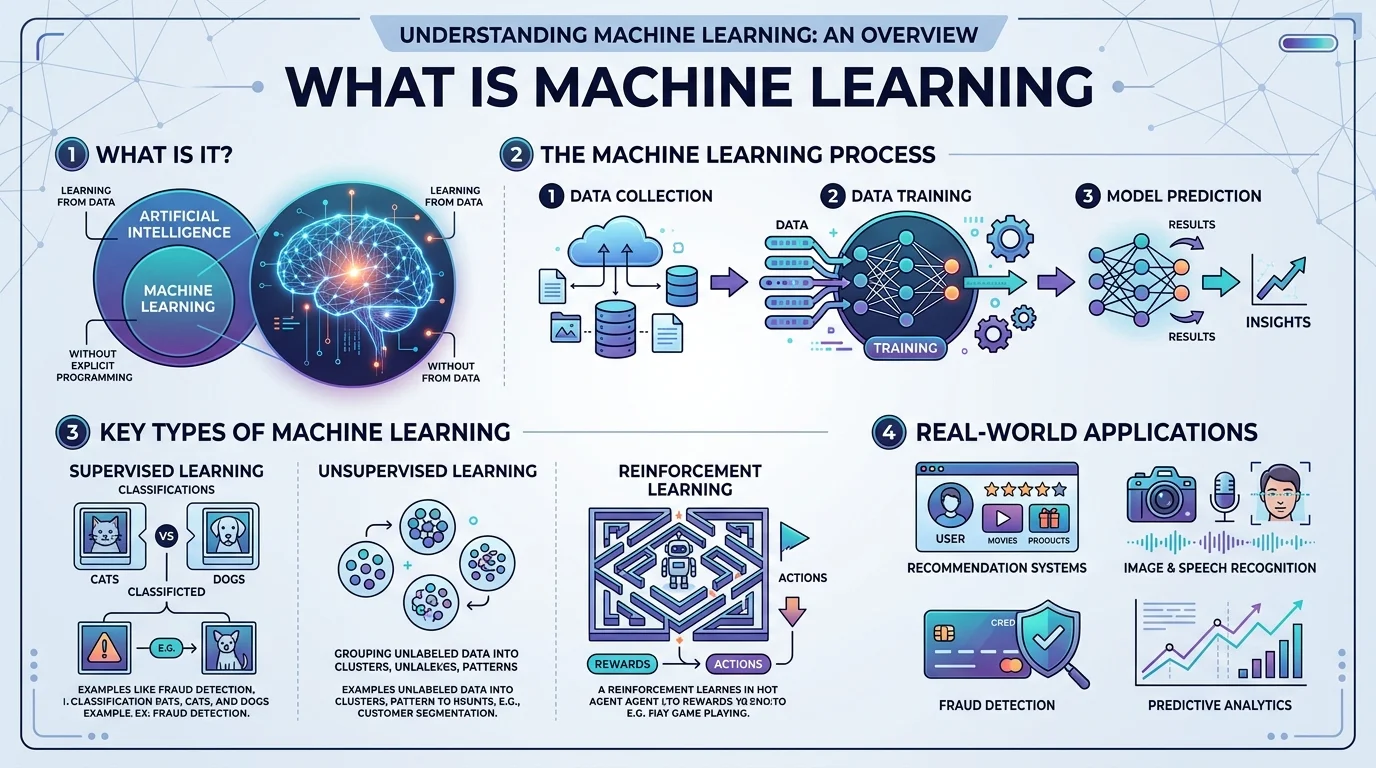
Machine learning is a subset of artificial intelligence that lets computers learn patterns from data and improve their performance without being explicitly programmed for every rule. Instead of following rigid, hand-written instructions, a machine learning model studies examples, identifies patterns, and applies what it learned to make predictions on new information. It's the technology quietly running behind Netflix recommendations, spam filters, and voice assistants — and by 2026, it's not a niche topic anymore. According to McKinsey, 88% of organizations now use AI in at least one business function, up from just 55% in 2023.
Let me walk you through what it actually is, how it works, and why it matters to you.
Machine Learning vs. AI vs. Deep Learning: What's the Difference?
Machine learning is a subset of AI, and deep learning is a subset of machine learning. People use these three terms interchangeably all the time, and honestly, that's where most of the confusion starts. Here's a table that clears it up fast.
Term | Definition | Example |
|---|---|---|
Artificial Intelligence (AI) | The broad field of building machines that mimic human intelligence | A chess engine, a chatbot, a self-driving car |
Machine Learning (ML) | A subset of AI where systems learn patterns from data instead of fixed rules | A spam filter that improves as it sees more email |
Deep Learning | A subset of ML using layered neural networks modeled loosely on the brain | Large language models, image recognition systems |
So next time someone says "AI" when they mean "machine learning," you'll know the difference. That distinction matters more than people realize when you're researching tools or courses.
How Does Machine Learning Actually Work?
Every machine learning model needs three things: data, an algorithm, and a way to measure success. You feed it data, it looks for patterns, and it uses those patterns to make predictions on unseen information. That's the whole game, really.
Here's the typical step-by-step process:
Collect the data — you gather examples relevant to the problem you're solving.
Clean and prepare it — messy data leads to messy predictions, so this step matters more than people think.
Choose an algorithm — this could be a simple linear model or a complex neural network.
Train the model — the system studies the data and adjusts itself to minimize errors.
Test and validate — you check performance on data it hasn't seen before.
Deploy and monitor — once it works, you put it into action and keep watching it.
If you've ever used a tool to transcribe an audio file for free, you've seen this exact pipeline in action — the model was trained on labeled audio, tested for accuracy, and deployed as the transcription engine behind the scenes.
Simple enough? Good. Let's go deeper into the types.
The Main Types of Machine Learning You Need to Know
There are five core types of machine learning: supervised, unsupervised, semi-supervised, reinforcement, and deep learning. Each one solves a different kind of problem, and knowing which is which will save you a lot of confusion down the line.
Supervised Learning
Supervised learning trains a model using labeled data, meaning every example already has the correct answer attached. Imagine teaching a kid to identify fruits by showing them a hundred labeled pictures — apple, banana, orange. Eventually, they get it. That's supervised learning in a nutshell.
It powers classification and regression tasks — think spam detection, price forecasting, and medical diagnosis.
Unsupervised Learning
Unsupervised learning works with unlabeled data, meaning there's no answer key at all. The model just looks for hidden structure on its own. This is how clustering works — grouping similar customers for marketing, or spotting unusual transactions for fraud detection.
Reinforcement Learning
Reinforcement learning trains an agent by trial and error, using rewards and penalties instead of labeled examples. It's basically how you'd train a dog. Good behavior gets a treat. Bad behavior doesn't.
This approach powered DeepMind's AlphaGo and now shows up in robotics, gaming, and dynamic pricing systems.
Semi-Supervised and Deep Learning
Semi-supervised learning mixes a small labeled dataset with a much larger unlabeled one. And deep learning — the powerhouse behind large language models and generative AI — uses layered neural networks inspired by how our brains work. Real brain science informed this, which is genuinely fascinating if you think about it.
Why Should You Actually Care About This?
Machine learning already shapes your daily life more than you probably realize. It's not abstract theory anymore — it's infrastructure.
Your speech recognition app transcribing voice notes — the same underlying idea behind free AI transcription tools that convert speech to text in seconds.
The recommendation systems on Spotify and Amazon.
Fraud detection systems protecting your bank account right now.
Image recognition tools tagging your photos automatically.
Sentiment analysis tools businesses use to read customer feedback.
If you've ever compared the best free AI transcription tools available today, you've already seen machine learning at work — the accuracy of modern speech-to-text software comes directly from models trained on massive labeled audio datasets.
The global machine learning market was valued at $100 billion in 2025 and is projected to grow to $684 billion by 2033, according to Grand View Research. That's not hype. That's a technology actively reshaping entire industries, and it's not slowing down.
Should You Learn Machine Learning Yourself?
Yes — and you don't need a PhD or a math background to start. What you need is curiosity and a willingness to build a little data science knowledge along the way.
Start small. Pick one course. Build one project, then another. Momentum builds fast once you're moving. Structured programs like Stanford and DeepLearning.AI's Machine Learning Specialization are a solid starting point if you want guidance instead of piecing things together randomly.
Common Mistakes Beginners Make
The most common beginner mistake is jumping into complex neural networks before understanding basic algorithms. A few others worth avoiding:
Ignoring data quality. Garbage in, garbage out, always.
Obsessing over model accuracy without checking for overfitting — when a model memorizes instead of actually learning.
Skipping the fundamentals of supervised and unsupervised learning before jumping to deep learning.
Avoid these, and you'll move faster than most people who dive in headfirst without a plan.
Frequently Asked Questions
Is machine learning the same as AI?
No. Machine learning is a subset of AI. AI is the broad goal of building machines that mimic human intelligence; machine learning is one specific approach that gets there through learning from data.
Do I need to know advanced math for machine learning?
Not to start. Basic statistics and algebra help, but many beginners start building simple models before deepening their math knowledge.
What's the difference between machine learning and deep learning?
Deep learning is a subset of machine learning that uses layered neural networks. Machine learning includes deep learning plus simpler methods like decision trees and linear regression.
How is machine learning used in business today?
Common uses include fraud detection, demand forecasting, customer segmentation, recommendation engines, and predictive maintenance.
Is machine learning still growing in 2026?
Yes. Market research firms project the global ML market to grow from roughly $100 billion in 2025 to well over $500 billion within the next several years, driven by adoption across healthcare, finance, and retail.
Final Thoughts
Machine learning isn't a far-off concept anymore. It's the quiet engine behind the apps you use every single day. You now understand what it is, how it differs from AI and deep learning, the core types, and why it matters at scale.
The only question left is what you do with this knowledge. Pick one small step today — a free course, a tutorial, a single project — and start building real, practical skills.