
Which iPhone Has Best Camera?
The iPhone 17 Pro Max has the best iPhone camera you can buy today — three 48MP sensors and the longest zoom Apple has ever shipped.
The iPhone 17 Pro uses the identical rear camera system for $100 less. It's the smarter buy for almost everyone.
Apple's advertised "8x zoom" is a 12MP crop from the 48MP telephoto, not a native 8x lens.
DXOMARK scored the iPhone 17 Pro at 168 and the standard iPhone 17 at 157.
The golden rule: an older Pro model beats a newer standard model for photography, every single time.
Let me save you twenty minutes of scrolling: the iPhone 17 Pro Max has the best camera Apple has ever built. That's the honest answer.
But here's the part almost nobody tells you — the iPhone 17 Pro takes literally identical photos for $100 less.
I dug through Apple's spec sheets, DXOMARK's lab data, and a pile of reviews to work out where your money actually goes. Some of what I found genuinely surprised me.
Stick with me. By the end, you'll know exactly which one to buy.
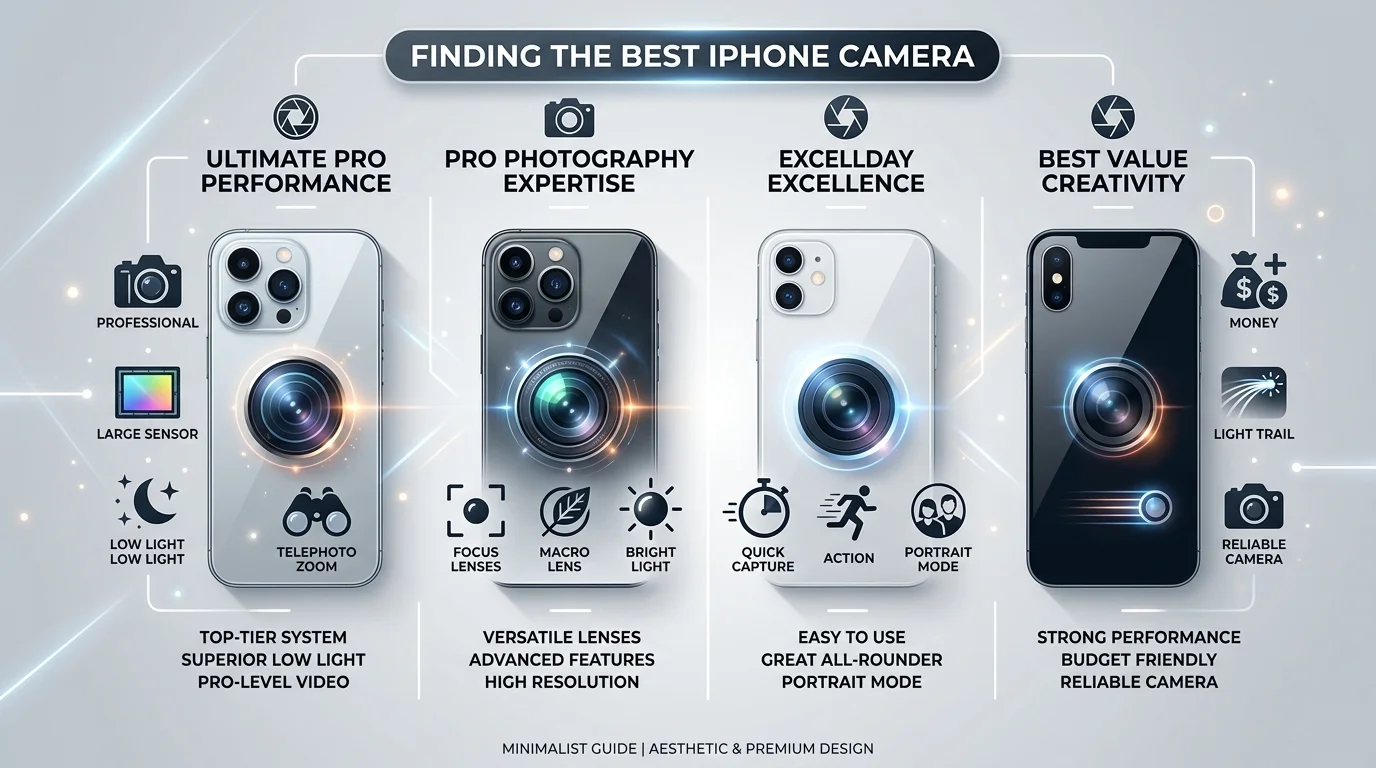
iPhone Camera Comparison at a Glance
Most "best iPhone camera" articles stop at the flagship and call it a day. That's lazy. The real question isn't which iPhone has the best camera — it's which iPhone has the best camera for what you shoot. Because the gap between "the best" and "the best for you" is worth several hundred dollars. Below is a full iPhone camera comparison across every current model, so you can stop guessing and start shooting.
Model | Rear Cameras | Optical Zoom | Price | Best For |
|---|---|---|---|---|
iPhone 17 Pro Max | 3× 48MP | 4x (8x optical-quality) | $1,199 | Outright best, long video shoots |
iPhone 17 Pro | 3× 48MP (identical) | 4x (8x optical-quality) | $1,099 | Same photos, smaller body |
iPhone 17 | 2× 48MP | 2x optical-quality | $799 | Most people, honestly |
iPhone Air | 1× 48MP | 2x optical-quality | $999 | Design lovers, not photographers |
iPhone 17e | 1× 48MP | 2x optical-quality | $599 | Budget buyers |
Notice something? The Pro and Pro Max are twins.
iPhone 17 Pro Max: The Ceiling
This is the one you buy when you actually care about photography. Apple gave it three 48MP sensors — a first for any iPhone — plus the longest telephoto zoom the company has ever put in a phone. I've read a lot of spec sheets in my life, and this one impressed me. It isn't a marginal refresh. It's the model that finally makes the 48MP camera system consistent across every focal length you'd realistically use.
The specs, straight from Apple's technical documentation:
48MP Fusion Main — 24mm, ƒ/1.78, second-generation sensor-shift optical image stabilization
48MP Fusion Ultra Wide — 13mm, ƒ/2.2, 120° field of view
48MP Fusion Telephoto — 100mm (4x), ƒ/2.8, tetraprism design
Plus a 12MP optical-quality 8x telephoto at 200mm
That last line matters. A lot. And if the jargon is new to you, my guide on what a telephoto lens actually is explains why focal length matters more than megapixels.
iPhone 17 Pro Max vs iPhone 16 Pro Max: The Zoom Trade-Off
Marketing language does heavy lifting here, and I want you going in with clear eyes. Apple advertises 8x zoom. What you actually get is more nuanced than the billboard suggests. This isn't a scandal — it's still a real upgrade — but understanding it changes which phone you should pick, especially if last year's model is sitting on a discount.
Spec | iPhone 17 Pro Max | iPhone 16 Pro Max |
|---|---|---|
Telephoto resolution | 48MP | 12MP |
Telephoto sensor size | 1/2.55-inch | 1/3.06-inch |
Native optical zoom | 4x (100mm) | 5x (120mm) |
Extended zoom | 8x optical-quality (200mm) | — |
Max digital zoom | 40x | 25x |
So here's the truth: the 8x mode is a 12MP crop from the 48MP telephoto sensor. It isn't a separate lens. And Apple actually shortened the native optical lens from 5x down to 4x.
Wait — that sounds like a downgrade?
Not quite. The new sensor is 56% larger, which means Apple can crop deep and still hand you a clean 200mm image. Digital zoom stretches to 40x, up from 25x.
Still, if pure optical zoom reach is your obsession, a used 16 Pro Max gives you true 5x for far less money. Notebookcheck's sample shots also show that 40x hybrid zoom falls apart in anything less than ideal light.
iPhone 17 Pro: The Smart Money
I'll be blunt, because this is where most buyers overspend. The iPhone 17 Pro carries the exact same rear camera array as the Pro Max — same main sensor, same ultra wide, same tetraprism telephoto, same 16x optical-quality zoom range. The only meaningful separator is battery endurance during long video sessions.
DXOMARK scored it 168 overall, with 175 on the main camera, 170 on bokeh, and 166 on photo. Their testers called its still image performance among the best they've ever measured, praising best-in-class video performance and its zoom versatility.
Worth noting for transparency: DXOMARK has published a full camera score for the 17 Pro but not for the 17 Pro Max. Given the identical hardware, expect near-identical results.
The 17 Pro also took the top spot in DXOMARK's front camera ranking, thanks to the redesigned 18MP Center Stage camera — the first square image sensor Apple has ever used.
The iPhone 17 Pro is the correct buy for most serious photographers, because it delivers a genuinely identical camera system for $100 less than the Pro Max.
iPhone 17: Enough Camera for 95% of People
Here's my mildly controversial take, and I stand by it. Unless you shoot professionally, the standard iPhone 17 covers almost everything you photograph. Two 48MP lenses. Photonic Engine and Smart HDR processing. The same upgraded Center Stage selfie camera. At $799, it delivers flagship-tier images for travel, family, food and social content without the Pro tax.
DXOMARK gave it 157 — genuinely close to the Pro in common scenarios.
Where does it fall short? Two places, and DXOMARK named both:
Low light — autofocus becomes less dependable, which hurts night portraits most
Zoom — no dedicated tele lens, so detail preservation drops noticeably past 4x
If those two situations rarely come up for you, save the $300.
Low-Light Performance: Where the Money Actually Shows
Daylight is the great equalizer. In good light, the standard iPhone 17 and the 17 Pro produce results most people couldn't separate in a blind test. Low-light photography is where the price difference finally earns itself, and it comes down to physics rather than software: bigger sensors gather more photons.
The 17 Pro's main camera uses a large 1/1.28-inch optical format sensor with sensor-shift stabilization. That combination lets Night mode use shorter exposures, which means fewer blurred faces and less smearing on moving subjects.
Three practical differences you'll actually notice after dark:
Portraits at night — the Pro locks focus faster and holds it
Indoor events — less noise, more natural skin tones
Handheld long exposures — sensor-shift OIS buys you sharper frames
DXOMARK ranked the standard iPhone 17 mid-table in low-light testing, with a clearer gap to the Pro than in bright conditions.
Best iPhone for Photography on a Budget
Not everyone has $1,100 to spend, and honestly, you don't need to. The best budget iPhone camera options come from the used and refurbished market rather than Apple's current entry-level lineup. Older Pro models were flagship-grade when new, and their sensors haven't aged — only their price tags have.
Your best value picks right now:
Refurbished iPhone 16 Pro — near-current imaging, true 5x zoom, significant discount
Refurbished iPhone 15 Pro — 48MP main sensor and ProRes video, still competitive
iPhone 14 Pro — the first 48MP iPhone, and prices have crashed
iPhone 17e at $599 — a single 48MP Fusion camera with 2x optical-quality zoom and 4K Dolby Vision
Skip the iPhone Air if photography matters to you. It's a stunning object, but it makes real compromises — a single rear camera, mono speaker, and shorter battery life — for $200 more than the better-equipped iPhone 17.
Video: What Only the Pro Models Give You
If you shoot video for money, or you want to, this section decides your purchase outright. Apple reserves its professional video toolkit for the Pro tier, and these aren't cosmetic differences — they're workflow features that determine whether footage survives a proper colour grade. Everything below is Pro and Pro Max only.
ProRes Log recording for full grading latitude in post
4K Dolby Vision at up to 120fps on the main camera
Dual Capture — front and rear recording simultaneously
4K 60fps across all three rear cameras, including the telephoto
Before you obsess over frame rates, it's worth understanding what 4K resolution actually means for file sizes, editing and delivery — most creators overshoot what their audience ever sees.
Action mode stabilization and Cinematic mode appear across the lineup, so casual creators aren't locked out. But for client work, the Pro is the entry point.
Your Step-by-Step Buying Guide
Enough theory. Let's make this decision fast and painless. I've built this as a simple decision path so you don't need to re-read the whole article. Answer each question honestly — not aspirationally — and you'll land on the right phone in about ninety seconds. Most people I walk through this end up spending less than they expected.
Step 1: Ask what you actually shoot. Kids, food, holidays, dogs? iPhone 17. Concerts, wildlife, property, sport? Go Pro.
Step 2: Decide if you need reach. If you regularly zoom past 4x, you need a Pro model. No exceptions.
Step 3: Check whether you shoot paid video. If yes, you need ProRes Log and 4K 120fps — Pro only.
Step 4: Pick your size. Pro and Pro Max shoot identically. Choose on hand comfort and battery, not the camera.
Step 5: Compare refurbished before you buy new. A refurbished 16 Pro still outperforms most Android flagships.
The Golden Rule Nobody Mentions
I want to leave you with the single most useful principle I found across every review, teardown and lab test I read for this piece. It's counterintuitive, it saves real money, and it's held true for roughly four generations now.
An older Pro beats a newer standard model. Every time.
So buy the highest-tier camera you can afford, even if it's a year or two old.
Frequently Asked Questions
Below are the questions readers ask most often about choosing an iPhone for photography, answered directly.
Is the iPhone 17 camera as good as the iPhone 17 Pro?
In daylight, on the main camera, the difference is minimal — DXOMARK scored them 157 and 168 respectively. The gaps open in low light, where the iPhone 17's autofocus is less dependable, and in zoom, where it lacks a dedicated telephoto lens. For everyday shooting, the standard iPhone 17 is genuinely excellent.
Does the iPhone 17 Pro Max really have 8x optical zoom?
Not exactly. The native optical lens is 4x at 100mm. The 8x, 200mm view is a 12MP crop from the 48MP telephoto sensor, which Apple calls "optical-quality" rather than optical. The results are strong in good light, but it isn't a true 8x lens.
Is the iPhone 17 Pro Max better than the iPhone 17 Pro for photos?
No. Both use an identical rear camera system — same 48MP main, ultra wide and telephoto sensors. The Pro Max's larger battery helps during extended video recording, but for stills there is no image quality advantage. Choose based on size and battery, not camera.
Should I buy an iPhone 15 Pro in 2026?
Yes, at the right price, especially refurbished. Its 48MP main sensor and ProRes video remain competitive. Be aware the standard 15 Pro has 3x telephoto rather than the 5x found on the 15 Pro Max, so check which variant you're buying.
Which iPhone is best for video and vlogging?
The iPhone 17 Pro. It combines ProRes Log, 4K Dolby Vision at 120fps, Dual Capture, and the 18MP Center Stage front camera that topped DXOMARK's selfie ranking — in a body light enough to hold all day.
Is the iPhone Air good for photography?
It's the weakest camera in the current premium lineup. A single 48MP rear camera means no ultra wide and no telephoto. At $999 it costs $200 more than the dual-camera iPhone 17. Buy it for the design, not the photos.
Should I wait for the iPhone 18 Pro?
Apple is expected to unveil the iPhone 18 Pro on September 9, 2026, reportedly debuting a mechanical variable aperture main camera — replacing the fixed ƒ/1.78 lens used for four generations. If that specific feature excites you, wait a fortnight. Otherwise, note that there is no standard iPhone 18 in 2026 at all; it slips to spring 2027.
My recommendation: buy the iPhone 17 Pro today. You get the best camera system Apple currently sells, in the more comfortable body, at the smarter price. Your photos will be better tomorrow morning.