
![What Is a Telephoto Lens? The Complete 2026 Guide | [Brand]](https://contiocdn.com/efdc9a99-5ac4-4f75-be3a-ed43de859d76/blog-covers/1787138653893-ru50banq-what-is-a-telephoto-lens--the-complete-2026-guide-.webp)
A telephoto lens is a camera lens with a long focal length and a narrow angle of view that makes distant subjects appear larger in your frame. Most photographers treat any lens from 70mm upward as telephoto, which on full frame means an angle of view of roughly 30° or less. You use one for wildlife, sports, portraits, and any scene where walking closer isn't an option or isn't wise. This guide covers what a telephoto lens actually is, the focal length ranges, the compression myth almost everyone repeats, and how to shoot sharp images with one.
I remember the first time I borrowed a 300mm. I lifted it, wobbled, and shot forty frames of a heron. Two were sharp.
That's the honest starting point for this guide.
What Makes a Lens "Telephoto" (The Answer Is Messier Than You Think)
Here's something most beginner guides skip: there are two definitions in circulation, and they don't agree. One is an optical engineering term. The other is casual photographer shorthand. Both are used constantly, often in the same sentence, which is exactly why you've probably read three articles giving three different mm numbers. Once you know both definitions, the confusion disappears and you can read spec sheets without second-guessing yourself. Let me walk you through each.
The strict optical definition
Technically, a telephoto lens is a specific sub-type of long-focus lens where the physical barrel is shorter than its focal length.
That sounds impossible. It isn't.
Lens designers add an internal group of elements called a telephoto group, which extends the light path inside a much shorter housing. Without it, a 500mm lens would need roughly 500mm of physical distance between the front element and the sensor. You'd be hauling around a drainpipe.
There's even a number for it. The telephoto ratio is the lens's physical length divided by its focal length. A plain long-focus lens sits near 1.0. A true telephoto sits below 1.0. Canon's 400mm f/4 DO IS hits 0.58, which is why it doesn't require its own suitcase.
So by the strict rule, "long lens" and "telephoto lens" aren't synonyms.
The everyday definition
In practice? Nobody checks the telephoto ratio before buying.
Photographers just call any long lens a telephoto. And the threshold shifts depending on who's talking:
Tamron, a lens manufacturer, says around 80mm or greater
Many retailers and educators say 70mm
Cambridge in Colour calls 70mm+ "medium telephoto" but reserves "full telephoto" for 135mm and beyond
Some sources go as low as 60mm
The cleaner way to think about it is angle of view, not millimetres. Telephoto lenses cover roughly 1° to 30° of a scene. Super-telephotos narrow that to about 1° to 8°. Cambridge in Colour pegs full telephoto at under about 15° across the widest dimension of your photo.
Angle of view doesn't lie. Millimetre thresholds are opinions.
Telephoto Focal Length Ranges Explained
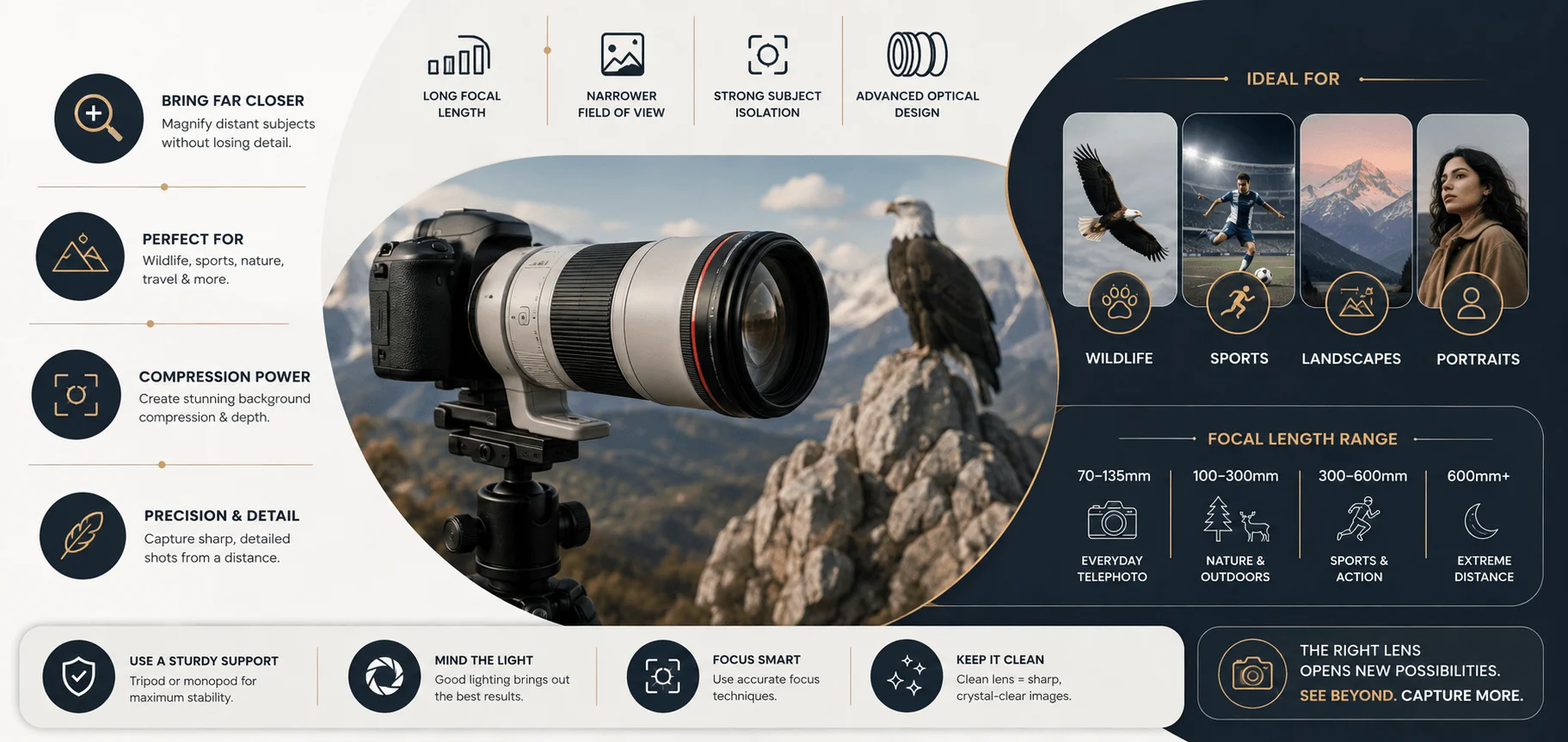
Not all telephotos behave the same way, and lumping an 85mm portrait lens together with a 600mm wildlife cannon is like calling a hatchback and a lorry "vehicles." Both statements are true and neither is useful. Below, I've broken the range into the three groups working photographers actually use, with the diagonal angle of view, typical weight, and the jobs each one does well. Find the row that matches your subject and you've basically chosen your lens category.
Class | Range (full frame) | Diagonal angle of view | Typical weight | Best for | Rough price band |
|---|---|---|---|---|---|
Short telephoto | 85–135mm | 28.5° at 85mm, 18° at 135mm | 400–950g | Portraits, products, events | £400–1,600 |
Medium telephoto | 135–300mm | 18° down to 8° | 1.1–1.5kg | Weddings, sport, wildlife starters | £600–2,500 |
Super telephoto | 300mm+ | 8° at 300mm, 4° at 600mm | 1.4–3.2kg | Birds, motorsport, the Moon | £900–13,000 |
Short telephoto: 85mm to 135mm
This is portrait territory.
You get pleasant background separation without standing across the road from your subject. Faces render naturally, with none of the nose-forward stretching a wide-angle produces up close. Event and product shooters live here too. These lenses are compact, hand-holdable, and comparatively affordable.
An 85mm f/1.8 typically weighs under 400g. You can carry one all day and forget it's there.
Medium telephoto: 135mm to 300mm
The workhorse band, and the one I'd recommend if you're buying your first. If you're weighing specific models, our guide to choosing your first telephoto lens breaks down the current options by system.
A 70-200mm f/2.8 covers weddings, indoor sport, and outdoor portrait photography in one barrel. Expect roughly 1.4kg on the scales. A 100-400mm adds serious reach for a modest price. You get significant magnification without the cost or weight of the exotic stuff.
Super telephoto: 300mm and beyond
Wildlife, motorsport, birds, the Moon.
Photography Mad notes that focal lengths run up to 800mm and past it. Current zooms in this class include the Nikon Z 180-600mm f/5.6-6.3 VR, the Sony FE 200-600mm G, the Canon RF 100-500mm L, and the Sigma 150-600mm Sports. All four land between 1.4kg and 2.1kg.
A 600mm f/4 prime is a different proposition entirely: around 3.2kg and the price of a used car.
The reach is extraordinary. So is the discipline required to get a sharp frame. This is not a casual purchase.
Telephoto vs Zoom vs Prime: Clearing Up a Common Mix-Up
I hear this one constantly, and it's an easy trap because camera shops use both words in the same breath. "Telephoto" describes focal length. "Zoom" describes whether that focal length is adjustable. They're two separate properties, and a lens can have either, both, or neither. Sorting this out takes about thirty seconds and it'll stop you buying the wrong thing online.
Term | What it actually means | Adjustable? | Example | Typical trade-off |
|---|---|---|---|---|
Telephoto lens | Long focal length, narrow angle of view | Either | 300mm | Weight and cost |
Zoom lens | Adjustable focal length | ✅ | 24-70mm | Slower aperture |
Prime lens | Fixed focal length | ❌ | 50mm | No framing flexibility |
Telephoto zoom | Both properties | ✅ | 70-200mm | Usually f/2.8 at best |
Telephoto prime | Long, but fixed | ❌ | 400mm | Sharper, wider aperture, pricier |
So a telephoto zoom and a telephoto prime are both telephoto lenses.
Primes generally deliver sharper results and wider maximum apertures for the money. Zooms give you flexibility, which matters enormously when your subject won't hold still.
What a Telephoto Lens Actually Does to Your Photo
Reach is the obvious benefit, but it's honestly the least interesting one. The moment you put a long lens on, three other things change about your image at once, and understanding them is what separates a snapshot from a photograph that looks deliberate. Here's what shifts the second you zoom past 100mm, and how each change can be used on purpose rather than by accident.
It magnifies distant subjects. You photograph a bird without flushing it. You shoot a footballer from the touchline. Just remember that reach only pays off if your sensor can resolve the detail, which is where 4K resolution and pixel density come into the conversation.
It narrows the field of view. Tamron makes a point worth remembering here: a telephoto captures less background information than a standard lens. A 300mm lens sees 8° of a scene where a 50mm sees 47°. Fewer bins, fewer stray tourists, fewer distractions.
It gives you shallow depth of field. Longer focal lengths produce a shallower plane of focus, so everything outside it melts into bokeh. Combined with the narrow view, this is the classic subject isolation look.
Three tools. One lens.
The Compression Myth Nobody Wants to Give Up
Now for the part where I contradict roughly ninety percent of the articles you'll find on this topic, including some very good ones. You've almost certainly read that telephoto lenses "compress" the background and flatten a scene. The visual effect is completely real. The explanation attached to it is not, and once you see why, you'll understand how to create the look with any lens you own.
What people claim
That a long focal length squashes the space between your subject and the background, making mountains loom huge behind a person.
What's actually happening
Perspective is determined by camera position, full stop.
Shoot the same scene from the same spot at 24mm and at 200mm, then crop the wide frame to match the tele frame. The perspective is identical. Fstoppers demonstrated this with a side-by-side comparison, and PetaPixel makes the same argument.
The lens changes nothing about the geometry.
What changes is you. A telephoto lets you achieve your framing from much further back, and it's that increased subject distance that produces compression distortion. Wikipedia's entry on perspective distortion puts it plainly: linear perspective changes come from distance, not from the lens.
Why you should care
Because it turns a lens property into a technique.
Want that compressed look? Walk backwards, then zoom in. Double your distance to the subject and you roughly halve the apparent size difference between foreground and background. The further back you stand, the more dramatically the background stacks up.
Landscape, architectural and sports photographers use this constantly to place a mountain range or a city skyline right behind a foreground subject. The same principle explains those Moon-behind-a-cyclist shots you've seen: shot at 600mm from several hundred metres away.
The glass didn't do it. Your feet did.
How to Get Sharp Shots: A Step-by-Step Guide
This is where most people give up on telephoto photography, and it's a shame, because the fixes are mechanical rather than mysterious. A long lens magnifies everything, including the tiny tremor in your hands and the vibration from your own shutter. Work through these six steps in order and your keeper rate will climb sharply, no new gear required.
Step 1: Apply the reciprocal rule. Set your shutter speed to at least 1 over your focal length. Shooting at 200mm? Use 1/200s or faster. At 600mm, 1/600s is your floor.
Step 2: Adjust for your sensor. On a crop body, multiply the focal length by the crop factor first. A 200mm lens on a 1.5x APS-C body needs roughly 1/300s.
Step 3: Factor in stabilisation, carefully. Image stabilization (Canon's IS, Nikon's VR, Sony's OSS) buys you roughly two to four stops. Nikon rates the Z 180-600mm f/5.6-6.3 VR at 5.5 stops, and the Z 100-400mm f/4.5-5.6 VR S at 5. Useful, but stabilisation only fights your shake, never your subject's. A bird in flight can need 1/2000s regardless.
Step 4: Mount to the lens, not the camera. If you're using a super-telephoto on a tripod, attach it via the tripod collar. Hanging a 2kg lens off the camera body puts real strain on the mount and can damage both.
Step 5: Switch stabilisation off on a tripod. Counterintuitive, but the system can hunt for movement that isn't there and introduce blur.
Step 6: Stop down one third to one full stop. Most telephotos are soft wide open. Moving from f/5.6 to f/6.3 or f/7.1 often produces a visible jump in sharpness. Top-tier glass is the exception.
Crop Sensors and Teleconverters: Cheap Reach and Its Cost
If a longer lens isn't in the budget, there are two shortcuts to more reach, and both involve a trade you should understand before committing. Neither one is a free lunch, but both are genuinely useful in the right situation. Here's exactly what each gives you and what it quietly takes away.
Crop factor
Smaller sensors crop the frame, which narrows your field of view and effectively extends your reach.
Sensor format | Crop factor | A 300mm lens frames like | Light-gathering trade-off |
|---|---|---|---|
Full frame | 1.0x | 300mm | Baseline |
APS-C (Nikon, Sony, Fuji, Pentax) | 1.5x | 450mm | ~1 stop noisier |
APS-C (Canon) | 1.6x | 480mm | ~1 stop noisier |
Micro Four Thirds | 2.0x | 600mm | ~2 stops noisier |
1-inch | 2.7x | 810mm | ~3 stops noisier |
A 300mm lens on Micro Four Thirds frames like a 600mm. Brilliant for wildlife photography. The catch is that you're gaining framing, not resolution, and smaller sensors typically struggle more in low light.
Teleconverters
A teleconverter sits between lens and body and multiplies your focal length. It also costs you light: 1 stop with a 1.4x, 1.5 stops with a 1.7x, and 2 stops with a 2x.
Put a 2x on a 70-200mm f/2.8 and you've got a 140-400mm f/5.6. Autofocus performance usually softens too.
What About the Telephoto Camera on Your Phone?
Plenty of people searching for this term aren't holding a camera at all. They're reading a phone spec sheet that mentions a "telephoto" or "periscope" module and wondering what they've paid for. The principle is identical to a camera lens, but the engineering solution is clever and worth a minute of your time, especially since the marketing numbers are frequently misleading.
A periscope camera folds the light path sideways using a prism or mirror, so a long focal length fits inside a slim body. Apple's "tetraprism" design works the same way, bouncing light four times to deliver 5x optical zoom at a 120mm equivalent. Huawei's P30 Pro pioneered the approach back in 2019 with an 8MP module.
The 2026 landscape looks like this:
Phone | Telephoto type | Optical zoom | Sensor note |
|---|---|---|---|
Samsung Galaxy S25 Ultra | Dual telephoto + periscope | 3x and 5x | 50MP periscope with OIS |
iPhone 17 Pro Max | Tetraprism periscope | 5x | 120mm equivalent, f/2.8 |
Xiaomi 15 Ultra | Periscope | 4.3x | Best-rated tele detail in independent testing |
Vivo X200 Pro | Zeiss APO periscope | 3.7x | 200MP, 1/1.4in sensor |
Basic phone telephoto modules manage 2x to 3x. Periscopes reach 5x to 10x.
Now, the warning. Headline claims of "100x" or "200x zoom" are digital zoom, meaning an AI-upscaled crop from the optical base. Independent lab testing shows usable detail rarely survives past about 25x. Optical zoom is the only figure worth comparing. And no mass-market phone currently ships with verified 10x optical zoom, whatever the box says.
The Downsides You Should Know Before Buying
I'd be doing you a disservice if I ended on the good parts alone, because a telephoto lens asks something from you that a 50mm never will. Some of these trade-offs are obvious in a shop. Others only bite after a full day of shooting. Read this list before you spend, not after.
Weight and bulk. More glass elements means a heavier barrel. A 70-200mm f/2.8 runs about 1.4kg before you add a body.
Cost. Fast telephoto glass is genuinely expensive, and the jump from f/5.6 to f/2.8 often triples the price.
Restricted view. At 4° of coverage, finding a moving subject in the frame is surprisingly hard.
Low light struggles. Consumer tele-zooms often max out at f/5.6 or f/6.3.
Shake sensitivity. Every tremor is magnified along with the subject.
File sizes. High-resolution telephoto work fills cards fast, and if you're shooting stills alongside video you'll want to understand JPG vs PNG before you decide how to export and archive.
None of these are dealbreakers. All of them are worth knowing.
Frequently Asked Questions
What is a telephoto lens in simple terms?
A telephoto lens is a camera lens with a long focal length that magnifies distant subjects and shows a narrow slice of the scene. On a full-frame camera, that generally means 70mm or longer, covering about 30° of view or less.
At what mm does a lens become telephoto?
Most photographers use 70mm as the practical starting point on full frame, though some sources say 80mm or 85mm, and stricter definitions reserve the term for 135mm and up. Angle of view is the more reliable measure: roughly 1° to 30°.
Is a telephoto lens the same as a zoom lens?
No. Telephoto refers to focal length, zoom refers to whether the focal length adjusts. A 400mm prime is a telephoto without being a zoom, and a 24-70mm is a zoom without being a telephoto.
What is the difference between telephoto and super telephoto?
Super telephoto generally means 300mm and above, with a diagonal angle of view of about 8° or narrower. Standard telephotos sit between roughly 70mm and 300mm.
What is a telephoto lens used for?
Wildlife, birds, sports, motorsport, portraits, candid event work, astrophotography, and compressed landscape shots. Anywhere you can't get physically close, or where standing back produces a better-looking result.
Does a telephoto lens really compress the background?
The effect is real, but it's caused by shooting from a greater distance rather than by the lens optics. Long lenses simply let you stand further back while keeping your framing.
What shutter speed should I use with a telephoto lens?
Start at 1 over your focal length, adjust for crop factor, then go faster for moving subjects. A 600mm lens needs 1/600s minimum handheld, and birds in flight often need 1/2000s.
Do I need a tripod with a telephoto lens?
Not always. Modern stabilisation buys two to four stops, which makes handheld shooting viable up to about 400mm in decent light. For anything longer, or in dim conditions, a tripod or monopod pays for itself immediately.
Does a crop sensor make my telephoto lens longer?
It narrows the field of view, which behaves like extra reach. A 300mm lens on a 1.5x APS-C body frames like a 450mm. The lens's actual focal length doesn't change.
Is a periscope phone camera a real telephoto lens?
Yes. It uses the same optical principle, with the light path folded sideways by a prism so a long focal length fits in a thin body. Current flagships deliver 3x to 5x true optical zoom.
Get the shutter speed right, understand that compression comes from where you stand, and pick a focal length that matches your subject rather than the biggest number you can afford. That's most of the battle.
Now go shoot something far away.
Final Thoughts: Which Telephoto Lens Should You Buy?
A telephoto lens is any long focal length lens, generally 70mm and up on full frame, that narrows your view to 30° or less and pulls distant subjects close. The real question is which one belongs on your camera, and that comes down to what you shoot.
People? Start at 85mm or 135mm. Light, affordable, and faces render naturally.
A bit of everything? A 70-200mm f/2.8 handles weddings, sport and portraits in one barrel.
Birds or motorsport? You need 400mm minimum, realistically 600mm.
Tight budget? An APS-C or Micro Four Thirds body stretches the glass you already own. A 300mm frames like 450mm or 600mm respectively.
Three habits matter more than any upgrade. Respect the reciprocal rule, stop down a third from wide open, and remember that compression comes from your feet rather than your glass. Want a mountain looming behind your subject? Walk backwards, then zoom in.
Master that last one and a heron on a far bank stops being a lucky shot.
Now go shoot something far away.