
The best AI detector for essays is one that keeps false positives low, shows sentence level highlights, and is used alongside a second tool. No detector is proof of authorship. Use scores as a self check, and keep your drafts as evidence.
Key facts at a glance:
Turnitin says its document level false positive rate is under 1% for documents with 20% or more AI writing. Its sentence level rate is about 4%.
Stanford researchers found detectors flagged 61.22% of essays by English learners as AI written.
Detectors are easily fooled by adversarial attacks, according to the RAID benchmark of 6 million generations.
38 US colleges had switched off AI detection as of October 13, 2026, per one tracker.
Let me be straight with you.
Most people pick an AI essay checker the wrong way. They grab the first free tool and trust the number blindly.
That's a mistake.
I dug through the studies, the university policies, and the vendor claims so you don't have to. Here's what I found.
How Does an AI Content Detector Work?
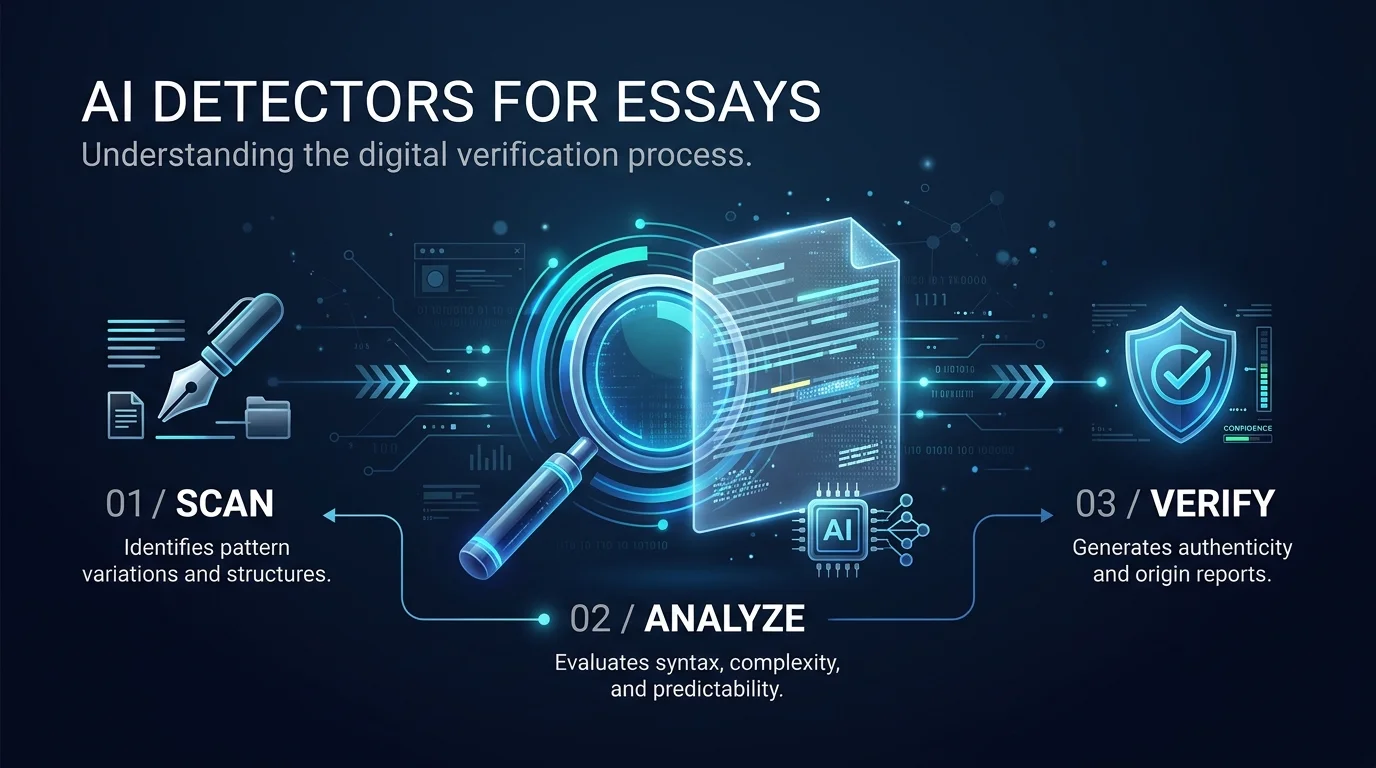
Before you pay for anything, understand what's under the hood. A detector doesn't know who wrote your essay. It guesses, based on statistical patterns that machine text tends to leave behind. If you're curious how the models behind those patterns learn in the first place, our guide on what is machine learning breaks it down simply.
Once you see that, every score makes more sense.
Perplexity and burstiness, in plain English
Perplexity measures how predictable your word choices are. Burstiness measures how much that predictability changes across the document. GPTZero explains both clearly.
Machine text tends to be smooth and even.
Human writing jumps around.
One catch: GPTZero says it moved to a deep learning classifier in autumn 2023. Those two signals are now supporting indicators, not the whole engine.
Why a score isn't proof
A "70% AI" result doesn't mean 70% of your essay came from a bot. It means the AI probability score leans that way.
Turnitin itself says its false positive rate isn't zero. So treat every score as a clue, never a verdict.
How Accurate Are AI Detectors?
You've seen the "99% accurate" claims. I have too. The honest answer is messier. Detection accuracy depends on the tool, the writing type, and whether the text was edited after generation. Here's what independent researchers actually measured.
What benchmarks and studies show
The RAID benchmark (ACL 2024) tested 12 detectors and found they struggle with adversarial attacks, new sampling strategies, and unseen models.
A 2026 Springer study was more encouraging on fully human text. Three of four tools produced zero false positives. But accuracy dropped sharply on hybrid and humanised AI text.
Another study found detectors had a 1.3% false positive rate versus 5.0% for human raters on STEM essays. Humans are worse at this than software.
The bias problem
Now the uncomfortable part.
Stanford's team found 97% of TOEFL essays were flagged by at least one of seven detectors. Essays by native speakers were classified near perfectly.
Why? Writing by English learners often has lower perplexity. Detectors read that as machine like.
If you're an ESL student, that matters. If you're a teacher, pause before accusing anyone. Good judgment here starts with strong evaluation habits, so it's worth learning how to improve critical thinking skills before you act on any score.
Why small error rates still hurt
Jisc calculated that even a 1% false positive rate could mean roughly 4,800 false flags a year at scale. That's thousands of real students.
AI Detector Comparison Table
You want a quick side by side. Fair enough. This table pulls together what I could verify from the sources I reviewed. Vendor claims are labeled as claims, and prices were reported earlier in 2026, so confirm them before you buy.
Tool | Best for | Reported starting price | Notable evidence |
|---|---|---|---|
GPTZero | Educators, free checks | $12.99 per month | Showed a small false positive rate in the Springer study |
Content and SEO teams | $14.95 per month | Paid only, built for high volume | |
Winston AI | Publishers, agencies | $18 per month | Vendor claims 99.98%. One review reports 75 to 85% real world accuracy |
Pangram | Writers, admissions checks | Check vendor | Reported near zero false positives in University of Chicago research |
Turnitin | Institutions | Via your school | Says under 1% document level false positives (20% or more AI text) |
One caution: vendors co authored some of the studies measuring their own tools, so weigh results accordingly.
Which AI Detector Should You Choose?
It depends on who you are. A student checking a draft needs different things than a publisher scanning 200 articles. Here's how I'd decide.
If you're a student or essay writer
Pick a tool with sentence level highlighting and a low false positive rate. Pangram and GPTZero are common picks. Run your essay through two, not one.
Your hardware matters too when you're writing and checking drafts all day. If you're shopping, see our picks for the best laptops for students in 2026 and the best laptop for writers.
If you're a teacher or editor
Don't use a score as evidence. Use it to start a conversation, then look at drafts and writing process.
Why paid beats free
Free tools are fine for a quick sniff test.
But paid plans give you longer documents, fuller reports, and saved history. That history matters. If anyone ever questions your work, a dated report is documentation.
For roughly the price of a sandwich a month, it's cheap insurance.
Step by Step: How to Check an Essay for AI
Ready to put this into practice? Follow my process. It takes about ten minutes, and the order matters.
Run two detectors. Combining tools cut false positives to nearly zero in one study.
Read the highlights first. Ignore the headline percentage. Are the flagged sentences generic or full of filler?
Check your version history. Google Docs or Word timelines show your real drafting trail.
Rewrite flagged parts in your voice. Add specific examples, vary sentence length, cut vague claims.
Rerun both tools. Then save dated screenshots of every report.
Saying your ideas out loud first can also help your essay sound more natural. If you like to dictate, our roundup of the best free AI transcription tools and the guide to free AI transcription show how to turn your spoken ideas into a first draft in your own voice.
Why Universities Are Turning Detectors Off
Here's what most tool reviews skip. Schools are walking away from detection scores, and it affects how your work gets judged.
The 2026 policy shift
Curtin University disabled Turnitin's AI detection from January 1, 2026.
The University of the Free State discontinued AI detection from July 1, 2026.
NTU in Singapore will deactivate its detector on December 31, 2026.
Yale's teaching center reportedly bars citing detector scores in formal complaints, per a secondary report.
What this means for you
Use a detector as a self check, not a courtroom exhibit. Pair it with drafts, notes, and your own process.
AI Detector for Essays: Frequently Asked Questions
What is the most accurate AI detector for essays?
No single tool wins everywhere. Pangram showed near zero false positives in reported university research, and GPTZero is a strong free option. Run two tools and compare.
Can AI detectors be wrong?
Yes. Turnitin reports a sentence level false positive rate of about 4%, and studies show higher rates for English learners.
Do AI detectors work on edited AI text?
Poorly. The Springer study found accuracy dropped considerably on hybrid and humanised text.
Is Turnitin's AI detector reliable?
Turnitin claims under 1% document level false positives for documents with 20% or more AI writing. Several universities have still disabled it over reliability concerns.
Why does my human written essay show as AI?
Simple vocabulary, uniform sentence length, and formal structure can look like low perplexity. ESL writers are affected most.
Are free AI detectors good enough?
For a quick check, yes. For anything high stakes, a paid tool with saved reports is safer.
My Verdict: Check Smart, Document Everything
So where does this leave you?
You can't control how a teacher, editor, or client treats a score. But you can control what you walk in with. A reputable paid AI detection tool, used alongside drafts and version history, gives you early warning and proof of effort.
Don't wait for a flag on your own work.
Pick a detector from the table above, run your next essay through two tools, and save the reports. Do it today.