
Write a Condolence Message: A condolence message should say the person's name, name the loss directly, and offer one specific way you can help — that's the whole formula. You don't need poetry. You don't need the perfect sentence. You need something short, honest, and sent soon. In this guide, I'll walk you through the exact structure, real examples, a comparison of formats, and the phrases you should never use, no matter how well-intentioned they sound.
I've sat in front of a blank card more times than I'd like to admit, pen in hand, completely stuck. You know that feeling, right? So let's fix that for you, once and for all.
Why Your Condolence Message Matters More Than You Think
A grieving person doesn't need Shakespeare, they need to know you noticed. Let's start here, because I think people underestimate this part completely.
According to etiquette expert Daniel Post Senning, the biggest mistake people make isn't picking the wrong words. It's not sending anything at all. Silence, even when it comes from good intentions like "I didn't want to bother them," reads as absence. And absence stings during bereavement.
Here's the thing: your message doesn't have to be long. It just has to be sincere. A short, honest sympathy card wording will always beat a long message that feels like it was copied from a template.
If you're also picking out a sympathy gift or flowers to go with your card, the same rule applies: simple and sincere beats elaborate every time.
The Simple Structure Behind Every Great Condolence Letter
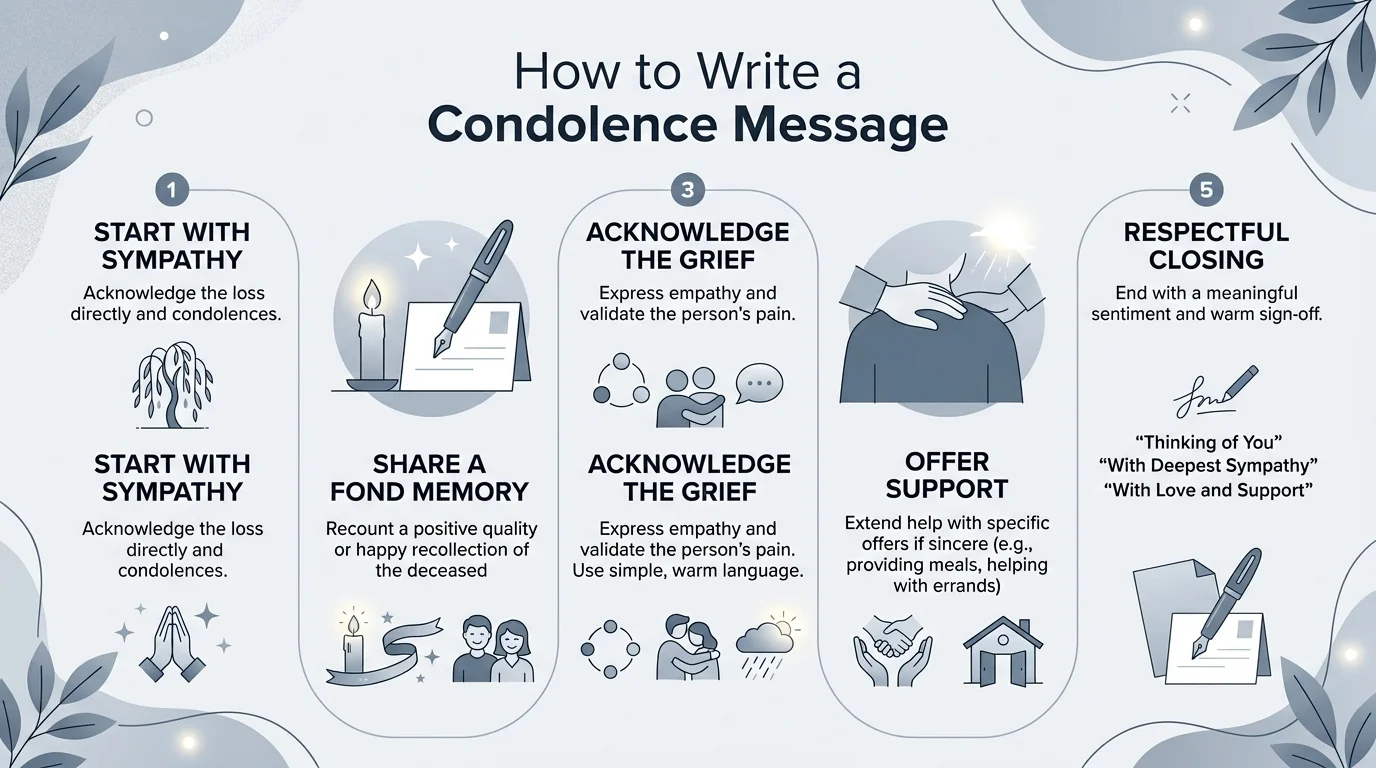
Every strong condolence message follows the same four-step structure, no matter who you're writing to. Once you see the pattern, you'll never stare at a blank card again.
Step 1: Open With a Direct, Warm Greeting
Skip the throat-clearing. Just say their name and get straight to it. Something like "Dear Maria" works better than a generic "To whom it may concern."
Step 2: Say the Hard Part Out Loud
This is where you express your words of condolence. Don't dance around the loss. Name it. "I was so sorry to hear about your dad" is warmer, and more specific, than a generic "sorry for your loss."
Grammarly's guide on condolence writing breaks this down well: your tone should shift depending on whether the death was expected or sudden. If someone battled a long illness, some families lean toward celebrating a life well-lived. Others, especially after a sudden loss, need something gentler.
Step 3: Add a Memory, If You Have One
This part is optional, but it's the piece that makes your message unforgettable. If you knew the person who passed, mention something specific — a joke they told, a habit that made everyone laugh. This turns your card from generic into personal.
If you didn't know the deceased well, skip this step. A forced memory you don't actually have will feel hollow.
Step 4: Close With Support, Not a Question
Here's a mistake I see constantly: people end with "Let me know if you need anything." Sounds kind, right? But it puts the burden back on the grieving person to ask, and most people won't.
Instead, offer something concrete: "I'll drop off dinner Thursday" or "I'm free to help with calls this week."
Text, Card, Email, or In Person: Which Format Should You Use?
The right format depends on how close you are to the grieving person and how urgently you want them to know you're thinking of them. Here's how the main formats compare, based on Etiquetteer's guidelines on condolence correspondence:
Format | Best For | Speed | Tone | Watch Out For |
|---|---|---|---|---|
Text message | Close friends, family | Immediate | Casual, warm | Can feel impersonal for distant relationships |
Handwritten card | Any relationship | Days | Formal, lasting | Slower to arrive; pair with a text first |
Coworkers, acquaintances | Immediate | Professional, brief | Can get buried in an inbox | |
In person | Very close relationships | Depends | Direct, personal | Timing matters — ask before visiting |
A good rule of thumb: send a quick text or call right away, then follow up with a handwritten card for anyone you're close to. Speed beats perfection every time.
If you're mailing a physical card, make sure it actually gets there — check out our guide on how to address an envelope so it doesn't get delayed or returned. And if you're sending your condolences over email instead, our guide on how to end an email can help you close it with the right tone.
What to Say When Someone Dies (Real Examples You Can Use)
Real examples work better than theory, so here are messages you can copy and adapt.
For a general loss: "I'm so sorry about your mom. I've been thinking of you all day. Sending you strength and comfort."
For a coworker: "I was very sorry to hear of your loss. Please accept my sincere condolences. Thinking of you and your family."
For a close friend: "I don't have the right words, and I'm not going to pretend I do. I love you, and I'm here."
For a pet loss: "I'm heartbroken for you. [Pet's name] had the best spirit, and I know how much they meant to you."
Notice how none of these try too hard? That's intentional. The best sympathy message examples sound like a real person talking, not a greeting card.
Words and Phrases You Should Avoid
A few common phrases, even said with good intentions, tend to land badly during someone's grieving process.
Avoid saying:
"Everything happens for a reason"
"They're in a better place"
"I know exactly how you feel"
"At least they're not suffering anymore"
Mayo Clinic Health System's guide on supporting grieving people points out that comfort usually comes from presence and validation, not from reasoning through the death.
Also worth knowing: many common phrases assume things you might not know, like whether there will be a burial or whether the family holds religious beliefs. That assumption matters more than people realize. The National Funeral Directors Association projected the 2025 U.S. cremation rate at 63.4%, compared with a 31.6% burial rate — which means burial-specific language ("at rest," "laid to rest") doesn't fit a growing share of families. When in doubt, skip the assumption and stick to language that works either way.
Condolence Messages for Specific Relationships
Different relationships call for different tones, so match your message to the connection.
Loss of a parent: Lean personal and warm. Reference the impact the parent had, if you know it.
Loss of a spouse: Acknowledge the depth of the bond directly. Avoid minimizing language.
Loss of a child: Keep it short and gentle. Together by St. Jude's guide on writing condolence letters recommends using the child's name if you know it, and avoiding any explanation for why it happened.
Workplace loss: Stay respectful but brief. "I'm so sorry for your loss. Thinking of you. No need to reply" works well without pressuring a response.
Sending Condolences on Social Media
Social media condolences should stay short, public-appropriate, and free of private details.
If you're commenting on a post or sharing a tribute, keep it brief: "So sorry for your loss. Thinking of you and your family." Don't share medical details, cause of death, or anything the family hasn't already made public — even if you know more.
If you want to say something more personal, send a private message instead of a public comment. It keeps the deeper conversation between just the two of you.
How to Reply to Condolences You've Received
If you're the one grieving, you don't owe anyone a long response — a short thank-you is enough.
Reply in the same format you received the message: text back if they texted, handwrite a card if they mailed one. Something as simple as "Thank you for your kindness during this difficult time" is complete on its own. If you posted publicly and received dozens of comments, one thank-you comment or status update covers everyone. There's no rule that says you have to respond individually.
FAQ: Common Questions About Condolence Messages
What do you say instead of "sorry for your loss"?
Try naming the person directly: "I'm so sorry about your dad" or "I've been thinking about [name] all day." It feels warmer and more specific.
Is it okay to text condolences?
Yes, especially for close friends and family. A quick text sent right away often means more than a perfectly worded card that arrives a week later.
How soon should you send a condolence message?
As soon as you hear the news. Waiting for the "right words" usually just delays comfort the person needs now.
Should you mention how the person died?
No, unless the family has already shared those details publicly. Stick to expressing sympathy, not asking or referencing specifics.
What if you didn't know the deceased?
Keep your message short and sincere. Focus on supporting the person grieving rather than trying to describe someone you didn't know.
Is a religious condolence message appropriate?
Only if you know the family shares that faith. When unsure, stick to secular language like "thinking of you" instead of "in God's hands."
Final Thoughts
Here's what I want you to take away from all of this: you don't need the perfect sentence. You need to send something, and it needs to sound like you.
Keep it short. Say the person's name. Offer something specific instead of a vague "let me know." And if words genuinely fail you, it's okay to say that too. Sometimes "I don't know what to say, but I'm here" is exactly the message someone needs to read.