
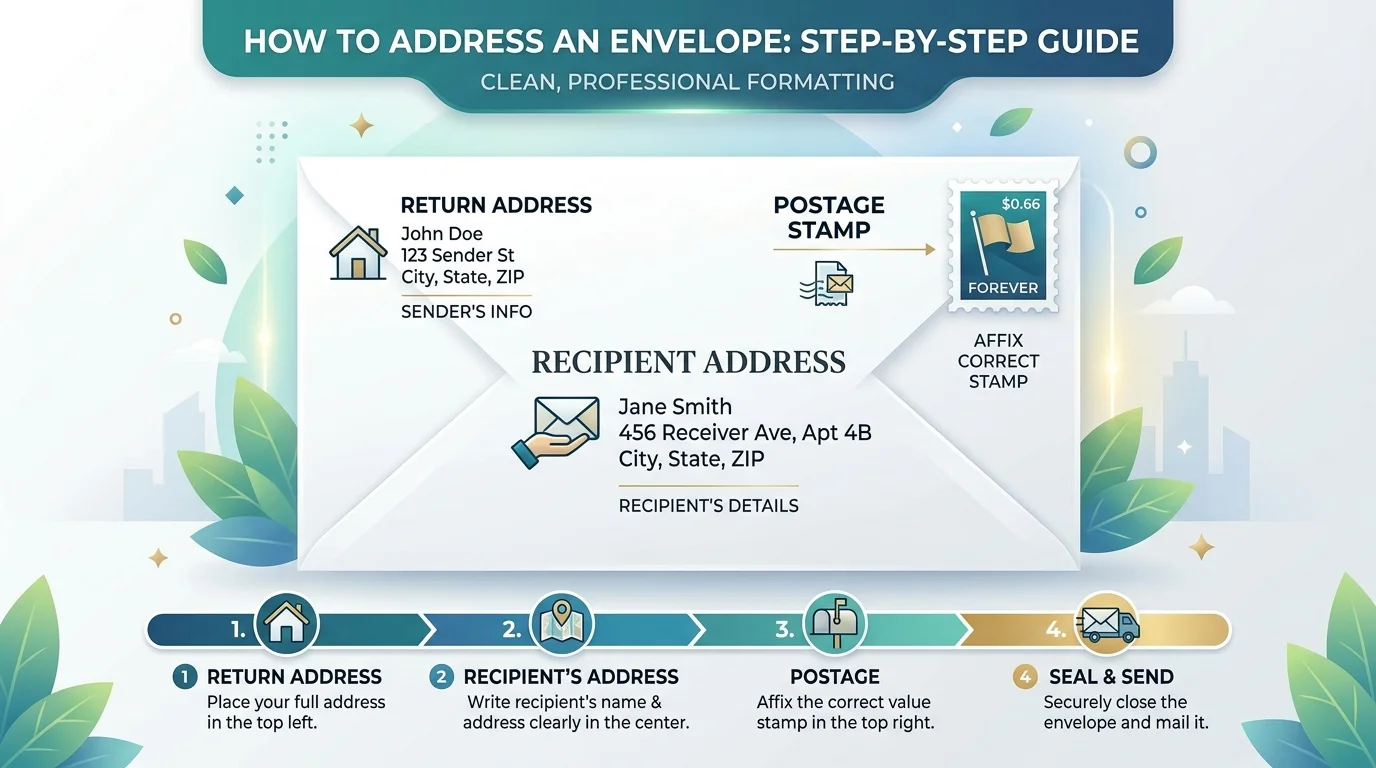
To address an envelope, write the recipient's full name, street address (or PO Box), and city/state/ZIP in the center of the envelope. Put your return address in the upper left corner, and place the stamp in the upper right. Use capital letters, skip punctuation, and keep writing off the bottom of the envelope — that strip is reserved for USPS scanning equipment.
That's the short version. But I want to walk you through why each of these rules exists, because a few small habits make the difference between a letter that arrives on time and one that gets bounced back to you.
Let's get into it.
Why Proper Envelope Addressing Actually Matters
You might be thinking, "It's just an envelope, why does the format matter so much?" Fair question.
Here's the deal: USPS doesn't sort mail by hand anymore. The service processes roughly 167 million pieces of mail every single day through automated sorting equipment that uses optical character recognition (OCR) to read your handwriting or print in a fraction of a second. If that machine can't confidently read your address, your letter gets pulled for slower manual processing — or sent back to you entirely.
So getting the envelope address format right isn't fussy perfectionism. It's the difference between your letter arriving on time and sitting in a sorting bin somewhere.
If you're sending something more formal, like a signed document, it's worth brushing up on how to end an email too — the same instinct for polished, professional formatting applies whether you're writing digitally or by hand.
Envelope Zones at a Glance
Before the steps, here's a quick reference table. Think of the front of your envelope as three zones, plus one no-go area.
Zone | What Goes There | Placement Rule |
|---|---|---|
Recipient address | Name, street/PO Box, city/state/ZIP | Centered, roughly ½ inch margin on all sides |
Return address | Your name and address | Upper left corner |
Postage | Stamp or meter imprint | Upper right corner |
Barcode clear zone | Nothing — leave empty | Bottom ⅝ inch strip, reserved for USPS sorting barcodes |
Keep this table in mind as you work through the steps below.
Step-by-Step: How to Address an Envelope
I like breaking this down into simple, ordered steps, since once you've done it a couple of times it becomes automatic.
Step 1: Write the Recipient's Full Name
Start in the center of the envelope. Include a title if it's a formal letter — think Mr., Ms., Dr., or Rev. If you're sending something professional or ceremonial, like a wedding invite, formal titles matter here.
Step 2: Add the Street Address (or PO Box)
Directly below the name goes the street address. If your recipient uses a PO Box, USPS has a specific format for that too — check their PO Box addressing rules if you're unsure.
Got an apartment or suite number? Put it on the same line as the street address whenever it fits. If it doesn't fit, place it on its own line right above the street address, not below.
Step 3: Write the City, State, and ZIP Code
This is the third and final line: city, two-letter state abbreviation, and ZIP code.
For extra delivery precision, use the full nine-digit ZIP+4 code. You can look this up for free with a ZIP code lookup tool.
Step 4: Add Your Return Address
Now flip to the upper left corner. Write your name and address the same way — name, street, then city/state/ZIP.
Why does this matter so much? If the letter can't be delivered, this is the only way it finds its way back to you instead of disappearing into the postal system.
Step 5: Place the Stamp
Top right corner. That's it.
Step 6: Follow USPS Formatting Rules
This is where most people slip up, so let's slow down here.
USPS prefers:
ALL CAPS for the recipient's address
No punctuation — skip commas and periods
Text lines parallel to the bottom edge of the envelope
Nothing written in the bottom barcode clear zone
I know, writing in all caps with zero commas feels a little unnatural. But it's genuinely what the sorting machines are built to read, according to USPS Publication 28, the official addressing standard.
Special Situations You Might Run Into
Not every envelope is a simple, standard letter. Here are the common exceptions.
Addressing Military Mail
Skip the city and state. Use APO, FPO, or DPO along with the military "state" code (AA, AE, or AP), and include the recipient's rank alongside their name.
Addressing International Mail
Sending overseas? Add a fourth line beneath the city/state/ZIP block, spelling out the destination country in full, in capital letters.
Addressing a Married Couple or Family
This trips people up constantly, especially for wedding or holiday mail:
Married couple sharing a last name: "Mr. and Mrs. [Last Name]"
Family with kids: parents first, then children by age
No apostrophe — it's "The Smiths," never "The Smith's"
Common Mistakes to Avoid
A quick rundown of the small stuff that slows mail down:
Writing the address too close to the edges — leave at least a half-inch margin so the scanner has room to work.
Mixing a street address with a PO Box — pick one, since USPS delivers to a single destination type, not both. If you're mailing a physical check instead of a letter, it's worth knowing how to void a check correctly too, since mail-related mistakes tend to cluster together when you're moving fast.
Using cursive or decorative fonts — it looks nice to you and me, but it's a nightmare for OCR software.
Forgetting the return address — if anything goes wrong, this is your safety net.
Frequently Asked Questions
Do I need a return address?
It's not legally required for most domestic mail, but skip it and there's no way for USPS to return your letter if it can't be delivered.
How do I address an envelope to a PO Box?
Replace the street address line entirely with "PO BOX" and the number. Don't include both a street address and a PO Box on the same envelope.
What's the correct way to address military mail?
Use the recipient's full name and rank, followed by the unit or PSC number, then APO, FPO, or DPO with the appropriate military state code (AA, AE, or AP) instead of a city and state.
Should I use commas when addressing an envelope?
USPS recommends omitting commas and periods, especially on the city/state/ZIP line, since punctuation can interfere with automated sorting.
Do I need the ZIP+4 code?
No — a standard five-digit ZIP works fine domestically. The ZIP+4 just adds precision and can speed up sorting.
Is a P.O. Box treated differently from a street address?
Yes. USPS delivers to one or the other, not both, so use whichever address the recipient actually gave you.
Wrapping This Up
Addressing an envelope isn't rocket science, but it does have real rules behind it — and now you know them. Center the recipient's address, tuck your return address in the top left, stamp goes top right, and keep the format clean enough for a machine to read at a glance.
Follow these steps and your mail moves through the system fast, without the delays, bounces, or "return to sender" surprises that come from a sloppy envelope.
Now go grab a pen — you've got this.