
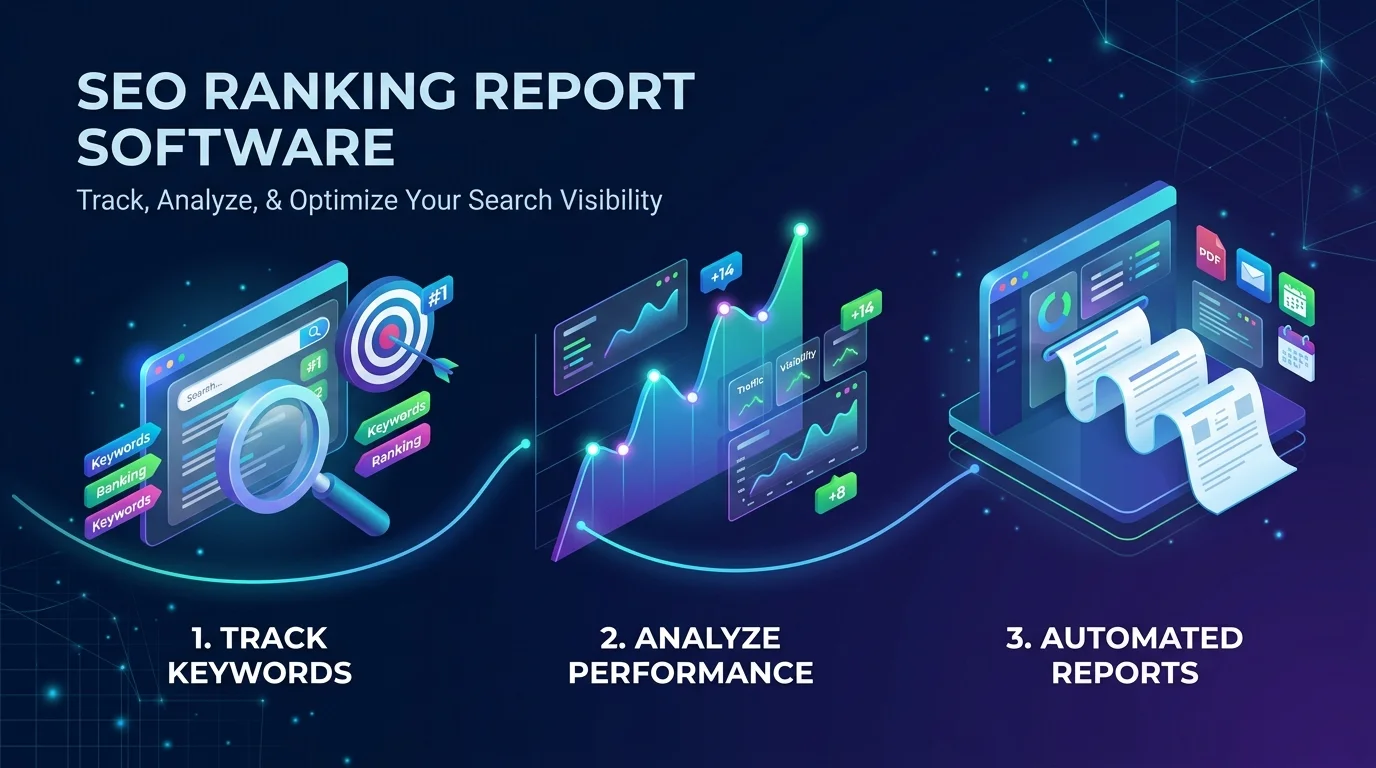
SEO ranking report software tracks where your pages rank in search and turns that data into scheduled reports. Most bloggers and small agencies start with SE Ranking, Semrush, or Moz Pro, and use Google Search Console as the free baseline. Choose based on your reporting goal, update frequency, white label reporting needs, and AI search visibility tracking.
What Is SEO Ranking Report Software?
Let's start simple. You publish a post, and you want to know whether Google is rewarding it. That's the job of this software. It checks your keyword rankings on a schedule, logs every change, and packages the results so you can act on them, or show a client.
According to Search Atlas, an SEO ranking report shows where your pages appear in search results for specific keywords.
A solid tool typically covers:
Rank tracking by device and location
SERP features like featured snippets and local packs
Competitor tracking and search visibility
Organic traffic, click through rate, and backlink data
Why Google Search Console Isn't Enough
Google Search Console is free, and I'd never tell you to skip it. Set it up today. If you're building your toolkit from zero, my roundup of free SEO tools is a good place to start.
But here's the catch. It was built to show you aggregate performance, not to watch individual rankings day by day. So you'll hit limits fast, especially if you manage more than one site.
The Average Position Trap
Google's official documentation explains how position works, and the example is eye opening. If your site appears at positions 2, 4, and 6 for one query, Google counts it as position 2, the topmost. Then it averages across queries. So one query at 2 and another at 3 gives you 2.5.
Sounds fine, right? Not quite. Averages hide movement.
As SEOcrawl points out, publishing 20 new posts that debut at positions 40 to 60 can drag your site average from 14 to 22, even though no existing page lost a single spot.
What Paid Tools Add
Now, let's talk about what you're actually paying for. Paid platforms add daily rank updates, history for every keyword, competitor benchmarking, and branded exports. You can see the exact day a page fell.
Better still, you can send a clean report to a client or boss without touching a spreadsheet. Search Engine Journal makes a smart point here: a report is a communication tool, not a data dump.
Best SEO Ranking Report Software Compared
Time for the part you came for. Below is a side by side look at the tools that keep showing up in independent roundups. I pulled the starting prices from third party comparisons rather than vendor pages, and those sources don't always agree. So treat the numbers as a ballpark, and confirm the current price before you buy.
Tool | Best for | Reported starting price | AI search tracking |
|---|---|---|---|
Google Search Console | Free baseline for Google clicks and impressions | $0 | No |
SE Ranking | Value for teams with many clients | About $65/month (Essential) | Add on or toolkit, depending on plan |
Semrush | All in one SEO and marketing reporting | About $139.95/month | Limited or beta |
Moz Pro | Smaller teams wanting simple reports | About $49/month (Starter) | Not confirmed |
Nightwatch | Local and segmented tracking | From about $39/month | Paid add on (about $99/month) |
Ahrefs | Backlinks plus rank tracking | From about $129/month | Extra cost on top |
AccuRanker | Speed and on demand refresh | Around $224/month | Not confirmed |
Quick takeaway? One Little Web rates SE Ranking as the best balance of price and AI readiness. Nextgrowth credits Nightwatch with geo grid tracking across 107,000+ locations, and says AccuRanker refreshes on demand in about two seconds.
One more thing. Many of these roundups are published by vendors with their own products to sell. So always trial before you trust.
How to Choose SEO Ranking Report Software: A Step by Step Guide
Choosing feels overwhelming because every landing page promises the moon. So here's my process. It takes about an hour, and it stops you from paying for features you'll never open.
Follow the steps in order. Don't skip ahead. I promise it's worth it.
Step 1: Define What Your Report Must Prove
Before you open a single pricing page, get clear on the goal. Are you reporting to a client, a manager, or just yourself?
A solo blogger needs simple keyword position tracking. An agency needs client dashboards. A local shop needs local rank tracking.
Write the answer on a sticky note. Then pick three to five metrics tied to it, and skip the vanity numbers.
Step 2: Score Your Shortlist
Next, narrow it to two or three tools. Don't compare everything, because you'll drown. Compare what actually moves the needle.
My Four Point Report Test
I use this simple scorecard. It's my own rubric, not an industry standard, so adjust the weights to fit you.
Accuracy and update frequency (30 points): daily updates, device and location options
Reporting (30 points): scheduled exports, white label reports, Search Console and GA4 integrations
AI search visibility (20 points): AI Overviews and citation tracking
Price and limits (20 points): keyword caps, add on fees, annual vs monthly billing
Score each tool out of 100. Then compare the totals.
Step 3: Set Up and Automate Your Reports
You've picked a winner. Now let's make it work for you.
Add your domain and connect Google Search Console.
Import your target keywords and group them by topic.
Add three to five competitors.
Schedule a weekly SEO report to your inbox.
Turn on alerts for big ranking drops.
Done. Reporting Ninja notes that the three essentials are branding control, automated delivery, and integrations. If a tool can't do those, move on.
Don't Ignore AI Search Visibility
Here's where things get interesting. Search isn't just ten blue links anymore, and a classic rank tracker can't see inside an AI answer.
Rankability reports that more SEO teams now track visibility in AI answers, local packs, and tools like ChatGPT and Gemini.
So what should you measure? Mainly citations, brand mentions, and share of voice.
A GEO Toolbox guide argues that "AI rank" isn't a real fixed position. It recommends trending share of voice across many runs, because single checks flicker. I agree with that.
Also, check whether AI tracking is bundled or sold separately. Some tools charge hundreds per month on top, as AIclicks shows.
Why You Should Buy SEO Ranking Report Software Now
Let me make this painfully simple. Every week you wait, you're guessing. You don't know which posts are climbing, which are dying, or which competitor just passed you. If you're running a young site on a tight budget, these startup tools can help you prioritize what to buy first.
Meanwhile, the cost is small. Several tools start around $50 to $65 a month, and the big suites cost more. You'll spend far more on content that quietly stops ranking.
Here's what you get back:
Hours of reporting time. One roundup claims the fastest tools generate a report in about a minute, versus 15 to 20 minutes for slower ones, as cited by Agency Platform.
Faster fixes when rankings dip
Client trust from branded, automated reports. BrightLocal shows how white label delivery works for agencies
Proof that your SEO work pays off
So here's my advice. Start two free trials today, run them side by side for a week, and keep the one that makes your Monday easier. You've got the checklist. Now go use it.
Frequently Asked Questions
Still have questions? Good. Below are the ones I hear most, answered in plain English. Skim them, grab what you need, and then go start your trial. Each answer is short on purpose, so you can act on it right away.
What is the best free SEO ranking software?
Google Search Console is the best free option for real Google performance data. It reports clicks, impressions, and average position. For daily tracking of each keyword and competitor comparisons, though, you'll need a paid tool. Some, like Moz Pro and Ubersuggest, offer limited free tiers, per AEO Vision.
How often should you check your rankings?
Check weekly for reporting, and let alerts watch for sudden drops in between. Daily tracking is now standard in most paid tools. Don't obsess over daily wiggles, though. Trends over weeks tell you far more than one bad Tuesday.
Is average position the same as my real ranking?
No. Google Search Console's average position is an impression weighted average across many searches, and personalization and location shift it, as Seer Interactive explains. Your live rank for one keyword can differ. That's exactly why dedicated rank trackers exist.
What should an SEO ranking report include?
Include keyword positions, organic traffic, click through rate, competitor movement, and one clear next step. Keyword.com lists keyword rankings and competitor rankings among the core metrics. Keep it short. Busy readers skim, so lead with the headline result.
Do I need AI search tracking?
If AI answers appear for your target queries, yes, at least a basic version. Track citations, mentions, and share of voice across a fixed keyword set. If your budget is tight, start with classic rank tracking and add AI tracking once your core reporting runs smoothly.