

Growth navigate startup tools are software platforms that help you research markets, track leads, understand users and automate busywork. A solid starter stack is a free CRM, a product analytics tool and one workflow automation app. You can build all three for $0 today and upgrade only when revenue justifies it.
What Are Growth Navigate Startup Tools?
Picture a compass for your startup growth. It doesn't drive the car, but it tells you where to point it. Techjockey's 2026 guide describes them as business management software that helps founders manage and scale growth.
One quick note so you don't get confused. This has nothing to do with the Vienna Business Agency's Growth Navigator, which is a coaching program. We're talking software here.
Who Actually Uses Them?
Founders, first sales hires, marketers and RevOps folks. If you're running your pipeline from spreadsheets, that's you. Cleverly's analysis says sales teams juggle 10+ point solutions for a single outbound motion. That's rough for a tiny team.
Why Your Startup Needs a Growth Stack
Here's the sobering part. CB Insights studied 101 startup postmortems. It's an older study, but it's still the most widely cited one on the topic. Founders cited more than one reason each, so the numbers add up to more than 100%.
No market need: 42%
Ran out of cash: 29%
Not the right team: 23%
Outcompeted: 19%
Pricing or cost issues: 18%
Notice something? Most of these are information problems. Good tools give you data driven decisions instead of guesses, and guesses get expensive fast.
Cash is the other half of the story. Before you buy anything, map your runway with a simple bootstrapped startup financial model. Then you'll know exactly how much software you can afford.
Growth Navigate Tools Compared (2026)
Before the steps, here's the cheat sheet. I picked these tools because each has a free tier or a low entry price, and each solves one clear problem. Prices change often, so confirm them on each vendor's site before you buy.
Tool | Best for | Free plan | Starting paid price |
|---|---|---|---|
Investor and market research | Yes | $49/mo (annual) | |
Attio | Flexible CRM | Yes (3 seats) | $35/user/mo (annual) |
HubSpot CRM | Complete CRM suite | Yes | Paid tiers vary |
PostHog | Product analytics | Yes (1M events) | Usage based |
Amplitude | Behavioral analytics | Yes (2M events) | Custom |
Zapier | Workflow automation | Yes | $19.99/mo |
Notion | Team knowledge hub | Yes | $10/member/mo |
Closely | LinkedIn and email outreach | No | $49/mo |
How to Build Your Stack, Step by Step
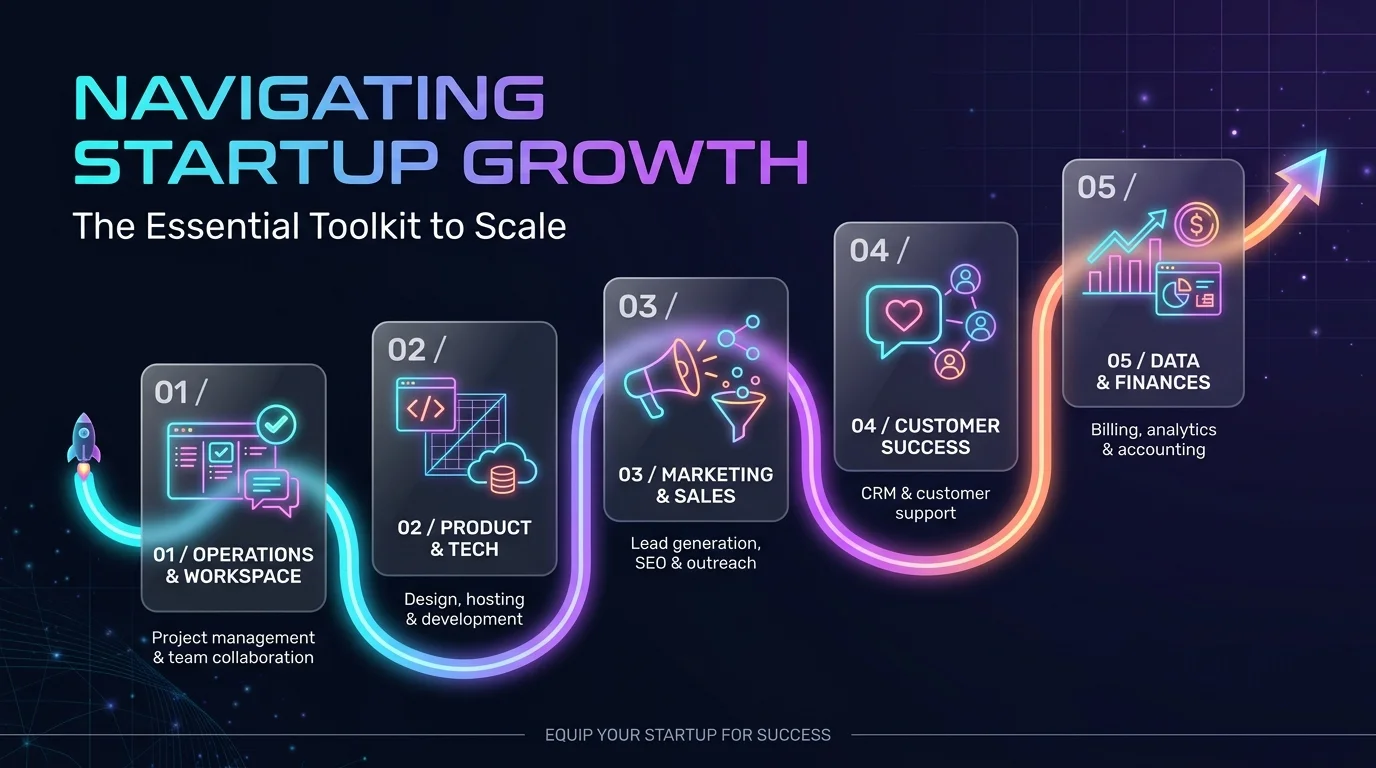
Don't buy everything at once. That's the biggest mistake I see. Instead, work through these five steps in order. Each one fixes a specific problem, and each starts free or cheap.
Step 1: Research Your Market and Investors
Start with intelligence, because you can't aim at a target you can't see. Crunchbase tracks funding rounds, acquisitions and competitors, so you know who's active in your niche.
Use it to:
Spot investors who back companies like yours
Run quick competitor analysis checks
Time outreach around funding news
Skip Dealroom.co for now. It starts around €12,000 a year.
Step 2: Organize Leads in a Modern CRM
Next, stop losing leads. Attio offers real time contact syncing and automatic data enrichment. Its free plan covers up to 3 seats, and you get a 14 day Pro trial. Eligible teams can also get up to 80% off.
Prefer something familiar? HubSpot CRM has a free tier too. Pick one, import your contacts and finish by Friday.
Step 3: Track What Users Actually Do
Now the fun part. Product analytics shows where users click, stay or quit. PostHog bundles analytics, session replay and feature flags into one tool. Amplitude goes deeper on behavioral cohorts.
My rule of thumb:
Led by engineers? Choose PostHog.
Led by marketers? Choose Amplitude.
Step 4: Automate the Boring Stuff
Time for workflow automation. Zapier connects thousands of apps without code. Build a workflow once and it runs forever.
Then centralize everything in Notion for wikis and knowledge management. Here's a tip: write down each repeatable process using a standard operating procedure template before you automate it. Why bother? Because every hour you save is an hour you can spend talking to customers.
Step 5: Scale Your Outreach
Finally, go get customers. Closely automates LinkedIn outreach and email, with messages personalized by AI, from $49 a month. One warning, though. Automation with weak messaging just spams people faster, so write like a human.
Mistakes That Quietly Wreck Your Stack
I've made most of these myself.
Buying for the startup you'll be in two years. Enterprise features just gather dust.
Skipping free trials. Annual lock in on an untested tool wastes budget.
Ignoring integrations. If your CRM and email don't sync, you're copying data by hand.
Trusting automation over strategy. A tool can hand you 500 target accounts and still book zero meetings.
Frequently Asked Questions
What are growth navigate startup tools?
They're software platforms that help startups research markets, manage leads, analyze user behavior and automate repetitive work. Think CRM, product analytics and workflow automation working together.
What is the best free growth tool for a startup?
Start with a free CRM like Attio or HubSpot. It organizes leads immediately and costs nothing.
How much does a startup growth stack cost?
You can start at $0 using free tiers. A paid starter stack of Crunchbase Pro, Attio Plus and Closely runs roughly $130 a month for one user, based on current published prices.
Do I need product analytics before launch?
Not really. Add it once real users arrive, then use it to watch retention and drop off.
How many tools should I use at first?
Two or three. Pair one CRM with one analytics tool, then add automation as you grow.
Start Building Your Stack Today
Look, your competitors are already using these tools. They find investors faster, close leads sooner and ship smarter.
The good news is you can start for nearly nothing. A free CRM, a free analytics plan and a free automation tier cost $0 today. That's a complete growth stack without touching your runway.
So here's my advice. Pick one CRM from Step 2 and one analytics tool from Step 3. Set them up this week.
Sign up for both free plans right now, and run them for 14 days. You'll thank yourself by the end of the month.