


Short-term goals turn a distant, vague long-term career goal into a series of small, weekly actions you can actually complete. Research on goal-setting theory shows that specific, time-bound goals combined with regular feedback consistently outperform vague ambitions like "grow in my career." That combination — small steps plus a clear destination — is how real career progress happens in 2026, not through one dramatic leap.
I used to roll my eyes at "goal setting" advice. It sounded like fluff. Vision boards. Sticky notes on a mirror.
Then I looked into the actual research behind it.
It turns out the connection between short-term goals and long-term career goals is one of the most well-documented ideas in organizational psychology. So let's break down how it works — not the Pinterest version, the real one.
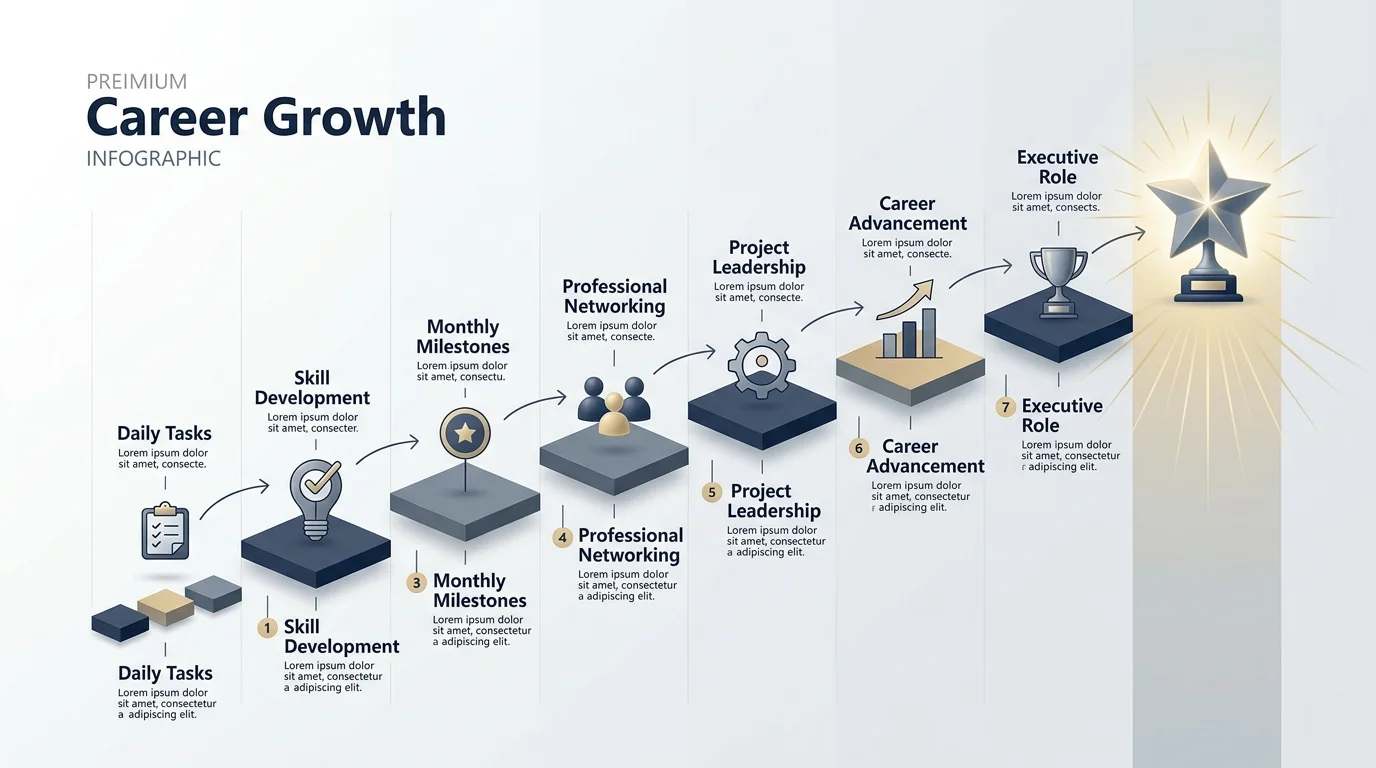
Why Your Big Career Goal Feels So Far Away
Long-term goals are huge. They're vague by nature. They live three to five years in the future, and your brain doesn't quite know what to do with something that far off.
You want to be a Creative Director. Or a VP of Sales. Or run your own agency. Great. Now what do you actually do on Tuesday?
That gap is exactly what career development goals exist to fill. A long-term goal gives you direction, sure, but direction alone doesn't move your feet. You need something closer. Something you can touch this week. It also helps to genuinely begin with the end in mind, so every short-term step you take is actually pointed at the right destination.
What the Research Actually Says
I won't turn this into a psychology lecture, but you should know this much: goal-setting theory, developed by Locke and Latham, found that specific, challenging goals combined with feedback consistently beat vague ones like "just do your best." That finding has held up across decades of studies.
Here's the stat that stuck with me most:
42% higher goal achievement — people who write down specific, structured goals are 42% more likely to achieve them, according to Dr. Gail Matthews' research at Dominican University.
If you've been keeping your career goals in your head instead of on paper, that's your first fix. Do it today.
Short-Term Goals Are the Bricks. Long-Term Goals Are the House.
You can't build a house by staring at a blueprint. You lay one brick, then another.
Short-term career goals work the same way. They're time-bound, action-oriented, and small enough that you actually finish them. According to Bryant & Stratton College, short-term goals typically run three months to a year, while long-term goals stretch three to five years or more.
Without short-term goals in between, your five-year vision just floats there, untouched.
The Momentum Effect
Finishing a small goal creates a real psychological lift. This is called career momentum, and it's a documented pattern in how short-term and long-term goals interact — not just motivational-poster talk.
Every checkbox you tick gives you a small hit of confidence. That confidence carries into the next task, and the next. Compare that to waiting around for one giant leap toward your dream job — a leap that, statistically, almost never comes. Strong self-management habits are what actually keep that momentum going day to day, so it's worth understanding what self-management really means before you set your next goal.
Key Stats at a Glance
Stat | What It Means for You | Source |
|---|---|---|
42% higher goal achievement | Writing down goals beats keeping them in your head | Dominican University (Dr. Gail Matthews) |
76% of employees get no career conversation | Your manager likely won't build this roadmap for you | 2025 Gallup State of Work Poll |
3 months–1 year | Typical timeframe for a short-term career goal | Bryant & Stratton College |
3–5+ years | Typical timeframe for a long-term career goal | Bryant & Stratton College |
A Step-by-Step Guide to Connecting the Two
Step 1: Write your long-term goal down. Specifically. Not "I want to grow in my career." Try: "I want to become a Senior Product Manager within four years."
Step 2: Break it into 90-day chunks. What has to be true 90 days from now for you to be on track? Maybe it's a certification. Maybe it's leading your first small project.
Step 3: Turn each chunk into a SMART goal. Specific, Measurable, Achievable, Relevant, Time-bound. This isn't trendy for no reason — it's the practical application of goal-setting theory.
Step 4: Get feedback often. Don't wait for your annual review. Ask your manager, a mentor, or a peer.
Step 5: Reassess every quarter. Careers shift. Your short-term goals should shift with them.
Don't Skip the Mentoring Piece
Peer-reviewed research from the APA shows that mentoring relationships strengthen your professional identity — and that identity shapes how effectively you pursue both short-term and long-term goals.
Translation: find a mentor. It's one of the highest-leverage professional development goals you can set, and it pays off for years.
The Part Nobody Wants to Admit
The 2025 Gallup State of Work Poll found that 76% of people never get a career conversation or a career plan from their manager.
Read that again. Most people are on their own here. Which means you have to build the bridge between short-term and long-term goals yourself — and honestly, that's freeing. You don't need permission to set a 90-day goal today.
Frequently Asked Questions
How many short-term goals should I have at once?
Most career coaches recommend 2–3 active short-term goals at a time. More than that, and focus tends to break down.
What's a good example of a short-term career goal in 2026?
Completing a certification this quarter, leading a small cross-functional project, or scheduling monthly check-ins with a mentor are all realistic 90-day goals.
How do I know if my short-term goal actually supports my long-term goal?
Ask whether completing it moves you measurably closer to the skills, experience, or visibility your long-term goal requires. If it doesn't, it's busywork, not progress.
What if my long-term career goal changes?
That's normal. Reassess your short-term goals every quarter and adjust — the goal is progress, not rigid adherence to a plan made a year ago.
Do I need a mentor to make this work?
No, but research shows mentoring strengthens your professional identity and goal follow-through, so it's one of the highest-leverage steps you can take.
Bringing It All Together
Your long-term career goals are your compass. Your short-term goals are your footsteps.
Skip the short-term goals, and your long-term vision stays a daydream. Skip the long-term vision, and your short-term goals become busywork with no destination. You need both, constantly feeding into each other.
Pick one short-term goal this week that clearly ladders up to where you want to be in five years. Write it down. Set a deadline. Ask someone to hold you accountable.
That's genuinely how the big career changes happen — one brick at a time.