

"Begin with the end in mind" is Habit 2 from Stephen Covey's The 7 Habits of Highly Effective People (1989). It means picturing your desired outcome clearly before you take action, so every step you take actually moves you toward the life or result you want — instead of just staying busy.
I'll be honest with you — most people wander through life without ever asking themselves where they're actually headed.
They wake up, grind through the day, check off a to-do list, and repeat. Sound familiar?
Here's the thing: Covey called this the "activity trap" — and it's the reason so many hardworking, talented people feel stuck even when they're doing everything right.
In this article, I'm going to walk you through this habit and show you exactly how to apply it, step by step. Along the way, I'll also touch on how this connects to your everyday decision-making process and to broader self-management skills — because clarity of vision feeds directly into both.
Let's dive in.
What Does "Begin With the End in Mind" Actually Mean?
Okay, so let's break this down simply, because the definition matters more than the buzzword.
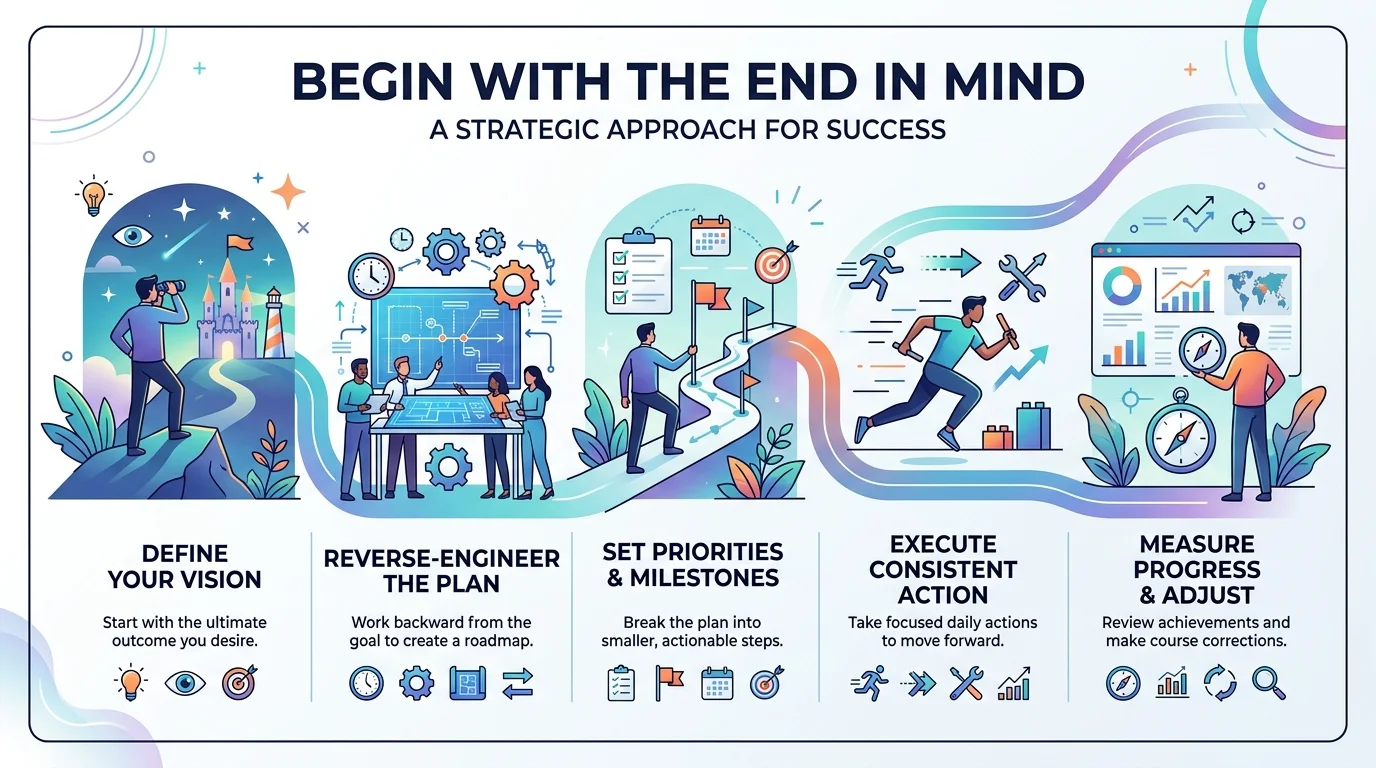
To begin with the end in mind means you picture your destination before you take a single step toward it. You're not reacting. You're not drifting. You're designing.
Think about it like this: would you ever build a house without a blueprint? Of course not. You'd end up with walls that don't connect and a roof that doesn't fit.
Your life works the same way.
According to FranklinCovey, this habit means to "look out across the coming hours, days, weeks, months, and years with a clear vision of your desired destination — and then to proactively pursue that future."
I love that phrase. Proactively pursue. Not passively hope.
The "Two Creations" Principle
Here's where it gets interesting.
Covey believed everything in life is created twice.
First, there's the mental creation — the idea, the vision, the plan in your head.
Then there's the physical creation — the actual thing you build, write, launch, or become.
Most people skip step one. They jump straight into "doing" without ever clarifying what they're doing it for. And that's exactly why so many hardworking people end up — in Covey's words — pushing a rope with all their might.
You don't want to be that person. I know you don't.
Begin With the End in Mind vs. Traditional Goal-Setting
People often confuse this habit with plain goal-setting. They're related, but not the same thing. Here's a quick side-by-side so you can see the difference clearly:
Aspect | Traditional Goal-Setting | Begin With the End in Mind |
|---|---|---|
Starting point | A specific target (e.g., "hit $10K/month") | A personal mission statement and core values |
Timeframe | Usually short-to-medium term | Life-long vision, then broken into goals |
Focus | Outcomes and metrics | Identity, purpose, and legacy first |
Tools used | KPIs, deadlines, SMART goals | Mission statement, values audit, visualization |
Risk if skipped | Missing the target | "Wrong jungle" — achieving goals that don't matter to you |
In short: goal-setting answers "what do I want to hit?" Begin with the end in mind answers "who do I want to become, and why?" — then goal-setting becomes the execution layer underneath it. This is also where good self-management habits kick in, since sticking to that vision day-to-day takes discipline.
Why Most People Never Get Clarity (And Why It's Costing Them)
Let's get real for a second.
You've probably worked incredibly hard on something — a project, a career move, a relationship — only to realize halfway through that you were climbing the wrong ladder entirely.
Covey nailed this exact feeling when he wrote that people are "working harder than ever, but because they lack clarity and vision, they aren't getting very far."
Ouch. But true.
The problem isn't effort. You've got plenty of that. The problem is direction. And without direction, effort just becomes wasted motion.
A Quick Real-World Example
Picture a mid-level manager — let's call her Sara — who spends a full year chasing a promotion. She hits every metric, works late, says yes to everything.
She gets the promotion. And then she realizes the new role pulls her away from mentoring people, which was the actual part of work she loved.
That's a "wrong jungle" moment. She climbed fast — just up the wrong wall. A clear personal mission statement, written before she chased the promotion, would have flagged this mismatch early. Notice, too, that this mismatch traces back to the very first step in her decision-making process — she skipped defining the actual goal before evaluating the opportunity.
The Funeral Exercise: Covey's Most Powerful (and Uncomfortable) Tool
Now here's where things get a little intense — but stick with me, because this exercise is genuinely useful.
Covey asks you to imagine your own funeral.
Yep, really.
He wants you to picture the room, the people, the eulogy being read about you. Why? Because, as explained by Art of Manliness, this thought experiment "distills what you ultimately value in life — or at least what you want to value — and what you hope it all adds up to in the end."
It's uncomfortable. It's supposed to be.
Ask yourself right now:
What would you want your friends to say about you?
What would you want your family to remember?
What would you want your legacy to actually be?
That, right there, is your end in mind.
How to Build Your Personal Mission Statement (Step-by-Step)
Alright, let's get practical.
Step 1: Reflect on Your Core Values
Grab a notebook. Seriously, do this.
Ask yourself:
What do I want to accomplish, personally and professionally?
What core values matter most to me?
How do I want to be remembered?
According to Toggl, this reflection is the foundation of a strong personal mission statement.
Step 2: Visualize Your Ideal Future
Close your eyes. Picture your life five, ten, twenty years from now. Where are you living? Who's around you? What are you doing each morning?
ClickUp describes this as visualizing "the life you want to lead" — one of the most clarifying exercises you can do.
Step 3: Write Your Mission Statement
Now put it into words. Think of it as your personal constitution — a short, powerful declaration of who you are and what you stand for. It "reaffirms who you are, puts your goals in focus, and moves your ideas into the real world," as FranklinCovey puts it.
Step 4: Turn Vision Into SMART Goals
A vague goal like "be more successful" won't get you anywhere.
Instead, make it specific, measurable, achievable, relevant, and time-bound — the classic SMART goals framework.
For example, instead of "improve productivity," try: "Increase team output by 15% over six months through weekly check-ins."
See the difference? One's a wish. The other's a plan.
Applying This Habit at Work (Not Just in Life)
This habit isn't just for personal growth — it's a leadership skill too.
Asana points out that teams can apply this by defining shared goals before diving into work, then breaking those goals into clear, trackable action items.
Imagine walking into a project with your entire team already aligned on what "done" looks like. No confusion. No wasted meetings. No scope creep. That's the power of starting with the end.
How This Habit Connects to Covey's Other Habits
It doesn't work alone.
It connects with Seek First to Understand, which is about genuine communication. It ties into Synergize, where combining diverse perspectives creates stronger outcomes. And it's sustained by Sharpen the Saw — the ongoing self-renewal that keeps you energized enough to chase your vision.
In other words, this isn't a one-time exercise. It's a mindset you carry into everything else, and it works hand-in-hand with strong self-management practices day to day.
Frequently Asked Questions
Is "begin with the end in mind" the same as goal-setting?
No. Goal-setting is the execution layer. Begin with the end in mind comes first — it's about clarifying your values and identity, then letting goals flow from that vision (see the comparison table above).
What's a simple example of this habit in daily life? Before starting a work project, write down in one sentence what "success" looks like when it's finished. Before a difficult conversation, decide what outcome you actually want. Both are small, everyday versions of this habit.
Do I need to write a full personal mission statement to benefit from this habit? No — even a rough one-paragraph draft of your values and priorities gives you more clarity than none at all. You can refine it over time.
Is this habit still relevant today? Yes. Though Covey's book was published in 1989, current organizations like Asana, ClickUp, and Tempo continue publishing guidance on this exact habit as recently as 2025–2026, and goal-setting research (Locke & Latham, American Psychologist, 2002) continues to support the underlying psychology.
What's the biggest mistake people make with this habit? Skipping the mental creation step entirely — jumping into action without ever defining what "the end" actually looks like, then wondering why hard work isn't paying off.
Final Thoughts: Your Vision Is Waiting
Sitting down to define your life's purpose feels big. Maybe even a little scary.
But research on goal-setting from Locke and Latham (2002) confirms that people with a clearly articulated vision experience greater motivation and stronger performance over time.
So don't wait for clarity to find you. Go find it yourself.
Grab a notebook today. Ask yourself the hard questions. Write your mission statement. And then, step by step, start building the life you actually want — not the one that just happens to you.