
Self-management is your ability to regulate your thoughts, emotions, and behaviour on purpose so your actions match your goals even when nobody is supervising you. It sits on top of self-awareness and includes emotional regulation, goal setting, time management, and self-monitoring. Research across psychology, education, and healthcare confirms it's a learnable skill, not a fixed personality trait.
Let me be blunt with you.
I spent years believing I had a productivity problem. Turns out I had a self-management problem. Completely different animal.
Once I understood the difference, everything changed — my mornings, my deadlines, my temper on bad days. So in this guide I'll break down what self-management actually is, where the concept came from, and the exact 6-step system I use now.
No fluff. Let's go.
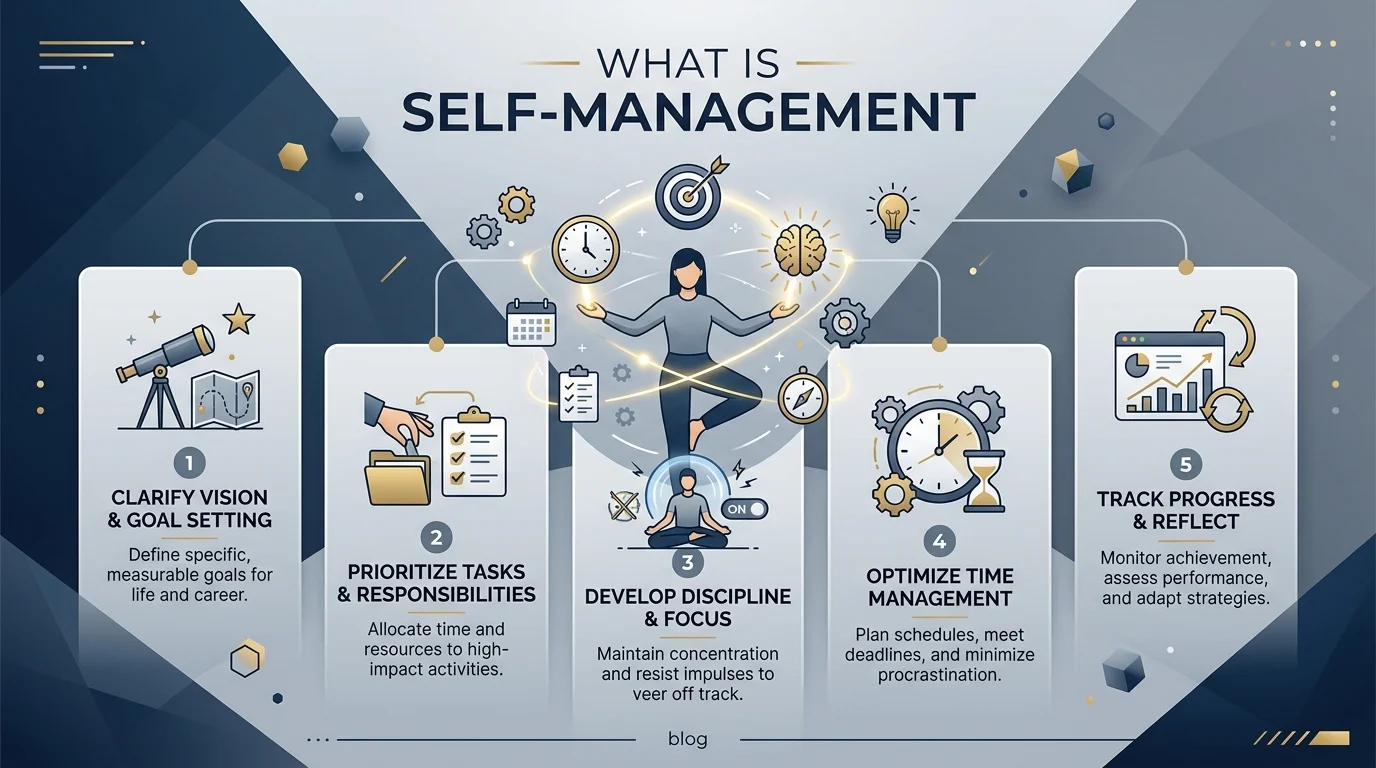
What Is Self-Management, Really?
Here's what nobody tells you: self-management isn't one skill. It's a stack of skills sitting on top of each other, and most people only ever learn the top layer. Merriam-Webster keeps it simple — management by oneself, of oneself, and of one's own affairs. Cambridge Dictionary adds a useful nuance: the ability to control and organize your work, health, or behaviour. Notice that second verb. Organizing. That's the part everyone skips.
So the fuller definition looks like this:
Self-management is your ability to regulate your thoughts, emotions, and actions — deliberately, and over time — so your behaviour lines up with your goals, even when nobody's watching.
That last clause is everything.
Where The Idea Actually Comes From
I assumed this was a LinkedIn buzzword. It isn't. The concept has independent roots in four separate disciplines, and each contributes something the others miss. When psychologists, teachers, physicians, and management theorists all converge on the same idea, you're looking at something real — not a trend.
Here's how each field frames it:
Field | How it defines self-management | Key framework | Primary source |
|---|---|---|---|
Psychology | Regulating emotion and impulse; a branch of emotional intelligence | Self-awareness → self-regulation → self-efficacy | Bandura, social cognitive theory |
Education | One of five teachable social-emotional competencies | The CASEL 5 | CASEL SEL Framework |
Learning science | Cyclical control of your own learning process | Zimmerman's three phases | Zimmerman & Moylan |
Healthcare | Daily management of a chronic condition and its emotional load | Three tasks, six skills | Lorig & Holman, 2003 |
Business | Being your own CEO in a knowledge economy | Managing Oneself | Peter Drucker, HBR |
Psychology: It Starts With Self-Awareness
Self-management descends directly from emotional intelligence theory, where it's usually called self-regulation. And here's the hierarchy that reframed everything for me: you cannot regulate what you cannot see. Self-awareness comes first — it gives you conscious access to your thoughts, urges, and feelings. Only then can you manage them. It's the same reason sharpening how you think through problems pays off before you try to fix your habits. So if you've been white-knuckling your way toward better routines without examining the pattern underneath? That's exactly why it keeps failing.
Education: The CASEL Framework
Schools have taught this for decades. CASEL — the body behind modern social and emotional learning — names self-management as one of five core competencies, alongside self-awareness, social awareness, relationship skills, and responsible decision-making. It also runs on Zimmerman's cyclical model of self-regulated learning: forethought, performance, self-reflection. Plan. Do. Review. Repeat. I stole that loop shamelessly.
Healthcare: The Most Rigorous Research You've Never Read
This surprised me most. The best framework for self-management didn't come from business — it came from chronic illness research. Lorig and Holman's 2003 paper remains the field's most-cited definition, and it's far more precise than anything in the productivity aisle:
The 3 tasks | The 6 skills |
|---|---|
Medical management | Problem solving |
Role management | Decision making |
Emotional management | Resource utilization |
Building a provider partnership | |
Action planning | |
Self-tailoring |
Their identified mechanism? Self-efficacy — the belief your actions actually matter. That's the engine underneath the whole machine.
Business: Drucker Called It In 1999
Drucker's argument was that knowledge workers outlive their organisations. So you must be your own CEO. Nobody's coming to plan your career. In a remote and hybrid world this landed harder than ever — workplace autonomy only works if the person holding it can genuinely self-direct. That's true individually and structurally, which is why how you organise a project or team matters as much as personal discipline. Otherwise it's just unsupervised drift.
Self-Management vs. Self-Discipline (Stop Confusing These)
This distinction is worth the price of admission, and I lost roughly four years to it. Self-discipline is willpower — forcing yourself to do the thing you don't want to do. It's finite, it depletes, and it abandons you precisely when you're tired. Self-management is broader. It contains discipline but adds planning, emotional regulation, and long-term goal setting.
The difference in one image: discipline is dragging yourself to the gym at 6am. Self-management is packing the bag the night before, so the decision never has to happen.
One relies on force. The other relies on design.
Guess which survives a bad week.
The 6-Step Self-Management System I Use
Theory's useful, but you came for something you can run tomorrow. This loop combines Zimmerman's three phases with the clinical self-monitoring research. Work through it in order — don't jump to step four because it sounds fun. The sequence matters more than any individual step, and skipping the boring front end is precisely why most self-management strategies collapse by week three.
Step 1: Audit before you optimise
For seven days, just record. Where the time goes, when energy dips, what triggers the spiral. No judgement, no fixing. This is self-monitoring — the foundation of nearly every evidence-based intervention in the literature.
Step 2: Pick one keystone goal
One. Specific and time-bound. "Get organised" isn't a goal, it's a mood.
Step 3: Build the action plan, not the intention
Intentions are wishes. Action plans specify when, where, and for how long. Write it down. If the behaviour repeats weekly, turn it into a documented routine — a simple standard operating procedure removes the decision entirely.
Step 4: Design your environment
Remove friction from good behaviour, add friction to bad. Your time management improves dramatically once your setup does half the work for you.
Step 5: Self-evaluate weekly
Compare what happened against your standard. Fifteen minutes, same slot every week. This is where accountability stops being abstract.
Step 6: Reinforce and self-tailor
Reward progress, then adjust the system to fit you — not the version of you in a productivity book.
Why This Skill Is About To Matter Even More
The ground is shifting under all of us, and the data isn't subtle. The World Economic Forum's Future of Jobs Report 2025 found employers expect 39% of core job skills to change by 2030, with roughly 170 million new roles created this decade. Resilience, flexibility, agility, motivation and self-awareness all rank among the capabilities rising fastest — and seven in ten companies now call analytical thinking essential. As AI absorbs routine execution, what's left is judgement, adaptability, and self-direction.
The good news? It's trainable. A Campbell systematic review synthesised 75 single-case studies plus 4 group-design studies and found self-management interventions genuinely work. A separate review of 31 classroom studies classified them as an evidence-based practice.
This isn't personality. It's practice.
Frequently Asked Questions
Why is self-management important?
Because it's the skill that makes every other skill usable. Without it, knowledge stays theoretical and goals stay aspirational. WEF data ranks self-directed capabilities among the fastest-growing workplace requirements through 2030.
Is self-management a soft skill?
Technically yes, though the label undersells it. It's measurable, teachable, and backed by decades of controlled research — which is more than most "hard" skills can claim.
Can self-management be learned?
Yes. Systematic reviews covering 79+ studies confirm structured interventions produce measurable behaviour change across ages and settings.
What's the difference between self-management and self-regulation?
They largely overlap. Self-regulation is the psychological term for controlling internal states; self-management is the broader applied version, adding planning, resources, and environment design.
What are examples of self-management at work?
Hitting deadlines without reminders, staying composed in a hostile meeting, protecting deep-work blocks, asking for feedback before it's offered, and adjusting your approach after a failure instead of repeating it.
The Easiest Way To Actually Run Steps 1 and 5
Here's the part where most people quit. Step 1 asks you to record seven days of behaviour, and Step 5 asks you to review it every single week — and typing all that out is exactly the friction that kills the habit before it forms.
So don't type it. Speak it.
Record a two-minute voice note at the end of each day, then run it through AudioToTextify's free audio-to-text converter to turn it into a searchable written log in seconds. No signup, no software, no transcription fee. By Sunday you've got a complete week of self-monitoring data sitting in plain text — patterns visible, triggers obvious, ready to review.
That's the whole trick. Lower the cost of the habit until skipping it takes more effort than doing it.
Start your 7-day audit today. Build the system once. Use it for the rest of your life.
Your future self is already waiting.
Read more: Welcome to the Team Message: 30+ Examples & Templates (2026)