
improve Critical thinking skills through five specific habits: questioning your sources, spotting logical fallacies, practicing active listening, reflecting weekly on your own decisions, and seeking out people who disagree with you.
A Stanford and University of British Columbia study found that students trained this way were 12 times more likely to improve their own reasoning, and 70% of employers now rank critical thinking as an essential hire-worthy skill.
This guide breaks the full method down, step by step, with the research behind each part.
Let's get into it.
What Critical Thinking Actually Means
You've probably heard the term critical thinking a thousand times. But what does it actually mean?
According to the Foundation for Critical Thinking, critical thinking is "the art of analyzing and evaluating thinking with a view to improving it."
Read that again.
It's not about being smart. It's not about winning arguments.
It's about self-directed reasoning — catching your own blind spots before they cost you.
The most respected model here is the Paul-Elder Framework, built around eight elements of reasoning, nine intellectual standards, and eight intellectual traits.
Sounds academic, I know. But stick with me — it gets practical fast.
If you're also working on the broader decision-making process, this pairs naturally with that guide, since sharp reasoning is the foundation every good decision is built on.
Weak-Sense vs. Strong-Sense Thinking
Here's the part that changed how I look at this topic entirely.
The Paul-Elder model splits thinkers into two camps:
Weak-sense thinkers defend their own opinions skillfully, but rarely question them
Strong-sense thinkers apply the exact same scrutiny to their own beliefs first
You want to be the second one.
Why? Because weak-sense thinking feels like critical thinking. It has all the moves — arguments, evidence, confidence. But it's one-directional. It only points outward.
Strong-sense thinking points inward first. That's the whole game.
Critical Thinking Frameworks Compared
Different frameworks approach critical thinking skills from different angles. Here's how the three most-cited ones stack up:
Framework | Origin | Core Focus | Best For |
|---|---|---|---|
Paul-Elder Framework | Richard Paul & Linda Elder, 1990s | Elements of reasoning + intellectual standards | Building daily reasoning habits |
Socratic Questioning | Ancient Greek philosophy | Structured, probing questions | Testing the strength of an argument |
Bloom's Taxonomy | Benjamin Bloom, 1956 | Cognitive skill levels (recall → evaluate → create) | Education and curriculum design |
Why This Skill Matters Right Now (Not Someday — Now)
You might be wondering if this is just another "soft skill" buzzword.
It isn't. Here's what the data says:
38% of UK recruiters named critical thinking and problem-solving among the most in-demand skills for 2026
70% of employers now consider it essential, on par with technical skills
12x — how much more likely trained students were to improve their own reasoning in the Stanford/UBC study below
300+ employers were surveyed by Carnegie Mellon and Microsoft on how AI use affects human reasoning
And here's the twist nobody talks about enough: AI is making this skill more valuable, not less.
Researchers found that heavy AI reliance, according to this report, "may also reduce critical engagement, particularly in routine or lower-stakes tasks in which users simply rely on AI."
Translation: if you let the tool think for you, your analytical thinking muscle atrophies.
So no, this isn't optional anymore. It's survival gear.
How to Improve Critical Thinking Skills: Step-by-Step
Alright. Theory's done. Let's build something.
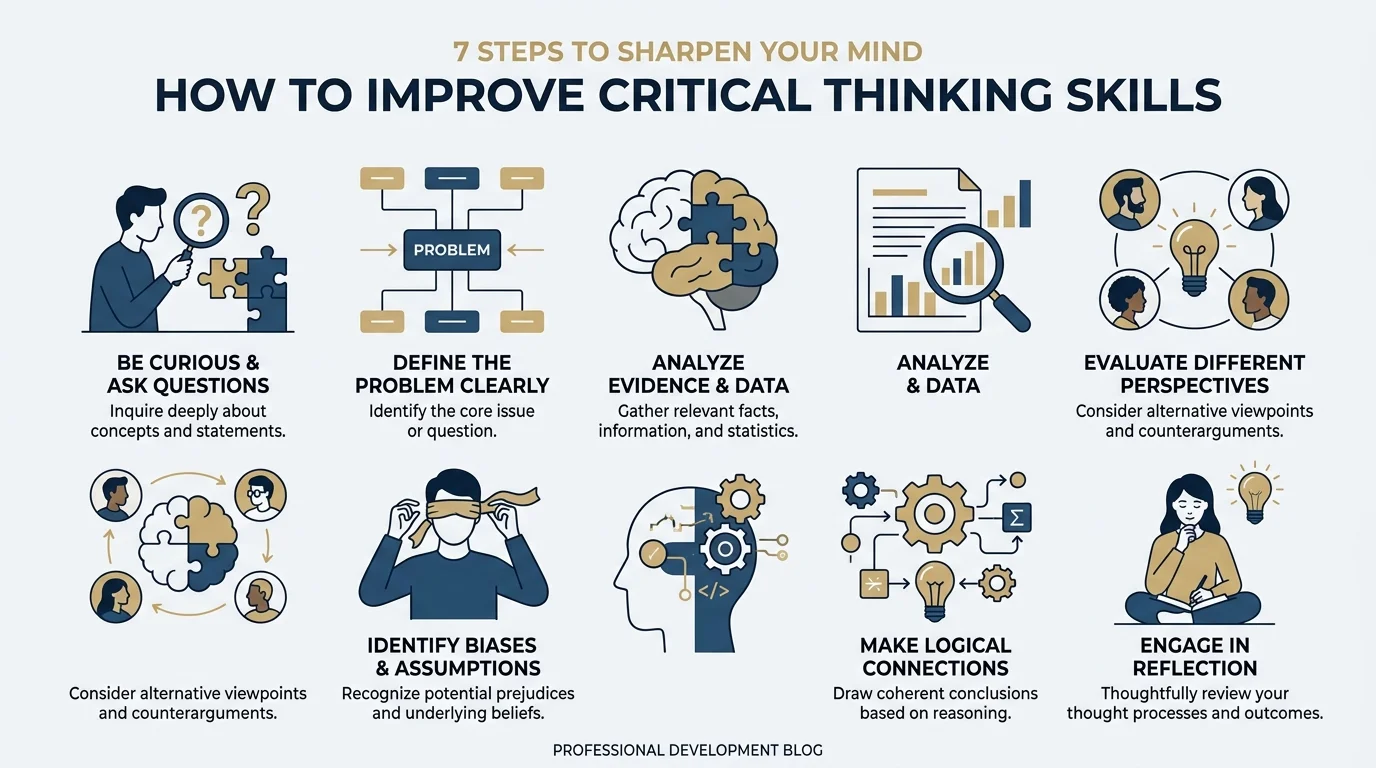
Step 1: Question the Source Before the Claim
Before you accept anything as true, ask where it came from.
Every piece of information has a motive behind it. An ad wants to sell you something. A study wants funding. A headline wants clicks.
This is source evaluation 101, and it's the fastest way to sharpen your information literacy.
Ask yourself:
Who benefits if I believe this?
What's missing from this argument?
Would I believe this if it confirmed the opposite conclusion?
Step 2: Hunt for Logical Fallacies (In Others AND Yourself)
This step is uncomfortable. But it works.
Start noticing logical fallacies — strawmen, false dichotomies, appeals to authority — in the arguments you read every day.
Then, and this is the hard part, start noticing them in your own reasoning.
You will find them. Everyone does. That's not failure — that's the process working.
Step 3: Practice Active Listening Like It's a Skill (Because It Is)
Most people listen to respond. Not to understand.
Real active listening means holding your rebuttal until the other person is completely finished. Then asking a clarifying question before you say a single word of disagreement.
Try it in your next conversation. It's harder than it sounds.
Step 4: Reflect on Your Own Decisions Weekly
Set a timer. Once a week, ten minutes, no phone.
Walk back through one decision you made. Ask: What assumption did I make without checking it? What would I do differently?
This single habit builds metacognition faster than almost anything else on this list.
Step 5: Seek Out People Who Disagree With You
Not internet strangers yelling into the void. Real people, in real conversations.
Diverse perspectives expose the gaps in your reasoning that an echo chamber never will.
The Proof This Actually Works
I know what you might be thinking: does any of this actually move the needle, or is it just self-help theater?
Here's real evidence.
Researchers at Stanford and the University of British Columbia, in a study published in the Proceedings of the National Academy of Sciences, found that students trained to make autonomous, iterative decisions during lab experiments were 12 times more likely to improve their own data collection methods than students taught the traditional way.
Four times more likely to correctly identify the limits of their own conclusions.
And here's the best part: a year later, they were still doing it. In a completely different class.
That's not a fluke. That's a trained skill, sticking.
Common Mistakes That Quietly Kill Your Progress
Let's cover what not to do, because this trips people up constantly.
Mistake #1: Treating critical thinking as a personality trait. It's not something you either have or don't. It's a skill, and skills are built through repetition.
Mistake #2: Only applying it to other people's arguments. If you never turn the lens on your own beliefs, you're doing weak-sense thinking dressed up as strong-sense thinking.
Mistake #3: Confusing skepticism with cynicism. Questioning everything isn't the same as trusting nothing. One builds understanding. The other just isolates you.
For a deeper dive into more exercises and daily habits, check out our companion post on the best ways to enhance critical thinking, which builds on several of the steps above.
FAQ
Can critical thinking really be taught, or are some people just born with it?
It can absolutely be taught. The Stanford/UBC study above is direct proof — deliberate practice changed outcomes measurably, and the effect lasted well beyond the original class.
How long does it take to notice improvement in critical thinking?
Most people notice a shift in how they evaluate information within a few weeks of consistent practice — journaling decisions, questioning sources, and reflecting weekly.
Is critical thinking the same as intelligence?
No. You can be highly intelligent and still reason poorly if you never question your own assumptions. Critical thinking is a discipline, not an IQ score.
What is the fastest way to improve critical thinking skills?
Start with source evaluation. Before accepting any claim, ask who benefits if you believe it. This single habit catches more bad information than any other single technique.
What are examples of critical thinking in everyday life?
Checking a news headline against its actual source before sharing it, pausing before agreeing with a group opinion, and asking "what am I assuming here?" before making a decision are all everyday examples.
Where You Go From Here
Look, none of this works if you read it and close the tab.
Pick one step from the list above. Just one. Do it this week.
Come back next week and add another.
That's it. That's the whole system.
You don't need to overhaul your brain overnight. You need to start catching one bad assumption at a time — and let that compound.
Read More: Begin With the End in Mind: Covey's Habit 2 Guide