

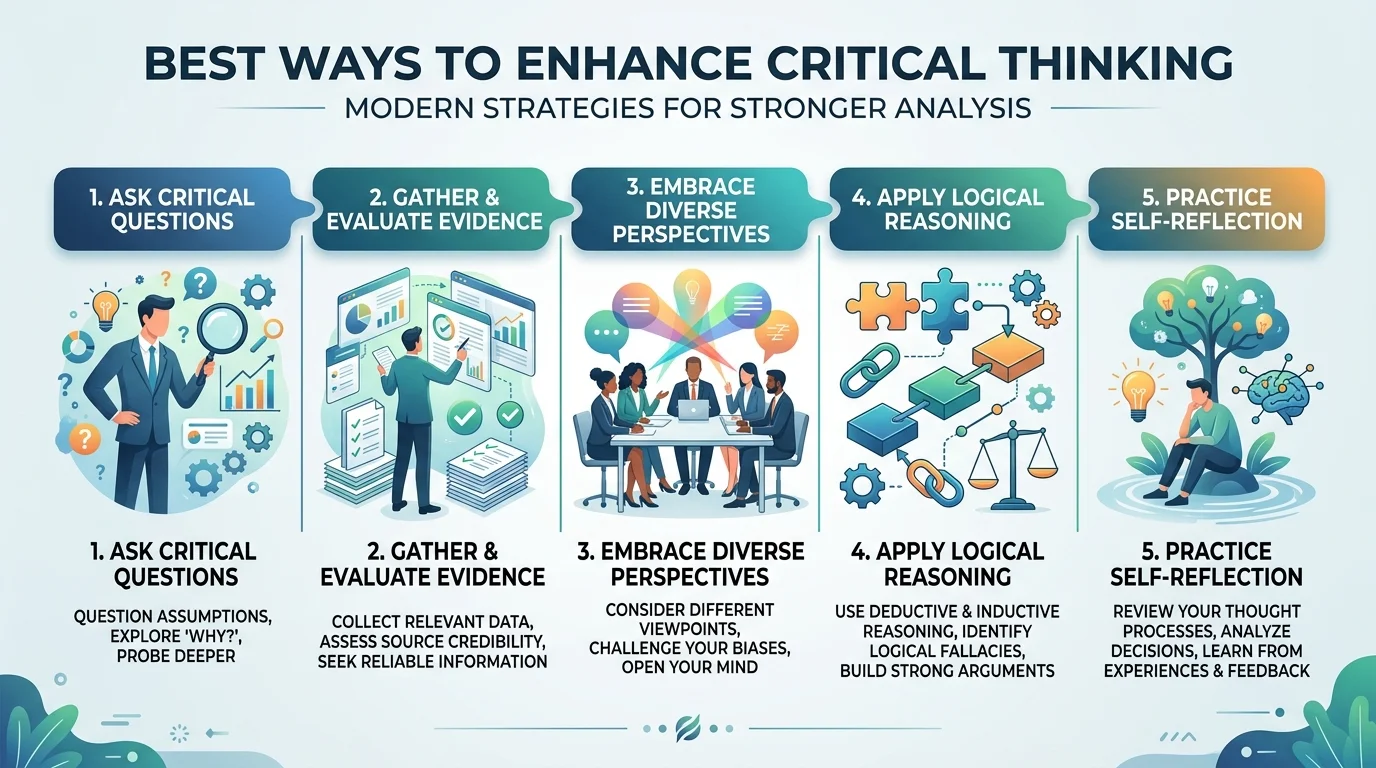
The best ways to enhance critical thinking include Socratic questioning, recognizing and countering cognitive bias, reflective journaling, mindfulness meditation, iterative decision-making practice, media literacy training, and deliberately seeking disagreement. Each method is backed by peer-reviewed research — from Stanford's PNAS study on decision-making to meta-analyses on media literacy education. According to the World Economic Forum, analytical thinking has topped employers' most in-demand skills list for three years running, with seven in ten companies calling it essential heading into 2026. Below, I'll walk you through all seven methods, a common myth to avoid, and a simple framework to start today.
Okay, now let's get into the why and how, because the intro barely scratches the surface.
You've probably Googled "how to improve critical thinking skills" a dozen times, right? And most of what you found was fluffy, generic advice like "just think more clearly!" Cool tip. Thanks.
Here's the thing: I've spent weeks digging through cognitive science research, university frameworks, and studies from places like Stanford and Harvard Business Review. And I found something interesting — the people who are genuinely great at critical thinking skills aren't smarter than you. They just use a handful of specific, learnable techniques.
What Is Critical Thinking, Anyway?
Let's clear this up first, because a lot of people confuse critical thinking with just "being smart."
According to the Paul-Elder Framework — one of the most respected models in the field — critical thinking is the disciplined process of analyzing and evaluating your own thinking so you can improve it. That's analytical thinking applied to yourself, not just to the world around you.
And that distinction matters. If you only focus on logical reasoning about external problems, you'll miss the biggest lever available: fixing the biases and blind spots inside your own head. This becomes especially clear once you start applying critical thinking to real work — for example, if you've ever had to analyze interview transcripts for qualitative research, you already know how much evidence-evaluation and bias-checking that kind of analysis demands.
Why This Skill Matters More Than Ever in 2026
I'll be honest — the numbers here are too wild to skip.
Per the World Economic Forum's Future of Jobs Report, analytical thinking remains the top employer-demanded skill globally, with roughly 39% of workers' core skill sets expected to change between 2025 and 2030. It's no coincidence that critical and analytical thinking questions show up so often during hiring — our guide on project manager interview questions breaks down exactly how interviewers test candidates for this skill. So if you're trying to level up your career, your decision-making, or just your day-to-day clarity, this isn't optional anymore. It's foundational.
7 Science-Backed Ways to Enhance Critical Thinking
Here's a quick side-by-side before we go deep on each one — useful if you're deciding where to start:
Method | Evidence Strength | Time Needed | Difficulty |
|---|---|---|---|
Socratic Questioning | High | ~5 min/day | Medium |
Debiasing Techniques | High | ~5 min/day | Medium |
Reflective Journaling | High | ~5 min/day | Easy |
Mindfulness Meditation | High | 10–20 min/day | Easy |
Iterative Decision-Making Practice | High | Ongoing | Medium |
Media Literacy Training | Medium-High | ~10 min/day | Easy |
Seeking Disagreement | Medium | Ongoing | Hard |
Now let's break each one down.
1. Master the Socratic Questioning Method
This one's ancient, but it still works ridiculously well.
The Socratic method is a structured way of asking "why" until you hit bedrock. Instead of accepting your first conclusion, keep probing:
What's my evidence for this?
What am I assuming here?
What would change my mind?
Simple? Yes. Easy to do consistently? Not really. But Socratic questioning works precisely because it forces you to slow down.
2. Learn to Spot (and Beat) Your Own Cognitive Bias
Here's an uncomfortable truth: your brain is lying to you constantly. Not maliciously — it's just taking shortcuts.
Researchers studying organizational decision-making found that deliberately generating multiple competing options before deciding significantly reduces confirmation bias and anchoring.
Step-by-step version you can use today:
Before deciding anything important, write down at least two alternative explanations or options.
Ask yourself, "What would prove me wrong?"
Only then make your call.
Feels slow at first. Stick with it anyway.
3. Start a Reflective Thinking Journal
I know — "journaling" sounds like self-help fluff. Hear me out, though.
Per research from Northern Illinois University, reflective journaling is directly linked to stronger metacognition — your ability to think about your own thinking.
A controlled study on metacognitive instruction found measurable improvements in critical thinking scores when journaling was paired with structured reflection. So simple: at day's end, write three sentences about a decision you made and why.
4. Practice Mindfulness Meditation
This surprised me, honestly.
A peer-reviewed PubMed study found experienced meditators significantly outperformed non-meditators on every attention measure tested. Mindfulness correlated strongly with cognitive flexibility — your brain's ability to switch perspectives without getting stuck.
You don't need an hour. Ten minutes counts.
5. Practice Structured, Iterative Decision-Making
Here's my favorite finding from the research.
A Stanford study published in PNAS found students who practiced iterative decision-making during hands-on experiments significantly improved problem-solving skills — and were still applying them a full year later, in an unrelated class.
Don't just read about good thinking. Practice it, in real decisions, over and over.
6. Build Your Media Literacy Muscle
We're drowning in information, and honestly, most of it's noise.
A meta-analysis on media literacy education found that teaching source-verification and "cognitive inoculation" techniques significantly improved people's ability to spot misinformation. This is media literacy in action, and it's non-negotiable in 2026.
7. Seek Out Disagreement on Purpose
Last one — and maybe the hardest.
Business transformation expert Helen Lee Bouygues, interviewed by Harvard Business Review, breaks critical thinking into three parts: questioning assumptions, reasoning through logic, and deliberately diversifying your thought process to avoid "selective thinking."
Translation: find someone who disagrees with you. Actually listen.
Quick Myth-Busting Break: Brain Games Won't Save You
Brain-training apps are marketed as decision-making skills boosters. But a large-scale study found zero evidence that active users performed better on cognitive tests than non-users, across every demographic tested.
Other research on brain training points out: if gains barely transfer between similar tasks, why would tapping bubbles on your phone transfer to real-world rational thinking?
Skip the apps. Do the seven things above instead.
Read Also: How to Memorize Something Fast (Proven Methods)
Your Simple 5-Step Starting Framework
Pick one method from the list above — not all seven.
Practice it daily for two weeks, even badly.
Journal one sentence each night about how it went.
Ask one person to challenge your thinking this week.
Add a second method once the first feels automatic.
Frequently Asked Questions
What are the best ways to enhance critical thinking?
The best ways include Socratic questioning, recognizing cognitive bias, reflective journaling, mindfulness meditation, iterative decision-making practice, media literacy training, and deliberately seeking disagreement. All seven are backed by peer-reviewed research rather than pop-psychology claims.
Can adults improve their critical thinking skills?
Yes. Critical thinking isn't fixed at a certain age — studies on adult learners, workplace training, and meditation all show measurable improvement is possible with consistent, deliberate practice, even starting later in life.
Do brain training games improve critical thinking?
No, not according to large-scale research. Studies found no evidence that brain-training app users outperform non-users on cognitive tests. Transferable habits like journaling and questioning work far better than gamified drills.
How long does it take to improve critical thinking?
Most studies measuring real gains use interventions lasting weeks to months, not days. Expect to notice small shifts within two to four weeks of consistent daily practice, with more durable gains after several months.
What's the difference between critical thinking and analytical thinking?
Analytical thinking focuses on breaking down external problems into parts. Critical thinking is broader — it includes analyzing and evaluating your own reasoning, assumptions, and biases, not just the problem in front of you.
Is critical thinking something you're born with, or can you learn it?
It's learnable. Research on Socratic questioning, metacognitive training, and mindfulness all confirm that critical thinking is a trainable skill set, not a fixed trait you either have or don't.
Final Thoughts
Improving your critical thinking skills isn't about becoming a genius overnight. It's about stacking small, evidence-backed habits until clearer thinking becomes your default mode.
Start with one technique today. Just one. You'll thank yourself in a month.
Read more: What's First Step in Decision-Making? 2026 Guide