
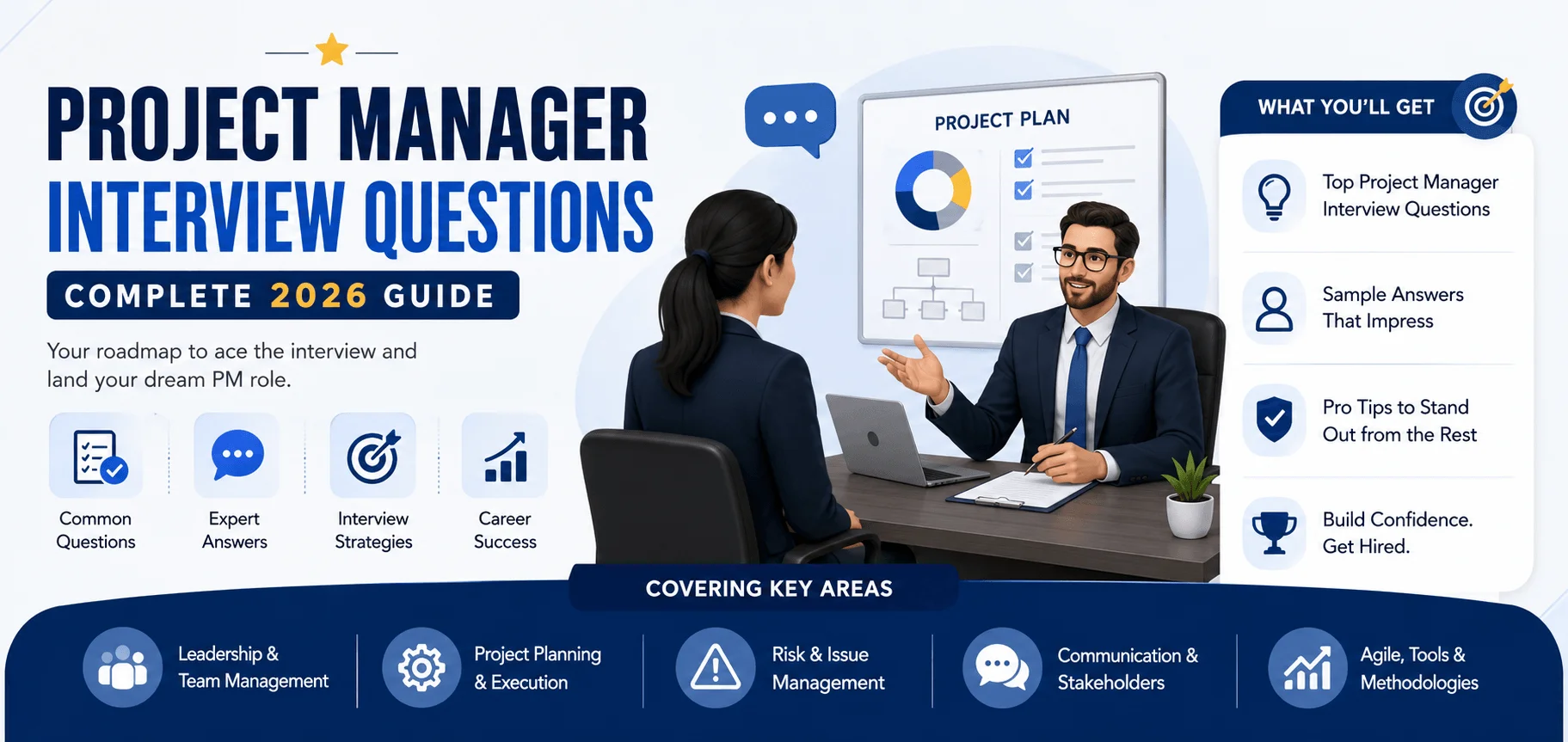
Project manager interview questions typically fall into three buckets: behavioral, technical, and scenario-based — and hiring managers use them to test whether you can lead under pressure, not just recite theory. The most common ones ask about handling scope creep, resolving team conflict, and choosing between Agile and Waterfall. Below, I'll walk you through the exact questions you'll likely face, how to structure winning answers using the STAR method, and a step-by-step prep plan you can run through before your next interview.
Let me be honest with you.
The first time I sat down for a project manager interview, I froze on a question I should have nailed. I knew the theory. I knew the frameworks. But nobody had shown me how to actually talk about my experience in a way that made a hiring manager lean forward instead of zone out.
That's exactly what I'm fixing for you today.
Why Project Manager Interviews Feel So Different
Here's the thing most candidates get wrong: they prep for a PM interview like it's any other interview.
It's not.
Interviewers aren't just testing what you know — they're testing how you think under pressure. And the stakes are real. PMI's Global Project Management Talent Gap report (2025) estimates that 25 million new project-oriented workers will be needed by 2030, and the U.S. Bureau of Labor Statistics projects employment of project management specialists to grow 6% between 2024 and 2034 — faster than the average for all occupations. That means competition for good roles is fierce, and hiring managers can afford to be picky.
So they dig deep. They want proof — not promises — that you can handle stakeholder management, keep a budget in check, and still ship the project on time when everything's on fire.
That's why generic answers don't cut it anymore.
The Framework Every Strong Answer Needs: STAR
If you take one thing from this article, take this.
The STAR method — Situation, Task, Action, Result — is the backbone of almost every strong behavioral interview question answer. Behavioral questions dominate PM interviews because they reveal how you actually operate, not how you think you'd operate in theory.
Here's how it breaks down:
Situation — Set the scene quickly. What was the project, and what was at stake?
Task — What was your specific responsibility here? Not the team's. Yours.
Action — Walk through the concrete steps you took. This is where you shine.
Result — Close with the outcome, ideally backed by a number. Time saved, budget preserved, client retained — whatever moves the needle.
I know it sounds simple. It is simple. But most candidates skip straight to the result and skip the action — which is the part interviewers actually care about most.
Here's a trick that works better than rehearsing in your head: record yourself answering out loud, then run the recording through a free audio-to-text converter to get a full transcript. Reading your own answer back on paper makes it painfully obvious where you ramble or bury the result — way faster than replaying audio over and over.
The Questions You're Almost Guaranteed to Hear
Let's get tactical.
Below are the categories of common PM interview questions that show up again and again across real hiring loops, based on patterns from ProjectManager.com, Monday.com, and KORE1's recruiting data.
Behavioral & Leadership Questions
These probe your soft skills — communication skills, team leadership, and conflict resolution.
"Tell me about a time a project went off track. What did you do?"
"Describe a conflict between two team members. How did you handle it?"
"Give an example of how you influenced a stakeholder who disagreed with you."
Answer these with STAR, every single time. No exceptions.
Technical & Methodology Questions
This is where interviewers check your fluency in Agile methodology, Scrum, Waterfall, and hybrid project management approaches.
"How do you decide between Agile and Waterfall for a new project?"
"Walk me through how you'd build a project timeline using the critical path method."
"How do you handle scope management when a client keeps adding requests?"
Keep these answers tight and specific. Vague theory reads as inexperience.
Scenario-Based Questions
Interviewers love throwing you a curveball scenario to test risk management and decision-making on the spot.
"A key vendor just missed a critical deadline. What's your next move?"
"Your budget just got cut by 20% mid-project. How do you respond?"
Don't panic here — think out loud, calmly. That composure is the answer.
What's New in 2026: AI and Hybrid Leadership Questions
This one's worth flagging separately, because it's catching candidates off guard.
According to The Interview Guys, 2026 hiring loops increasingly test AI integration skills, hybrid team leadership, and data-driven decision-making alongside the traditional competencies above. Expect questions like:
"How have you used AI tools to streamline reporting or forecasting?"
"How do you lead a team that's split between in-office, remote, and contract workers?"
Don't skip prepping for these — even one confident answer here can set you apart from candidates still rehearsing 2020-era scripts. Read Also: 50+ Ice Breaker Questions for Team Meetings (2026)
Question Type vs. What It Actually Tests
Here's a quick reference table so you know exactly what each question category is designed to reveal:
Question Type | What It Tests | Sample Question | Best Framework |
|---|---|---|---|
Behavioral | Leadership, communication, conflict resolution | "Tell me about a time a project went off track." | STAR |
Technical | Methodology fluency (Agile, Waterfall, hybrid) | "How do you decide between Agile and Waterfall?" | Direct + example |
Scenario-based | Risk management, real-time decision-making | "A vendor just missed a deadline. What's next?" | Think-aloud + calm logic |
AI/Hybrid leadership | Adaptability to 2026 work trends | "How do you lead a hybrid team?" | Specific tool + outcome |
A Step-by-Step Way to Prepare (That Actually Works)
I'm not going to tell you to "just be confident." That's useless advice.
Instead, here's the exact prep sequence I use before any project management interview:
Step 1: Build your story bank.
Write down five to seven real projects. For each, jot the situation, your role, the action you took, and the result — in bullet form.
Step 2: Map stories to likely questions.
Go back through the categories above and match your stories to them. One good project story can often answer three or four different questions.
Step 3: Practice out loud — not in your head.
Say your answers out loud, ideally to another person or on video. You'll immediately notice where you ramble.
Step 4: Time yourself.
Aim for 90 seconds to 2 minutes per behavioral answer. Longer than that, and you'll lose the interviewer's attention.
Step 5: Prep two smart questions of your own.
Asking sharp questions about the team, the tools, or PMP certification expectations signals genuine interest — and it flips a bit of power back to you.
Once you've got a transcript of your practice answer, treat it like a mini research document. Our guide to analyzing interview transcripts breaks down how to spot patterns, filler words, and weak spots in spoken answers — the same technique researchers use, applied to your own interview prep.
Frequently Asked Questions
Is a PMP certification required for a project manager interview?
No, but it helps. PMI's Job Growth and Talent Gap report has shown PMP-certified professionals earn meaningfully more on average than non-certified peers, and some employers use it as a screening filter before round one.
How long does a PM interview process usually take?
Most mid-to-senior PM roles run three to five rounds over two to three weeks, according to recruiting firm KORE1. Enterprise companies with formal PMOs often take longer; smaller companies sometimes compress it into two calls.
What's the difference between a project manager and a program manager?
A project has clearly defined start and end points, while a program is a group of interrelated projects managed together with a broader, evolving scope.
What is the STAR method, and do I really need to use it?
STAR stands for Situation, Task, Action, Result. It's not mandatory, but it's the clearest way to structure behavioral answers so interviewers can follow your reasoning and measure your impact.
Are technical questions more important than behavioral ones?
Not necessarily — most PM interviews weigh them roughly equally, since the role requires both process fluency and people leadership.
Should I ask questions during a PM interview?
Yes. The questions you ask signal what you'll prioritize in the role, and thoughtful ones about team structure or tools can leave a strong final impression.
Final Thoughts
Here's my honest take.
Project manager interview questions aren't designed to trip you up — they're designed to find out if you can lead under pressure, communicate clearly, and deliver results when things don't go to plan.
You already have the experience. Now go structure it, practice it out loud, and walk into that room like you've already done this a hundred times.
You've got this.
Read more: Welcome to the Team Message: 30+ Examples & Templates (2026)