

Building something on your own does not mean going it alone. The moment a second person joins your effort, you need a personal project team organization structure — a way to organize roles and responsibilities, decision-making authority, and reporting lines. At Audiototextify, we know that clear structure matters far beyond transcription, since it applies to any small team trying to move fast without stepping on each other's toes. This guide covers eight practical structures, a side-by-side comparison, and a simple process for turning your choice into a real org chart. You will also learn which mistakes stall small teams, and how communication flow shapes leadership decisions along the way.
What Is a Personal Project Team Organization Structure?
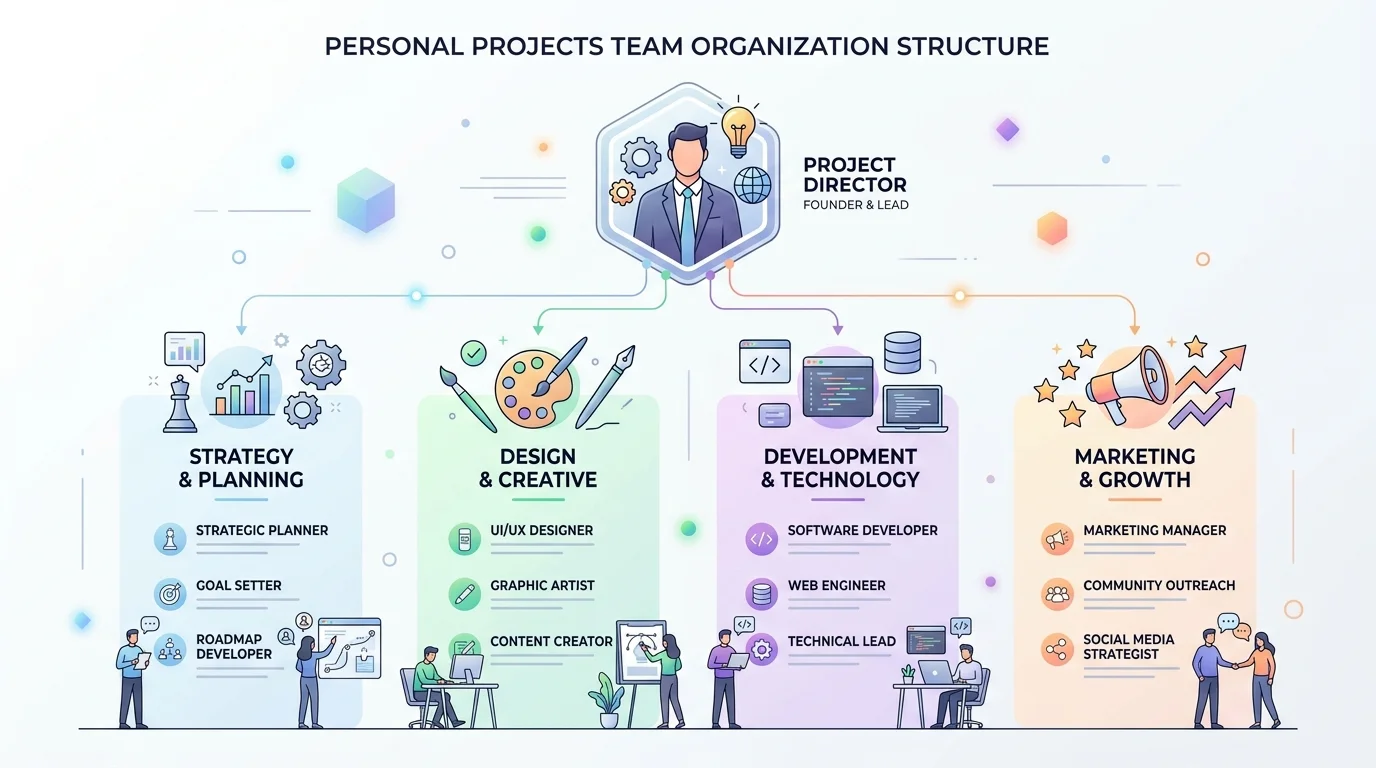
This structure defines who does what, who reports to whom, and who makes the final call on a personal project. It covers three essentials: reporting lines, decision-making authority, and communication channels. Good organizational design also decides where your team sits on a vertical vs. horizontal structure spectrum. Think of it as the invisible skeleton holding your project together.
Unlike a corporate organizational structure, a personal project rarely needs a full PMO, a Project board, or a Senior management team. Where a company might lean on a Project manager, a Functional manager, or a Project coordinator to hold the chain of command together, a personal project usually puts all of that on one person: you. Even a Flat structure benefits from someone having the final call on tough decisions.
Why Team Structure Matters for Personal Projects
Every hour spent wondering who's in charge is an hour not spent building. A defined team organization approach cuts decision delays, prevents duplicate work, and boosts team efficiency across the board, a core piece of business productivity for any small group. Picture a three-person design project: without clear roles and responsibilities, two members redo the same task while a third waits for direction.
Structure also strengthens accountability and supports genuine team collaboration, since everyone knows exactly where they fit. It supports scalability too, since adding a fourth or fifth collaborator becomes simple once the pattern already exists. Strong structure even helps with resource allocation, making sure the right person spends time on the right task instead of guessing.
A structure isn't bureaucracy. It's just clarity, written down.
8 Types of Personal Project Team Structures
Here are the eight personal project team organization structures worth knowing, trimmed down from the corporate playbook to fit smaller teams. Big companies use ten or more variations, including a Market-focused divisional structure, a Geographical divisional structure, a Circular structure, a Projectized structure, or even a Multi-divisional structure, but personal projects rarely need that scale.
Some structures suit a two-person side hustle. Others fit a ten-person volunteer group running a community event. Read through all eight, then match your team size, timeline, and goals to the closest fit in the comparison table below.
Functional Structure
A Functional structure groups people by skill: one person handles design, another handles writing, another handles outreach. Each person answers mainly to you, the project lead, which narrows the span of control at the top. This works well once your team passes four contributors, each one owns a distinct specialization, and each has a small career path toward owning that skill area long-term. Just watch for silos forming between skill groups.
Matrix Structure
A Matrix structure gives contributors two points of contact: a skill lead and a project lead, which naturally encourages cross-functional collaboration. This suits people juggling your project alongside a day job or other commitments. A Strong matrix tilts the authority balance toward the project lead, a Weak matrix leaves most authority with the skill lead, and a Balanced matrix splits it evenly. Flexibility comes at the cost of occasional split priorities.
Flat (Organic) Structure
A Flat structure, sometimes called an Organic structure, drops the hierarchy entirely and leans hard into team empowerment. Everyone shares decision-making, and titles barely matter. This fits two or three people building a passion project on evenings and weekends. It works beautifully at small scale, but tends to break down once more than four or five people join.
Hierarchical Structure
A Hierarchical structure puts one clear leader at the top, with everyone else reporting upward. This suits projects where you, as the sole accountable owner, need final say on every decision. It trades some collective input for speed. Unlike a flat setup, nobody wonders who breaks a tie.
Process-Based Structure
A Process-based structure organizes the team around workflow stages instead of people: research, then build, then launch. Each stage has its own process leader guiding that phase. This fits repeatable personal projects, like a content pipeline or a seasonal product drop. It keeps internal processes consistent every single cycle.
Product-Focused Structure
A Product-focused structure, close cousin to the corporate Product-focused divisional structure, organizes the team around the actual deliverable. Tech teams often call this the Squad model, where a small crew owns one product end to end. Everyone works toward one app, one course, or one book, guided by a Product lead. Focus stays sharp because there's only one output to obsess over.
Virtual / Remote Structure
A Virtual structure connects a distributed team through async tools rather than a shared office. Most modern personal projects run this way, with collaborators spread across time zones. Communication flow depends entirely on documentation, since nobody can just tap a shoulder to ask a quick question. A free transcription tool can turn quick voice updates into searchable notes everyone can review later.
Network Structure
A Network structure relies on loosely connected freelancers pulled in as needed, with no fixed team at all. A solo founder might hire a designer for one week and an editor for another. This keeps overhead low and resource flexibility high. The trade-off is less consistency, since contributors rotate in and out.
Quick Comparison: Which Structure Fits Your Project
Reading eight descriptions back to back can blur together fast. The table below lines them up side by side, so you can compare team size, strengths, and drawbacks in a single glance.
Structure | Best For | Team Size | Pros | Cons |
|---|---|---|---|---|
Functional | Skill-based projects | 4+ | Deep expertise | Slower cross-skill coordination |
Matrix | Multi-priority contributors | 3–8 | Flexible resourcing | Competing priorities |
Flat | Early-stage passion projects | 2–4 | Fast decisions | Breaks down at scale |
Hierarchical | Single-owner projects | 2–10 | Clear accountability | Bottlenecks at the top |
Process-Based | Repeatable workflows | 3–6 | Predictable output | Rigid for one-off work |
Product-Focused | Single deliverable | 2–6 | Deep product focus | Duplicated effort across projects |
Virtual/Remote | Distributed collaborators | 2–15 | Location-independent | Async communication lag |
Network | Freelancer-driven projects | 1–5 core + freelancers | Low overhead | Less consistency |
Notice a pattern? The Flat structure, Hierarchical structure, and Virtual structure cover the vast majority of personal projects. Everything else exists for specific situations, like repeatable workflows or freelancer-driven work.
How to Choose the Right Structure for Your Personal Project
Picking the right personal project team organization structure comes down to five factors, not gut instinct. Walk through each one honestly, and the right fit becomes obvious fast.
None of these factors matter in isolation. A tight deadline with a five-person team points somewhere different than a tight deadline with two people. Weigh them together before you commit.
1. Define your project goals and workflow
Start with the basics: is this a one-time push or an ongoing effort? A single product launch fits a Product-focused structure, while a recurring newsletter fits a Process-based structure. Your workflow shape should drive the structure, not the other way around.
2. Consider timeline and budget
A tight deadline favors a Hierarchical structure, since one person can make fast calls without waiting on group consensus. A flexible timeline suits a Matrix structure or Flat structure instead. Budget matters too, since freelance-heavy projects lean toward a Network structure.
3. Match structure to team size and skills
Under five people, resist the urge to over-structure things. A Flat structure usually beats a heavy Functional structure at that size. Once you cross five or six contributors with distinct skills, functional grouping starts paying off.
4. Account for tools and collaboration style
Teams that communicate mostly async lean toward a Virtual structure almost by default. Teams meeting in real time, even occasionally, can run flatter without losing team alignment. Match the structure to how people actually talk to each other.
5. Revisit and adapt as the project grows
Structure isn't a one-time decision. Revisit it when a new member joins, when deadlines start slipping, or when nobody's sure who owns what. Organizational growth almost always demands a structural adjustment somewhere down the line.
How to Create a Team Organization Chart for Your Project
Once you've picked a structure, put it on paper. A simple org chart, sometimes called a project organization chart, turns an abstract idea into something your whole team can actually see and reference.
Building your team organization structure into a chart takes six steps, laid out in the table below. Pair it with a RACI matrix to clarify who's responsible for what, or a Gantt chart and Kanban board to track the work itself. If you're gathering input through contributor or stakeholder interviews first, our guide on analyzing interview transcripts can help turn those conversations into clear roles. A lightweight Work Breakdown Structure (WBS) helps too, once the project has more than a handful of moving pieces.
Step | What to Do |
|---|---|
1. List contributors | Name everyone involved and their skill area |
2. Assign a decision-maker | Even flat teams need one tie-breaker |
3. Map reporting lines | Show who checks in with whom |
4. Note outside contributors | Keep Network structure helpers and Stakeholders separate from the core team |
5. Choose a chart tool | A free organizational chart template works well to start |
6. Share and revisit | Send it to the team, then update it monthly |
Common Mistakes to Avoid When Structuring a Personal Project Team
Even smart teams stumble here. A few patterns show up again and again once you look at enough personal projects.
The table below covers the most common ones, along with a quick fix for each. Catching these early saves weeks of frustration later.
Mistake | Why It Hurts | Quick Fix |
|---|---|---|
Over-structuring a 2-person project | Adds bureaucracy nobody needs | Default to a Flat structure |
No single decision-maker | Everything stalls on group consensus | Assign one person final say |
Undefined freelancer roles | Network structure contributors feel disconnected | Write a one-line scope per freelancer |
Never revisiting the structure | Growth outpaces the original plan | Review every few months |
Confusing flat with leaderless | Flat teams still need ownership | Keep decision-making authority clear |
Team Structure, Communication, and Leadership
Structure doesn't just organize tasks. It shapes how information moves, whether your team leans centralized vs. decentralized structure, and who holds leadership authority when hard calls come up. Most of this plays out during regular check-ins, which is why solid meeting and business communication habits matter as much as the org chart itself.
Get this part wrong, and even a well-designed structure feels clunky in practice. Get it right, and the whole team moves faster without extra meetings.
How structure affects communication
A Hierarchical structure tends toward top-down communication, where updates flow from the leader outward. A Flat structure or Network structure favors bottom-up communication instead, with information moving freely in both directions. Neither approach is wrong, but mismatching your structure to your team's natural style creates friction fast.
How structure affects leadership and accountability
Clear structure ties directly back to the promise of faster decisions. When leadership authority, sometimes formalized as Project leadership, sits with one obvious person, or is explicitly shared, accountability stops being a guessing game. That clarity is often the biggest difference between a project that ships and one that stalls.
Frequently Asked Questions
What's the difference between team structure and organizational structure?
A team structure organizes one specific group working on one project. An organizational structure, by contrast, covers an entire company across every department and division. Most personal projects only need the smaller, team-level version, since there's no larger company structure sitting above it.
What's the best team structure for a solo or small personal project?
For a solo project or a small personal project team, a Flat structure almost always works best. It skips unnecessary layers and keeps decisions fast. Once you add a fourth or fifth person, consider shifting toward a light Hierarchical structure instead.
Can I use more than one structure at once?
Yes, and many successful projects do exactly that. You might run a Hierarchical structure for core decisions while using a Network structure for freelance support. Mixing models is common, and often more practical than forcing one label onto the whole team.
How do I know if my team structure needs to change?
Watch for repeated confusion over ownership, slow decisions, or contributors feeling disconnected from the work. These signs usually mean your current structure has outgrown the project. A quick review, using the comparison table above, often reveals the better fit.
What's the best structure for remote personal-project teams?
A Virtual structure fits remote teams best, since it's built around async tools instead of shared physical space. Pair it with a light Matrix structure if contributors also juggle outside commitments. Clear documentation matters more here than in any other setup.
Is a formal structure necessary for a small personal project?
Not a heavy one, no. But even a two-person personal project team organization structure benefits from knowing who has final say. Skipping structure entirely usually costs more time than setting one up would have taken in the first place.
Structure Your Personal Project Team for Success
The right personal project team organization structure isn't about picking the fanciest model. It's about matching structure to your team size, your timeline, and how your group naturally works together.
Start simple, lean Flat or Hierarchical for most small projects, then adjust as your team grows. Turn today's decision into a free organizational chart template your whole team can see and follow, and browse our blog for more guides like this one.
Read more: Standard Operating Procedure Template (Free Guide 2026)