
Legacy application modernization services are professional engagements that assess, redesign, and migrate outdated business applications to modern architectures — usually cloud-native, API-driven, and containerised. A typical mid-market program runs 9 to 18 months and costs between $250,000 and $2 million depending on which of the seven modernization strategies you choose. The single biggest predictor of success isn't your engineering talent. It's whether you picked the right strategy before writing any code.
Now let me be blunt with you.
Most guides on this topic read like they were written by someone who has never watched a batch job fail at 2 a.m.
I have. And this is the guide I wish someone had handed me back then.
Here's what you're getting: what these services actually include, the framework serious firms use to choose an approach, real cost and timeline benchmarks, an eight-step process you can start this quarter, and an honest read on what AI changed in 2026.
No fluff. Let's go.
What Are Legacy Application Modernization Services (And What They're Not)
Before we get tactical, I want to clear up a definition problem that costs companies millions. People use "modernization" to mean everything from a UI refresh to a full mainframe exit. Those are wildly different projects carrying wildly different risks, and conflating them is how budgets get set at a third of what they need to be. So let's anchor on something precise first, then add the nuance that vendors usually leave out of the sales deck.
IBM defines it as the process of upgrading or transforming outdated, often monolithic and inefficient legacy systems into more contemporary, efficient and adaptable solutions.
Clean. Useful.
But notice what that definition doesn't say. It doesn't say "rewrite." It doesn't say "move to the cloud." Those are tactics, and choosing between them is the actual work.
A real legacy application modernization engagement usually bundles:
Application portfolio assessment and dependency mapping
Legacy code analysis and business rule extraction
Architecture design — monolith to microservices, event-driven architecture, domain-driven design
Cloud migration and containerization
Data migration and database modernization
API-first integration layers
Legacy interface redesign (UI/UX)
DevOps enablement, automated testing, and post-cutover support
Count how much of that is coding.
Roughly half.
That's not a scoping accident — it's the entire point. If you'd like the infrastructure-only view of this work, our cloud migration services page covers the narrower scope.
Why "Legacy" Has Nothing to Do With Age
I want to kill a myth here, because it derails more projects than any technical problem I've encountered. A system is not legacy because it's twenty years old. Plenty of twenty-year-old COBOL applications are faster, safer, and more reliable than the shiny microservices mess someone shipped last spring. Age is a terrible proxy. Something more useful is available to you, and it takes about thirty seconds to apply.
A system becomes legacy the moment it stops letting your business change direction.
So ask yourself three questions:
Can you ship a meaningful feature in weeks, or does it take quarters?
Can you hire people who understand this stack without paying a 40% premium?
Would an auditor be comfortable with how it's patched?
Two bad answers out of three, and you have a legacy problem — regardless of the copyright date in the footer.
The Four Triggers That Force the Conversation
In my experience, modernization budgets get approved for one of four reasons, and almost never for "innovation." Security and compliance risk comes first, usually after end-of-life software stops receiving patches. Talent scarcity comes second, and it's brutal — the pool of engineers who can maintain thirty-year-old code shrinks every year. Scalability walls come third, when systems buckle under peak load. And fourth, strategic stagnation: the stack is too fragile to modify, so the roadmap quietly dies.
If you're in an asset-heavy sector, these triggers show up earlier and hit harder — our guide to digital transformation in manufacturing walks through how they surface on the plant floor.
The Real Cost of Doing Nothing
I'll admit something. For years I pitched modernization on "agility" and watched CFOs glaze over every single time. Then I started framing technical debt as a balance-sheet liability with a compounding interest rate, and the meetings got shorter while the approvals got faster. If you want funding for legacy system modernization, you need numbers — not adjectives. These are the four that consistently move a boardroom.
Deloitte's 2026 Global Technology Leadership Study estimates that technical debt absorbs 21% to 40% of total IT spending.
Read that again.
Up to two of every five dollars — servicing debt, building nothing.
McKinsey's research found that CIOs divert 10 to 20 percent of the technology budget earmarked for new products into resolving tech debt issues, and estimate that debt amounts to 20 to 40 percent of the value of their entire technology estate. McKinsey & Company
If you're building the numbers side of this from scratch, the fundamentals in our financial modeling guide apply directly — a modernization business case is just a cost-avoidance model with a longer horizon.
Then there's the human cost, which is worse. Stripe's developer survey found engineers reported wasting an average of 17.3 hours per week on maintaining bad legacy code — more than 42% of the work week.
Your best engineers. Nearly half their time. Gone.
The Market Is Voting With Its Wallet
Market data tells you one thing that internal analysis can't: whether you're early, on time, or late. And on application modernization services, the answer is unambiguous. I'm not going to pretend analyst forecasts are gospel — the estimates diverge considerably depending on who's counting and what they include. But the direction of travel is identical across every firm I checked, which is the part that actually matters.
Mordor Intelligence puts the market at $27.46 billion in 2026, growing at a 19.86% CAGR to $67.91 billion by 2031. Mordor Intelligence
Fortune Business Insights projects the services segment growing from $30.36 billion in 2026 to $92.08 billion by 2034. Fortune Business Insights
Grand View Research lands at $52.5 billion by 2030 at a 16.7% CAGR. Grand View Research
Three different numbers. One identical story.
The 7 Rs: How to Choose Your Modernization Strategy
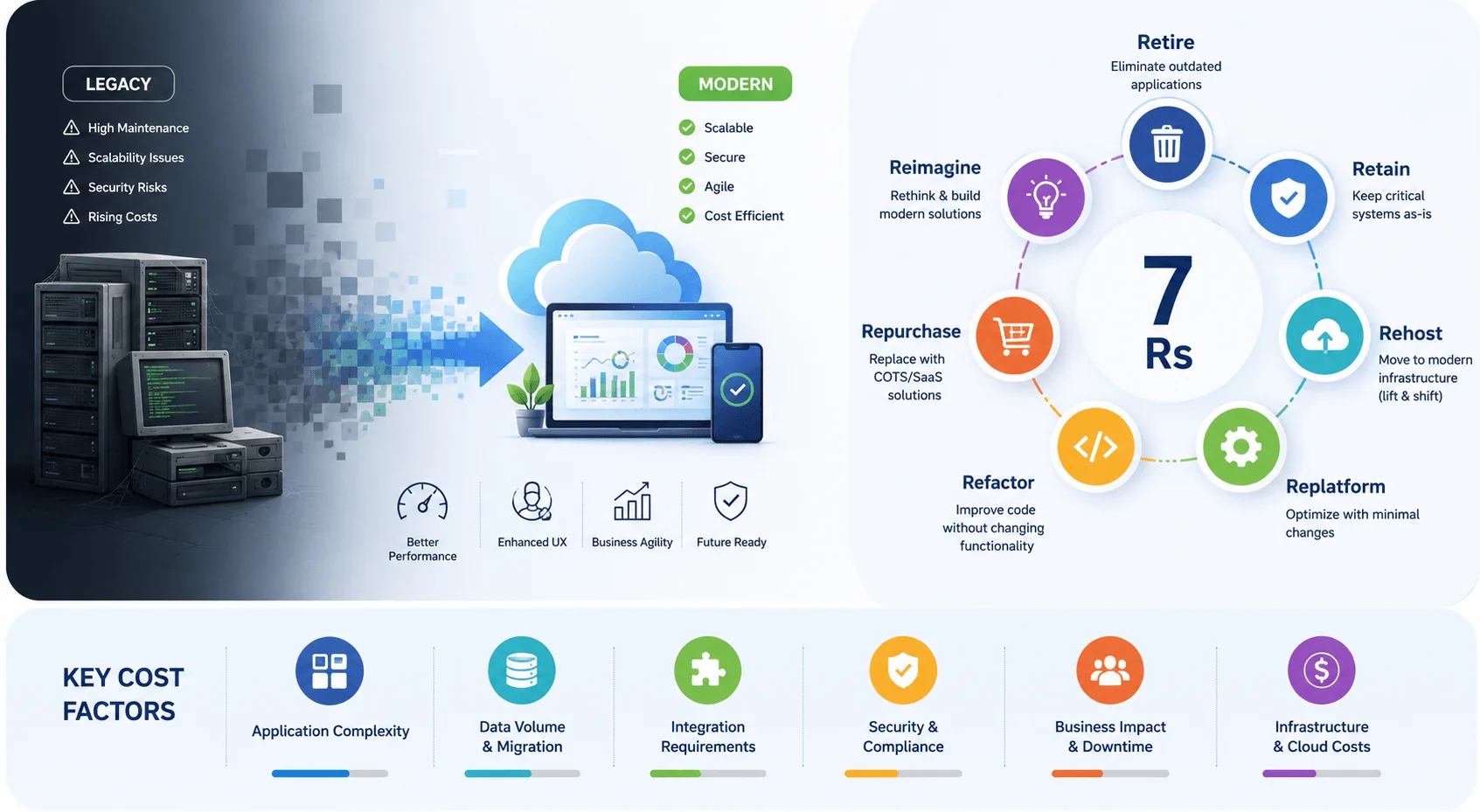
This is the section people bookmark, and rightly so. The single most expensive decision in any modernization program gets made on day one — before anyone touches a repository. Choose a rehost when the system needed a rebuild, and you've paid good money to relocate your problems to a pricier data center. Choose a rebuild when a replatform would have delivered most of the value, and you've signed up for an eighteen-month march that may never finish. Here's the framework that prevents both mistakes.
Gartner's seven modernization options are ranked roughly by ease of implementation:
Strategy | What it means | Risk |
|---|---|---|
Encapsulate | Expose existing data and functions as services via an API | Lowest |
Rehost | Redeploy to new infrastructure, no code change (lift and shift) | Low |
Replatform | Migrate to a new runtime platform, minimal code changes | Low–medium |
Refactor | Restructure code to remove technical debt, same external behavior | Medium |
Rearchitect | Materially alter code for a new architecture (microservices) | High |
Rebuild | Rewrite from scratch, preserving scope and specifications | High |
Replace | Eliminate it entirely and adopt something new | Highest |
Useful. But it's missing the two columns every executive asks about within ninety seconds.
What Each Strategy Actually Costs and How Long It Takes
I've never seen this table published anywhere, which is strange, because it's the first thing anyone wants. These are my working benchmarks from mid-market and enterprise programs — a single application of moderate complexity, fully loaded, including discovery and testing. Treat them as planning ranges, not quotes. Your regulatory environment and integration count will move these numbers more than your team size will.
Strategy | Typical timeline | Relative cost | Best fit when… |
|---|---|---|---|
Encapsulate | 4–10 weeks | $ | The core logic is sound but unreachable by modern systems |
Rehost | 6–16 weeks | $$ | Infrastructure is the constraint, not the code |
Replatform | 3–6 months | $$ | You want cloud economics without architectural surgery |
Refactor | 4–9 months | $$$ | The code is salvageable but unmaintainable |
Rearchitect | 9–18 months | $$$$ | Scale or release velocity is the binding constraint |
Rebuild | 12–24 months | The platform is unsupported and talent is unavailable | |
Replace | 6–18 months | $$$$ | A mature SaaS product covers 80%+ of requirements |
One caution. Replace looks cheap on the license line and then eats you alive in data migration and process change. I've watched that surprise land three times now. Budget for it. Our technical debt assessment framework exists partly to catch this before it's a line item.
Don't Confuse Gartner's 7 Rs With the AWS 7 Rs
Here's the trap almost nobody warns you about, and it's genuinely costly. I've sat through forty-minute arguments between two consultants who were quoting entirely different frameworks without either one realizing it. There are two well-known "R" lists in circulation. They overlap heavily. They were built for completely different jobs. Getting this straight will make you the sharpest person in the room.
Gartner's set — encapsulate, rehost, replatform, refactor, rearchitect, rebuild, replace — targets application architecture.
AWS's 7 Rs — retire, retain, rehost, relocate, repurchase, replatform, and refactor or rearchitect — describe migration strategies for moving applications to the cloud.
One is about modernizing software.
The other is about moving workloads.
They are not interchangeable, and most published guides quietly pick one, ignore the other, and leave readers comparing mismatched lists.
Also worth internalizing: most real programs use a hybrid. You rehost some applications, refactor others, replace a few, and encapsulate the ones that aren't worth touching yet.
That isn't indecision. That's portfolio management.
My Step-by-Step Legacy Modernization Process
Enough theory. This is the sequence I run, in this exact order, every time — because failures in this space are almost always sequencing failures rather than engineering failures. Teams skip discovery to look decisive. They start coding to demonstrate momentum. Then, six months in, they find an undocumented nightly integration that nobody alive fully understands. Follow these steps and you'll skip the expensive version of that lesson.
Step 1 — Inventory everything.
Every application, every integration, every scheduled job, every shadow-IT Access database someone in finance built in 2011. If it isn't on the list, it will bite you.
Step 2 — Score each application on two axes.
Business value on one. Technical health on the other. High value plus poor health is wave one. Low value plus poor health is a retirement candidate — and retiring dead weight is the cheapest win available to you.
Step 3 — Extract business rules before touching code.
This is the step people skip, and skipping it is the leading cause of "the new system calculates tax differently and nobody knows why." Decades of undocumented logic live in that codebase. Whatever you recover, write it down properly — a standard operating procedure template is a reasonable starting format for capturing rules the original team never documented.
Step 4 — Assign an "R" to every application.
Use both tables above. Then write down why in one sentence. You will need that rationale in month nine when someone questions the approach.
Step 5 — Pick a pilot that matters but won't kill you.
Not the crown jewel. Not a toy either. Something real enough that success proves the operating model.
Step 6 — Modernize incrementally using the strangler fig pattern.
Route traffic to new services piece by piece. Martin Fowler's strangler fig approach exists precisely so you never need a big-bang cutover — and big-bang cutovers are where careers go to end.
Step 7 — Instrument before, during, and after.
Observability isn't a nice-to-have. It's the only way to prove the replacement behaves like the original.
Step 8 — Track outcomes at 6, 12, and 24 months.
Maintenance hours. Release frequency. Incident rate. Infrastructure spend. Those four numbers become your next budget request, pre-written.
Why Most Programs Stall (And It's Rarely the Technology)
I need to hand you the uncomfortable statistic, because pretending it doesn't exist helps nobody. The most-cited benchmark in this industry comes from Advanced's Mainframe Modernization Business Barometer, and it's worth flagging its age directly — this is a 2020 survey that gets recycled in 2026 articles without a date attached. Treat it as directional rather than current.
That research found that 74% of organizations had started a legacy system modernization project but failed to complete it, with a disconnect between technical and leadership priorities cited as a leading obstacle (full release here).
Note the stated cause.
Not architecture. Not tooling. Alignment.
Six years later, the pattern holds in every post-mortem I've read. The most damaging decisions get made at the very beginning — a rehost chosen because it's fast when the system required a rebuild, or a rebuild launched when a replatform would have delivered eighty percent of the benefit at forty percent of the cost.
Slow down at the start. You'll go faster everywhere else.
AI-Augmented Modernization: What Actually Changed
If you read one section twice, make it this one — because the economics genuinely shifted, and the shift is recent enough that a lot of internal cost models are now quietly wrong. The parts of modernization that used to be punishingly expensive were the parts nobody wanted to do: reading a million lines of undocumented code, mapping dependencies by hand, writing documentation that never got written the first time. Those turn out to be exactly what machines are good at.
Gartner now recognizes a formal category — AI-Augmented Code Modernization Tools — defined as solutions using specialized AI agents, generative AI, and deterministic analysis to accelerate legacy transformation across code and architecture analysis, documentation, dependency mapping, risk assessment, migration planning, and refactoring.
The measured results are real. McKinsey reports that generative AI in application modernization can accelerate timelines by 40–50% and reduce technology-debt-related costs by roughly 40% — consistent with its broader work on AI for IT modernization.
One financial services firm built an internal tool that interpreted 9 million lines of obsolete code, saving its development team 280,000 hours.
Two hundred and eighty thousand hours.
But please read the caveat, because it's the part people skip.
High conversion accuracy at the code level does not guarantee functional equivalence at the business logic level. A COBOL-to-Java translation can be 95% syntactically correct and still get a rounding rule wrong in a way that surfaces during your first quarter-end close.
Translation: AI-assisted code refactoring compresses the reading. It does not replace the thinking. Architect-governed validation stays mandatory.
Which Industries Are Modernizing Fastest
Sector context matters more than most buyers expect, because it determines your regulatory constraints, your acceptable downtime window, and frankly your budget ceiling. Banks and insurers move differently from retailers. Government agencies move differently from everyone. Here's where the spend is actually concentrating, along with what changes about the engagement in each vertical.
According to Mordor Intelligence, BFSI accounted for 28.97% of the application modernization market in 2025, while healthcare and life sciences is the fastest-growing vertical at a 17.9% CAGR through 2031. North America captured 35.78% of 2025 revenue, and large enterprises generated 62.38% of it.
Banking and financial services carry the deepest mainframe modernization estates and the tightest audit requirements. Expect parallel-run periods measured in months, not weeks.
Healthcare is growing fastest and is the hardest to schedule — clinical systems have no natural downtime window, and HIPAA obligations extend to every intermediate data store.
Government and public sector programs are the most likely to require the encapsulate path first, because full replacement procurement cycles frequently outlast the administrations that fund them.
Retail and manufacturing tend to have the best modernization ROI stories, largely because their peak-load pain is seasonal, measurable, and painfully visible to the CEO.
If your program sits in a regulated vertical, our mainframe modernization approach documents the control-continuity requirements in more depth.
How to Choose a Modernization Partner
You've got the strategy. Now you need someone to execute alongside you — and this vendor landscape ranges from genuinely excellent to genuinely dangerous. The tell isn't the logo wall or the certification badges or the number of "R"s they can recite. It's whether they'll advise you not to modernize something. A partner who assigns "retain" to part of your portfolio is a partner who is actually thinking about your business rather than their utilization rate.
Ask these five questions in the first meeting:
Which of our applications would you leave completely alone, and why?
How do you extract and validate business rules from undocumented code?
What's the rollback plan at each phase, and who authorizes it?
Describe a program where your approach changed mid-flight. What triggered it?
How do you preserve audit evidence and control continuity during cutover?
Question one is the filter. If they can't name a single system worth retaining, walk. You can see how we've handled this across regulated environments in our modernization case studies.
Frequently Asked Questions
I get the same handful of questions on nearly every discovery call, so here are direct answers to all of them. If you're building a business case internally, this section is the one to forward — it's written to be lifted straight into a slide without editing.
How much do legacy application modernization services cost?
Most mid-market programs land between $250,000 and $2 million, driven primarily by which strategy you choose. An encapsulate project on a single application can close under $75,000. A full rebuild of a core platform routinely exceeds $3 million. Discovery and assessment alone typically run $25,000 to $100,000, and skipping it is the most common cause of budget overruns.
How long does legacy modernization take?
Between six weeks and two years per application. Rehost and replatform projects usually finish in one to two quarters. Rearchitect and rebuild efforts run nine to twenty-four months. Portfolio-wide transformations spanning dozens of applications are multi-year programs and should be funded in waves rather than as a single approval.
What's the difference between application modernization and cloud migration?
Cloud migration moves a workload to new infrastructure. Application modernization changes how the software itself is built. You can migrate without modernizing — that's a lift and shift — and you can modernize without migrating anywhere. Gartner's seven options address architecture; the AWS 7 Rs address migration. Most programs need both frameworks.
Should we modernize or replace our legacy system?
Replace when a mature SaaS product covers at least 80% of your requirements and your processes aren't a competitive differentiator. Modernize when the embedded business logic is the differentiator. The deciding question is never technical — it's whether the way you do this work is something customers actually pay you for.
What is the biggest risk in a modernization project?
Losing undocumented business logic during translation. Not downtime, not budget, not scope. Systems that have run for twenty years accumulate rules nobody wrote down, and those rules are frequently the reason the numbers reconcile. Business rule extraction and parallel-run validation are the controls that address this.
How do we measure modernization ROI?
Track four metrics at 6, 12, and 24 months: maintenance hours per week, release frequency, production incident rate, and infrastructure spend. Compare each against a pre-project baseline you capture before work begins. Most organizations forget to capture the baseline, which makes proving value impossible later.
The Bottom Line
Here's where I land after all of it.
Legacy application modernization services aren't a technology purchase. They're a decision-making discipline that happens to involve code.
The organizations that win don't employ better engineers. They sequence better: they assess before they architect, extract before they rewrite, pilot before they scale, and measure before they declare victory.
Technical debt compounds whether you act or not.
The only variable you control is whether you're paying interest — or paying down principal.
Start with the inventory. This week.
Read more: Digital Transformation in Manufacturing 2026 Guide