

Running a business without outside investors changes everything you do. Every dollar matters, and every decision needs a number behind it. That reality is exactly why startup booted financial modeling exists. It turns guesswork into a survival plan founders can actually trust. This approach blends careful revenue forecasting for startups, honest cash flow forecasting, and disciplined burn rate calculation into one clear system. Founders who build this early avoid a classic bootstrapped trap: discovering a cash crisis only after it hits. Instead, they track their startup runway calculator numbers weekly and adjust course before problems grow serious. This guide walks through the entire process, step by step, in plain English.
What Is Startup Booted Financial Modeling?
Startup booted financial modeling is the practice of forecasting your company's revenue, expenses, and cash flow using only the money your business actually earns. No venture capital funding. No outside investors covering the gap between spending and income. Just your own customers, paying you, keeping the lights on.
This is a completely different mindset than traditional corporate forecasting. It's financial modeling for founders who can't afford to guess. Every number needs to trace back to something real, like an actual sale or an actual bill. This approach is sometimes called self-funded startup planning, and it forces discipline that funded startups often skip entirely. There's no cushion here. Just clarity.
Booted (Bootstrapped) vs. VC-Backed Financial Modeling
A bootstrapped startup model and a VC-backed model answer completely different questions. One asks, "can we survive?" The other asks, "how fast can we grow?" Neither approach is wrong. But mixing them up can sink a company that doesn't have outside cash to fall back on.
Factor | Bootstrapped Model | VC-Backed Model |
|---|---|---|
Funding source | Customer revenue, savings | Investor capital |
Main goal | Survival, then profit | Fast growth, market share |
Risk tolerance | Low | High |
Spending style | Lean, controlled | Aggressive |
Success measure | Profitability | Scale, next round |
Why Bootstrapped Startups Need Financial Modeling
Founders without outside funding don't get a second chance if the math is wrong. There's no bridge round coming to rescue a bad quarter. That reality alone makes lean startup financial planning less of a nice-to-have and more of a survival requirement.
A solid model turns guesswork into decisions you can actually defend. It tells you what you can afford this month, not what you hope you'll afford in six months. Below are the five biggest reasons this matters so much for self-funded founders.
Controlling Cash Flow
Cash flow is different from profit, and that difference kills companies. You can look profitable on paper while your bank account sits empty. Cash flow forecasting shows you exactly when money actually lands in your account, and when it leaves again.
Protecting Runway
Runway tells you how many months your business can survive before cash hits zero. A startup runway calculator takes your current balance and divides it by your monthly loss. Watching this number weekly keeps founders from being blindsided.
Making Smarter Hiring Decisions
New hires raise your fixed costs for good. A model shows whether current revenue can carry that salary for the next six months. Before you grow the team, it also helps to think through your team organization structure so new roles fit cleanly into how work actually gets done, rather than creating overlap or confusion.
Avoiding Emotional, Reactive Decisions
Founders get excited. They also get scared. Both feelings lead to bad calls when there's no data steering the ship. A clear model replaces hope and panic with actual numbers you can trust.
Spotting Break-Even Timing Early
Knowing your break-even point months in advance changes how you plan. You can push harder on sales, trim a cost, or simply wait it out. Founders who fly blind usually discover break-even by accident, long after it would have helped.
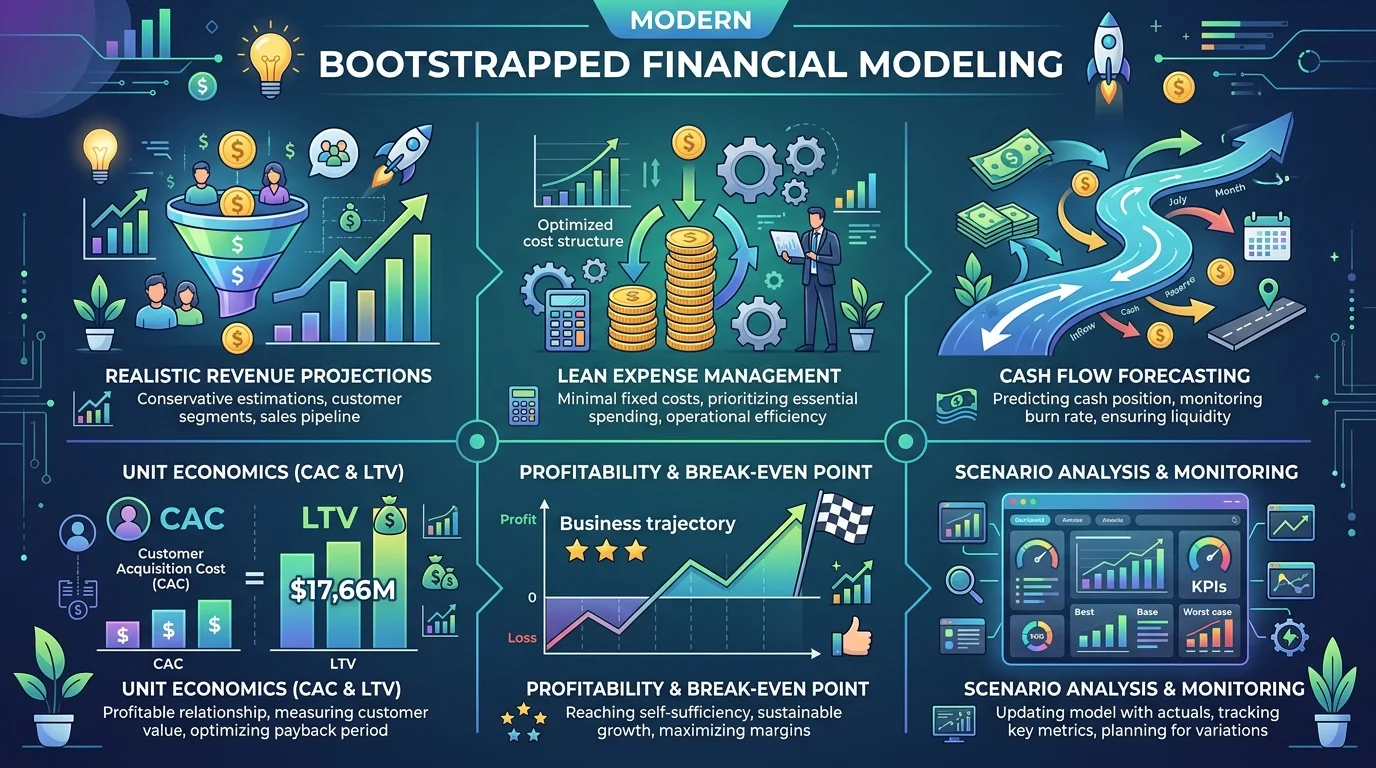
The Core Components of a Startup Booted Financial Model
Every dependable startup financial model template rests on the same building blocks. Skip one, and the whole forecast becomes shaky. These pieces work together, feeding into each other like gears in a clock.
Think of it as a chain. Your revenue assumptions shape your cash flow. Your cash flow shapes your burn rate. Your burn rate shapes how long you can operate. Miss a link, and the rest of the chain stops making sense.
Revenue Forecasting
Revenue forecasting for startups should start with numbers you already have, not numbers you wish were true. If you're closing five customers a month at $200 each, that's your baseline. Build forward from there, not from a slide claiming you'll "capture 1% of a massive market."
Cost Structure (Fixed vs. Variable)
Fixed costs stay the same no matter what you sell. Rent and salaries fall here. Variable costs move with sales, like payment processing fees or shipping. Separating the two shows you exactly how much flexibility your business really has.
Cash Flow Forecasting
This tracks the timing of money, not just the amount. A sale this month might not turn into cash for sixty days. Meanwhile, your bills are due next week. That timing gap is where otherwise healthy companies run into trouble.
Burn Rate and Runway
Your monthly loss, subtracted from your cash balance, tells you how long you have left. This single number often matters more than any other metric in the whole model, especially for founders without a funding cushion behind them.
Break-Even Analysis
Break-even analysis shows the exact revenue needed to cover every cost. Below that line, you're burning cash. Above it, you're building a cushion. It's the cleanest, most motivating number in the entire model.
Unit Economics: CAC, LTV, ARPU, Churn
Unit economics reveal whether each customer actually makes you money. CAC is what it costs to win one customer. LTV is what that customer is worth over time. ARPU shows average revenue per user, while churn shows how many customers walk away each month.
Metric | What It Measures |
|---|---|
CAC | Cost to acquire one customer |
LTV | Total value a customer brings over time |
ARPU | Average revenue per user |
Churn | Percentage of customers lost monthly |
Gross margin | Revenue left after direct costs |
The Three-Statement Model
A three-statement financial model links the income statement, the balance sheet, and the cash flow statement together. The income statement shows profit. The balance sheet shows what you own and owe. The cash flow statement shows actual money movement. Together, they paint the full picture.
How to Build a Startup Booted Financial Model, Step by Step
You don't need a finance degree for this. You need honest numbers and a willingness to update them often. Here's the process, broken into nine manageable steps that any founder can follow.
Each step builds on the last one. Skip ahead, and you'll end up guessing at parts you should have calculated properly. Take it slow the first time. It gets faster after that.
Step 1 — Define the Business Model
Start by naming exactly how your company makes money. Subscriptions, one-time sales, and service fees all behave differently. A SaaS company and an agency need very different assumptions, so get this foundation right before moving forward.
Step 2 — List Revenue Streams
Break income into clear, separate categories instead of one vague number. If you sell subscriptions plus onboarding fees, model them separately. This makes the entire forecast far easier to understand and adjust later.
Step 3 — Estimate Customer Acquisition
Use real inputs like website visitors, conversion rate, and close rate. Customer acquisition forecasting built this way holds up under scrutiny. A guess like "we'll get more customers somehow" simply won't.
Step 4 — Forecast Costs
List every expense, from salaries down to your smallest software subscription. Small recurring charges add up fast, and founders often underestimate this category by twenty percent or more in their first attempt.
Step 5 — Build the Cash Flow Forecast
Lay out starting cash, expected inflows, expected outflows, and ending cash for each month. For extra precision, many founders keep a rolling 13-week cash flow forecast alongside the longer monthly view.
Step 6 — Calculate Burn Rate and Runway
Subtract monthly income from monthly spending to get your burn. Divide your cash balance by that number for runway. This single calculation should be checked weekly once cash gets tight.
Step 7 — Calculate Break-Even Revenue
Divide fixed costs by your gross margin percentage. That result is the exact monthly revenue you need just to stop losing money. It becomes the number your whole team should rally around.
Step 8 — Add Best/Base/Worst-Case Scenarios
Scenario planning means building three versions instead of one. A best case, a base case, and a worst case each tell a different story. The worst case usually reveals the most useful information of all three.
Step 9 — Review Actuals Monthly
A forecast that never gets checked against reality is just a guess dressed up in a spreadsheet. Compare actual numbers to your projections every single month, then adjust the following month's assumptions accordingly.
Startup Financial Modeling Formulas Every Founder Should Know
Numbers only help if you know how to calculate them correctly. These six formulas cover almost everything a bootstrapped founder needs day to day. Memorize them, or better yet, build them straight into your spreadsheet.
Each formula answers a specific question about survival or profitability. None of them require advanced math. They just require honest inputs pulled from your real bank statements and sales records.
Formula | Calculation | Example |
|---|---|---|
Runway | Cash Balance ÷ Monthly Burn | $50,000 ÷ $5,000 = 10 months |
Burn Rate | Cash Out − Cash In | $15,000 − $10,000 = $5,000 |
Break-Even Revenue | Fixed Costs ÷ Gross Margin % | $10,000 ÷ 80% = $12,500 |
Gross Margin | (Revenue − COGS) ÷ Revenue | $16,000 ÷ $20,000 = 80% |
LTV | ARPU × Gross Margin ÷ Churn | $50 × 80% ÷ 4% = $1,000 |
CAC Payback | CAC ÷ Monthly Gross Profit | $200 ÷ $40 = 5 months |
Runway Formula
Your runway answers one question: how long can you keep operating? Divide cash on hand by your monthly burn. A ten-month runway gives you breathing room. A two-month runway means it's time to act now, not next quarter.
Burn Rate Formula
Burn rate calculation is simple subtraction. Take what leaves your account each month, subtract what comes in. The remainder is your burn. Watching this trend over three months tells you far more than any single snapshot.
Break-Even Revenue Formula
This formula tells you the exact sales target that gets you to zero loss. Once you know it, every sales conversation gains a clearer purpose. You're not just chasing revenue anymore. You're chasing a specific, meaningful number.
Gross Margin Formula
Gross margin percentage shows what's left after direct costs are covered. A higher margin means more room to invest, hire, or simply breathe. Software companies typically run high; physical product companies usually run lower.
LTV Formula
Customer lifetime value multiplies average revenue by margin, then divides by churn. It answers a simple question: what is one customer actually worth over their entire relationship with you? That number should always beat your acquisition cost.
CAC Payback Formula
This tells you how many months it takes to earn back what you spent acquiring a customer. Shorter payback periods mean healthier cash flow. For self-funded startup planning, anything beyond twelve months usually signals real trouble ahead.
A Real Example: SaaS Startup Booted Financial Model
Numbers make more sense with a real story attached. Meet a fictional founder we'll call Priya, running a solo B2B SaaS company out of Austin, Texas. She charges $99 a month and started with twenty paying customers.
"I used to just check my bank balance and hope," Priya says, describing her old process. "Once I built an actual model, I finally understood which decisions I could afford." Her numbers below show exactly how that shift played out across three scenarios.
Scenario | MRR | Monthly Expenses | Net Cash Flow | Runway |
|---|---|---|---|---|
Best Case | $6,500 | $4,200 | +$2,300 | Growing |
Base Case | $4,800 | $4,500 | +$300 | 24+ months |
Worst Case | $3,200 | $4,500 | −$1,300 | 11 months |
Best Case
In this version, growth beats expectations. Customer acquisition runs smoothly, churn stays low, and expenses stay controlled. Priya's cash position grows steadily, giving her room to reinvest in marketing or bring on part-time help.
Base Case
This is her realistic, expected outcome. Revenue covers most costs, with a small monthly cushion left over. It's not exciting, but it's stable, and stability is exactly what a bootstrapped founder should be aiming for early on.
Worst Case
Here, growth stalls and one major customer churns. Cash flow turns negative, though runway still holds for nearly a year. This scenario is uncomfortable to look at, but it's the one that actually prepares founders for real setbacks.
What Happens If CAC Rises or Churn Improves
If CAC climbs from $100 to $150, Priya needs roughly fifty percent more cash just to hit the same growth target. On the flip side, if churn drops from four percent to two percent, her LTV-to-CAC ratio doubles almost overnight. Small shifts in either number move the whole model dramatically.
Best Tools, Templates & AI Options for Startup Booted Financial Modeling
You don't need expensive software to get started. Most bootstrapped founders build their first working model in a free spreadsheet, then upgrade tools only once the business genuinely demands it.
That said, the right tool saves real hours. Below are the three categories worth knowing, along with guidance on when each one actually makes sense for your stage.
Spreadsheet Templates (Google Sheets vs. Excel)
Google Sheets financial model setups are free, cloud-based, and easy to share with a co-founder. Excel financial modeling offers more advanced formulas and automation once your business gets more complex. For most early-stage founders, Sheets is genuinely enough.
AI-Assisted Modeling Tools
AI financial modeling tools can now draft your first structure, write formulas, and stress-test assumptions in plain English. Pairing an AI assistant with a spreadsheet cuts setup time from days down to a few focused hours.
Choosing the Right Tool for Your Stage
Early on, a spreadsheet plus QuickBooks / Xero accounting covers nearly everything you need. As complexity grows, some founders eventually bring in fractional CFO services or add KPI dashboard tracking for cleaner, faster visibility.
Common Mistakes in Startup Booted Financial Modeling (and How to Fix Them)
Even careful founders trip over the same handful of mistakes. Recognizing them early saves months of confusion later, especially once actual bank statements stop matching the spreadsheet.
None of these mistakes are complicated to fix. Most just require a bit more honesty, or a bit more consistency, than founders naturally bring to the process on their own.
Overly Optimistic Revenue Assumptions
Assuming twenty percent monthly growth "because that seems reasonable" isn't a forecast. It's a guess wearing a spreadsheet costume. Base every projection on your actual conversion rate and actual sales history instead.
Ignoring Cash Flow Timing
Revenue and cash are not the same thing. A big sale this month might not become spendable cash for sixty days. Always model when money actually lands, not just when the invoice goes out.
Hiring Too Early
A new salary becomes a fixed cost the moment you sign an offer letter. Before hiring, check whether current revenue supports that role for at least six months. If you're bringing on a project or ops lead, a solid list of project manager interview questions helps you confirm you're hiring the right person before that cost hits your books.
Not Separating Fixed and Variable Costs
Lumping every expense together hides how much flexibility your business truly has. Fixed costs and variable costs behave completely differently under pressure, so your model needs to treat them as separate categories entirely.
Forgetting Taxes
Taxes surprise a lot of first-time founders. Payroll taxes, self-employment tax, and sales tax all pull real cash out of the business. Build estimated tax obligations into your model from month one, not as an afterthought.
Not Updating the Model
A model built once and never touched again becomes a historical document, not a planning tool. Set aside thirty minutes monthly to compare actuals against your forecast and adjust accordingly.
Copying a VC-Backed Model
Spending aggressively "because that's what funded startups do" is a fast way to run out of cash. VC-backed vs bootstrapped modeling requires completely different assumptions about risk, hiring pace, and acceptable losses.
How Often Should Founders Update the Model? (Monthly Checklist)
Once a month, sit down and compare your actual numbers against what you projected. This single habit does more for financial control than almost any other single practice a founder can adopt. Turning this into a documented standard operating procedure makes it far more likely you'll actually stick with the habit past the first few months.
If cash gets tight, or runway drops below six months, shift this review to a weekly rhythm instead. The table below covers what a solid monthly review should include.
Review Item | Why It Matters |
|---|---|
Actual revenue vs. forecast | Reveals if growth assumptions still hold |
Actual expenses vs. forecast | Flags cost creep before it compounds |
Cash balance and updated runway | Shows how much time is really left |
CAC and churn actuals | Confirms whether unit economics stay healthy |
Working capital position | Highlights delayed payments or collection issues |
Working capital management deserves special attention here. Late-paying customers can quietly drain a healthy-looking business, so tracking receivables alongside your cash forecast catches problems before they become emergencies. If your review lands the same week a new hire starts, a warm welcome message is a small touch that keeps culture intact even while you're heads-down in the numbers.
Frequently Asked Questions
What is startup booted financial modeling?
It's the process of forecasting revenue, expenses, and cash flow using only money the business generates itself. There's no reliance on outside investor funding. The goal is sustainable survival, not rapid, unchecked growth at any cost.
Is startup booted financial modeling the same as bootstrapped financial modeling?
Yes, essentially. Both terms describe the same approach: planning around self-funded startup planning principles, where customer revenue funds every decision instead of external capital from outside backers.
How do you calculate startup runway?
Divide your current cash balance by your monthly burn rate. If you hold $60,000 and lose $6,000 monthly, your runway equals ten months. Recalculate this every time your spending or income shifts noticeably.
How do you calculate startup burn rate?
Subtract monthly cash coming in from monthly cash going out. Spending $15,000 while earning $10,000 gives you a $5,000 monthly burn. Track this figure consistently to catch worsening trends early.
What's the difference between bootstrapped and VC-backed financial modeling?
Bootstrapped modeling prioritizes cash discipline and profitability from day one. VC-backed modeling often accepts short-term losses in exchange for faster growth and market share, betting on future funding rounds to cover the gap.
Conclusion
Startup booted financial modeling isn't busywork for a pitch deck nobody reads twice. It's the operating system behind every smart decision a self-funded founder makes, from hiring to pricing to simply deciding what to spend on next.
Build your first model this week. Keep it honest, keep it simple, and update it every month without fail. Founders who know their numbers cold tend to survive the moments that catch everyone else completely off guard.
Read more: Recent Innovative Marketing Campaigns 2026 (Examples)