
A voided check is a blank, unsigned check with "VOID" written across the front in large letters. It can't be cashed or deposited, but it still shows your routing number and account number — which is exactly why employers and billers ask for one to set up direct deposit or automatic payments. Below, I'll walk you through exactly how to void a check, safely, in under a minute.
I still remember the first time someone asked me for a voided check — I had no idea what to do with it. Turns out, it's a lot simpler than it sounds. Let's dive in.
What Is A Voided Check, Really?
Before we get into the "how," let's quickly nail down the "what," because this trips a lot of people up.
A voided check is simply a blank check with the word "VOID" written across the front of it in big, bold letters.
That's the whole concept.
It can't be used to pay anyone. It can't be cashed. It can't be deposited. But it still shows your bank account number and your routing number — which is exactly the info your employer or biller needs.
Think of it like handing someone your ID, but stamped "not valid for purchases." They can still read your name and info. They just can't use it to take your money.
Why You'd Ever Need To Void A Check
You might be wondering why this still matters in 2026, when nobody writes checks anymore. Fair question. Turns out, checks are still working quietly behind the scenes of a lot of digital banking — here's where you'll run into them.
Setting Up Direct Deposit
This is, by far, the number one reason people need to void a check.
When you start a new job, your employer needs to know exactly where to send your paycheck. Rather than have you scribble your account numbers on a sticky note — where one wrong digit could send your money to a stranger — they ask for a voided check for direct deposit instead.
Why? Because it's a pre-verified, bank-issued copy of your routing number and account number. No guesswork, no typos, no delayed paycheck.
Setting Up Automatic Payments
Landlords, utility companies, and loan providers often want a voided check too, so they can set up automatic bill payments or ACH withdrawals straight from your account. This is a common piece of good financial planning — similar to how having a contingency plan helps you stay prepared for unexpected expenses, keeping your recurring bills organized keeps your finances predictable too.
Fixing A Mistake
Ever written a check and immediately regretted it — wrong amount, wrong name, coffee spilled on it? Voiding it is way safer than just tossing it in the trash. More on safe disposal below.
Preventing Fraud
This one's huge, and people don't talk about it enough.
If a blank check falls into the wrong hands, someone could fill it out, write their own name as the payee, and drain your account. Voiding it properly makes that impossible.
How To Void A Check: Step-By-Step
Here's the part you actually came for. Let's make it simple.
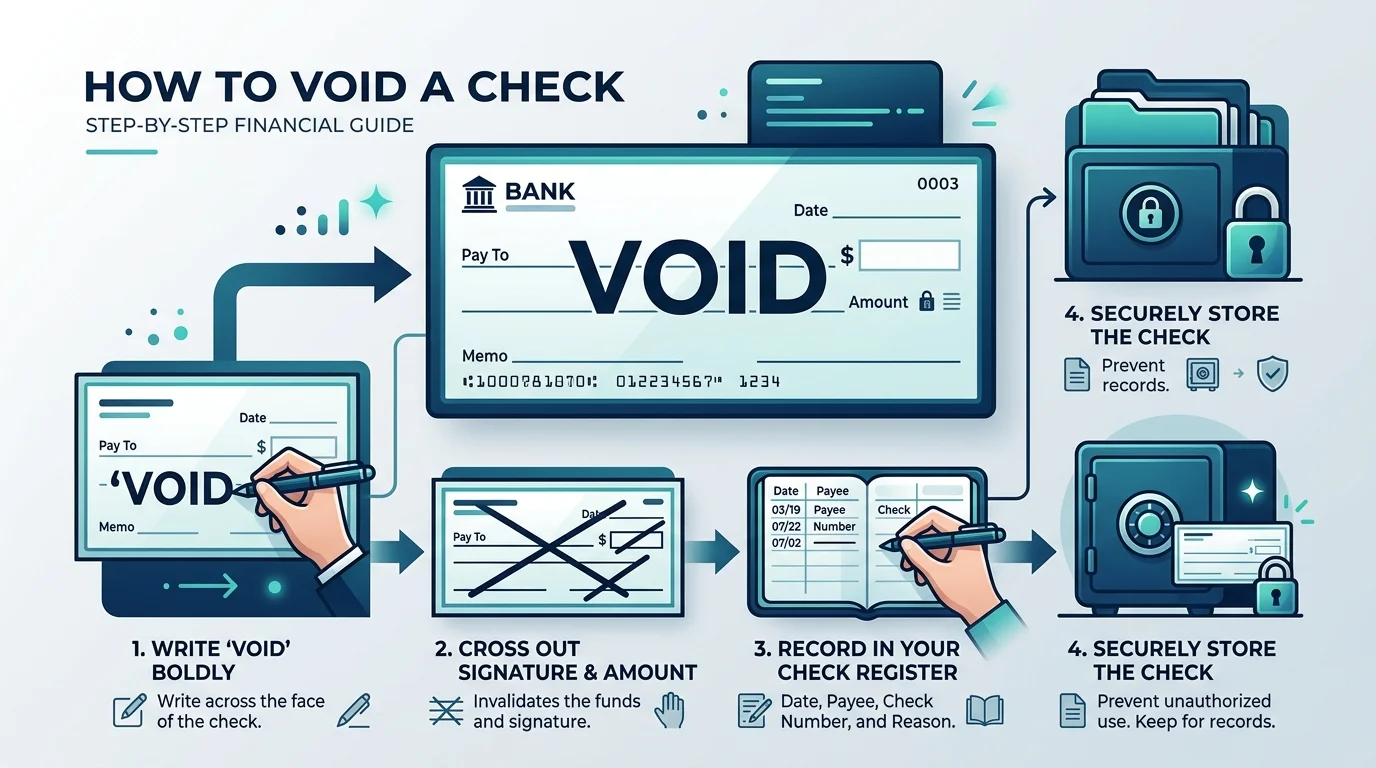
Step 1: Grab A Pen With Dark Ink
Use blue or black ink only — not a pencil, not a colored gel pen. Per PNC's official guide, other ink colors sometimes don't scan or photocopy well, which defeats the whole purpose.
Step 2: Write "VOID" In Big, Bold Letters
Write VOID in large capital letters across the front of the check. Make it obvious — it should cover most of the check's surface.
But don't cover the account number or routing number at the bottom. Those need to stay perfectly legible.
Step 3: Don't Touch The Check Number
Leave the check number alone. You'll want it later to track in your checkbook or banking app and confirm it never accidentally clears.
Step 4: Never Sign It
This one's non-negotiable. A signature authorizes a check to be used, so leaving it blank is your last line of defense — even if someone later tries to erase the "VOID" text.
Step 5: Snap A Photo Or Make A Copy
Before handing it over or shredding it, take a quick photo for your records. That way, if there's ever a dispute, you have proof of exactly what was submitted.
Step 6: Dispose Of It Safely
A voided check still carries your sensitive banking information. Don't just crumple it into the trash. According to Nebraska Bank's guide, the safest method is shredding — or cutting it into pieces with scissors, making sure you slice directly through your name, address, account number, and signature line.
What If You Already Sent The Check?
This is where things change a bit.
If a check has already left your hands — mailed or handed over — you can't just write "VOID" on it anymore. Instead, you'll need to place a stop payment through your bank:
Confirm the check hasn't already been cashed or deposited.
Provide your bank with the check number, date, and amount.
Pay a stop payment fee.
According to Melio's payments guide, stop payment fees typically run around $30 or more, and the order usually lasts about six months — so you'll need to renew it if the check is still outstanding after that.
Don't Have A Checkbook? No Problem.
If you don't have physical checks anymore — pretty common these days — you're not stuck.
You can ask your bank teller to print a pre-voided check on the spot. Or many employers will accept a direct deposit authorization form instead, where you just type in your routing and account numbers.
Voiding A Check Digitally Or In Accounting Software
If you're a business owner rather than an individual employee, you might be voiding checks inside accounting or payroll software instead of on paper.
In most systems, this works differently — you're not writing "VOID" by hand, you're marking a posted transaction as void so the ledger reflects that the check was never actually cashed. This typically involves:
Locating the check in your check ledger or payment journal
Selecting the transaction and choosing a "void check" action
Choosing whether to reverse just the bank entry or the full general ledger entry
Confirming the void date
This matters for bookkeeping accuracy — an unvoided but uncashed check can throw off your reconciliation at month-end. If you're building out your finances from scratch, this ties closely into good financial modeling for startups, where clean, accurate transaction records make forecasting far more reliable.
Voided Check vs. Deposit Slip vs. Direct Deposit Form
People often confuse these three, so here's a quick side-by-side:
Document | What It Shows | Best Used For | Security Level |
|---|---|---|---|
Voided check | Routing number, account number, name, address | Direct deposit setup, ACH payments | High — bank-verified, hard to falsify |
Deposit slip | Account number only (no routing number on some slips) | Manual bank deposits | Medium — limited info, not standardized |
Direct deposit form | Manually entered routing/account numbers | When no checks are available | Lower — relies on manual accuracy |
A voided check is generally the safer, more universally accepted option because it comes pre-printed with standardized, machine-readable banking details — reducing the chance of typos or payment errors.
Frequently Asked Questions
Do I need to sign a voided check?
No. Never sign a voided check. Leaving it unsigned is an extra layer of protection, even after you've written "VOID" across it.
Can I void a check that's already been cashed?
No. You can only void a check that's still outstanding — meaning it hasn't been cashed or deposited yet. If it's already cleared, voiding is no longer possible.
How much does a stop payment cost?
Fees vary by bank, but they typically run around $30 or more, according to Melio's payment guide.
Is a voided check the same as a canceled check?
Not quite. A voided check is one you've intentionally marked as unusable before it's ever used. A canceled check usually refers to one that's already been processed and cleared by the bank.
What if I don't have any checks left?
You can request a pre-voided check from your bank teller, or ask your employer if they'll accept a direct deposit form instead.
Final Thoughts
Voiding a check feels intimidating right up until you actually do it once.
Now that you know the steps — dark ink, big bold letters, protect the routing and account numbers, never sign it, shred it after — you're ready to handle it whenever your employer, landlord, or biller asks.
Set up that direct deposit. Get that automatic payment scheduled. You've got this.