
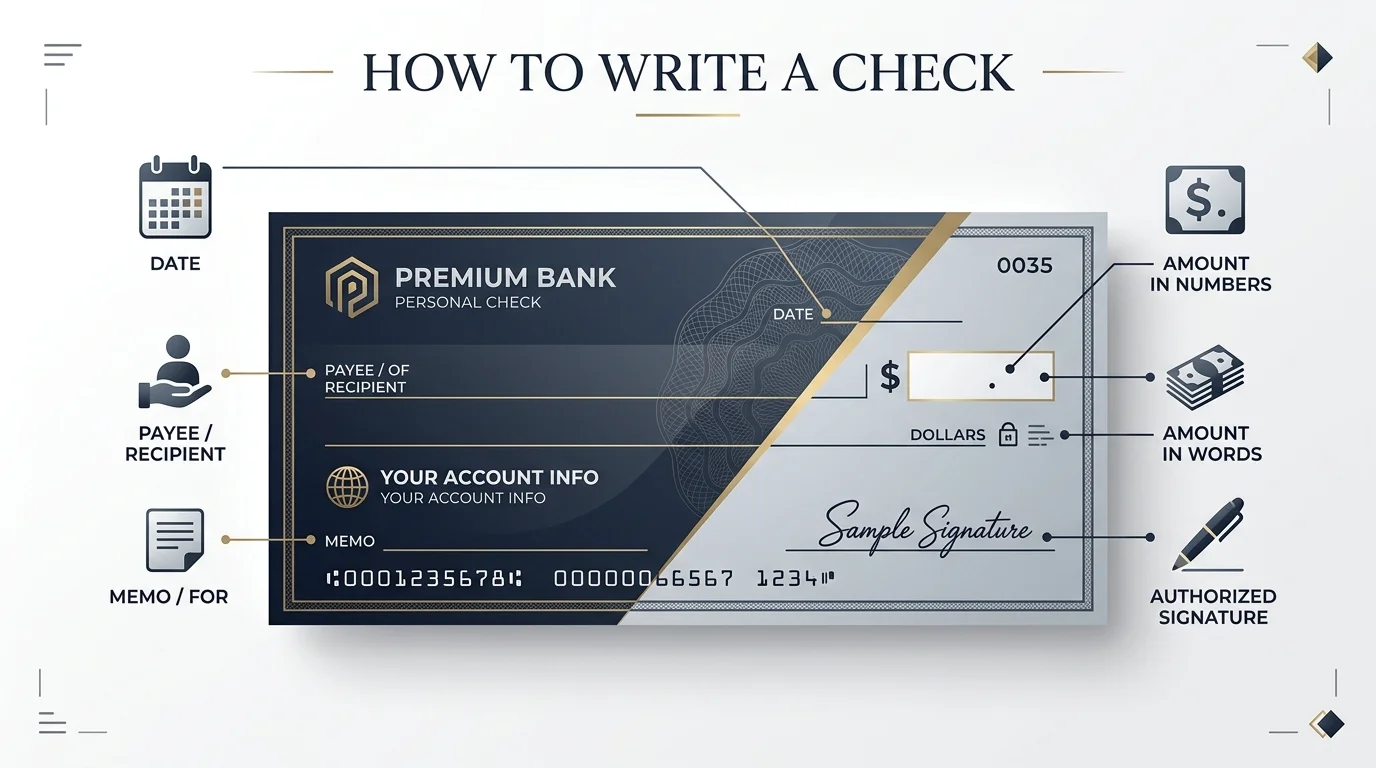
Write a check takes six steps: the date, the payee's name, the amount in numbers, the amount in words, a memo, and your signature. Each field has a specific spot on the check and a specific purpose, and getting them right the first time prevents delays, bounced payments, and fraud. Checks are still accepted for rent, contractor invoices, utility bills, and government payments, so knowing how to fill one out correctly remains a practical skill even as digital payments grow. This guide walks through every field on the check, shows real dollar-amount examples, and covers the mistakes that most often cause a check to be rejected.
Why Knowing How to Write a Check Still Matters
Paper checks remain one of the few payment methods accepted almost everywhere, including by landlords, small contractors, schools, and government agencies. Checks remain a common way to pay for things like rent, utilities, or services from small businesses, and they provide a secure and reliable method of payment with a clear paper trail. Unlike a digital transfer, a check also creates a physical record that both parties can reference later if a payment is disputed. For anyone managing a household budget, a landlord relationship, or a small business's accounts payable, a correctly written check is still one of the most dependable ways to move money.
Check use has dropped sharply in recent years. Just 7% of consumers said they paid a bill by check in 2024, down from 19% in 2020, and the Federal Reserve Bank of Atlanta found that 90% of surveyed consumers now prefer an electronic alternative for paying bills. Even so, checks haven't disappeared: many landlords, contractors, schools, and government agencies still require or prefer them, which is exactly why writing one correctly still matters.
How a Check Compares to Other Payment Methods
Payment Method | Speed | Fraud Risk | Paper Trail | Common Use Case |
|---|---|---|---|---|
Personal check | 1–5 business days to clear | Moderate (alterable if not secured) | Yes, physical | Rent, contractors, small businesses |
Cashier's check | Same day, bank-guaranteed | Low | Yes, bank-issued | Large purchases, closings |
Money order | Same day, prepaid | Low | Yes, receipt-based | Small guaranteed payments |
Digital/ACH transfer | 1–3 business days | Low to moderate (phishing risk) | Yes, digital record | Bill pay, payroll, rent apps |
What You Need Before Writing a Check
Gather these before you start filling anything in:
A blank check from an active checking account
A blue or black pen (never pencil or red ink)
The payee's full, correctly spelled name
The exact payment amount, including cents
Enough funds in your account to cover the amount
Your checkbook register, budgeting app, or spreadsheet for recording the transaction afterward
Using a blue or black gel pen keeps the information clear and helps protect against fraud, since pencil can be erased and red ink can be hard to read or photocopy.
Step-by-Step: How to Fill Out a Check
Step 1: Write the Date
Write the date in the upper right corner, including the month, day, and year. You can either spell out the month or use numbers; both "July 1, 2026" and "7/1/2026" are accepted. You can generally write a check with a future date, known as a postdated check, though a bank may still process it before the date written on the check.
Step 2: Write the Payee's Name
On the line that says "Pay to the order of," write the full name of the person or business being paid. Spell the name correctly to avoid any issues with the payee cashing the check. Never leave this line blank, and never write "cash," since anyone who finds the check could then cash it.
Step 3: Enter the Amount in Numbers
Write the amount numerically in the small box next to the payee's name, using a decimal point to separate dollars from cents even for a whole-dollar amount, such as "100.00," and add commas for amounts over $1,000. Write the numbers large enough to fill the box, since writing the amount close to the left-hand border helps prevent fraud, such as someone adding extra digits to turn 100.00 into 2,100.00.
Step 4: Write the Amount in Words
Below the payee line, spell out the dollar amount and write the cents as a fraction over 100. For a check in the amount of $55, this line should read "Fifty-five and 00/100," and for $52.45 it should read "Fifty-two and 45/100." This step matters legally: if the numeric and written amounts ever disagree, the written words are what determines the amount owed.
Begin writing as far left on the line as possible. If space remains at the end of the line, draw a horizontal line through it so no one can add extra words or numbers.
Step 5: Fill In the Memo Line (Optional)
The memo line lets you note the purpose of the check, which is useful if you get a scanned copy back later and can't remember why it was written. Some payees, such as utility companies or the IRS, ask you to write an account number here instead, since that information isn't printed elsewhere on the check.
Step 6: Sign the Check
Sign on the line in the bottom right corner, using the same signature your bank has on file. The recipient can't deposit or cash the check unless it's signed. Always sign last, after every other field is filled in and double-checked, since a signed check with blank fields is a security risk.
How to Write a Check With Cents
Cents cause the most confusion when writing a check, so it helps to see it worked through directly. Put the cents amount over 100 in the written line, so a check for $236.79 is written as "two hundred thirty-six and 79/100." Even a whole-dollar payment should include "00/100" or "no/100" on the written line for clarity, such as "Three hundred seventy-five dollars and 00/100" for a $375.00 check.
Check Amount | Numeric Box | Written Line |
|---|---|---|
$55.00 | 55.00 | Fifty-five and 00/100 |
$236.79 | 236.79 | Two hundred thirty-six and 79/100 |
$1,000.50 | 1,000.50 | One thousand and 50/100 |
$5,250.00 | 5,250.00 | Five thousand two hundred fifty and 00/100 |
$0.75 | 0.75 | Zero and 75/100 |
For a check under a dollar, such as 75 cents, write "0.75" in the amount box and "Zero and 75/100" or "No Dollars and 75/100" on the written line.
How to Void a Check
Mistakes happen, and a voided check is the safest way to correct one. To void a check, write "VOID" in large letters across the entire face of the check, or write it individually across the date line, payee line, amount box, amount line, and signature line. Shred the voided check once it's no longer needed rather than throwing it away intact.
How to Track a Check After Writing It
Recording every check keeps your account balance accurate and makes it easier to catch fraud or bank errors. Record the check number, date, payee, amount, and new running balance in a checkbook register, budgeting app, or spreadsheet, and repeat this for every transaction, including debit card purchases, ATM withdrawals, deposits, and fees. Each month, compare your register against your bank statement to confirm everything matches. For a deeper look at reading your overall finances once your register is up to date, check out our guide on how to read a balance sheet.
Common Mistakes to Avoid When Writing a Check
Leaving the amount blank. Filling in the amount before signing prevents a payee from entering any figure they choose.
Using pencil. A pen prevents erasures and tampering; pencil does not.
Writing "cash" as the payee. This lets anyone who finds the check cash it.
Leaving blank space after the amount. Draw a line through unused space on both the numeric box and the written line.
Mismatched numeric and written amounts. Double-check both fields match before signing.
Mailing from a residential or curbside mailbox. Drop mailed checks at a post office rather than an unsecured mailbox to reduce theft risk.
Sharing photos of checks online. A visible check exposes your routing and account numbers, address, and signature, which can be used to create counterfeit checks or commit identity theft. If you ever need to cancel a payment instead of risking this, see our guide on how to void a check.
Frequently Asked Questions
Can I write a check with a future date?
Yes. This is called a postdated check, but a bank may still process it before the date listed, so it isn't a guaranteed way to delay payment.
What happens if the numbers and words on a check don't match?
Banks generally treat the written-out amount as the official amount, since it's harder to alter than a number.
Do I have to fill in the memo line?
No, the memo line is optional. It's mainly useful for your own records or when a payee asks you to note an account number there.
How do I write a check for less than one dollar?
Write the decimal amount, such as "0.75," in the numeric box, and write "Zero and 75/100" or "No Dollars and 75/100" on the written line.
What ink color should I use to write a check?
Blue or black ink is standard. Red ink can be hard to read and may not photocopy or scan well.
Can someone alter a check if I leave blank space?
Yes. Leaving blank space after the amount, in either the numeric box or the written line, makes it easier for someone to add extra digits or words. Draw a line through any unused space.
How do I fix a mistake on a check I haven't handed over yet?
Write "VOID" across the entire check and start over on a new one rather than crossing out and correcting the error.
Is it safe to write a check for someone I don't know well?
A check reveals your bank account and routing numbers to the payee, so only write checks to people and businesses you trust.
Conclusion
Writing a check correctly comes down to six consistent fields: date, payee, numeric amount, written amount, memo, and signature. Getting each one right, using permanent ink, avoiding blank spaces, and recording every check in a register are the habits that keep your account both accurate and secure. Once you've written a few checks following these steps, the process becomes routine.
Read Also: What Is Machine Learning? A Clear 2026 Guide