
Quick answer: To learn Spanish fast, expect roughly 350–400 hours to reach conversational B1 — not 30 days. The fastest route is mastering the 1,000 most frequent words, consuming input you understand ~98% of, and speaking from week two. Everything else is optimization around those three levers.
Now the hook.
I want to learn Spanish fast. You probably do too — otherwise you wouldn't be here.
But here's the thing nobody tells you upfront: most "fastest way to learn Spanish" advice is recycled nonsense written by people who don't speak Spanish. I got tired of it. So I went digging through FSI data, corpus linguistics papers, and second-language acquisition meta-analyses to figure out what actually moves the needle.
What I found surprised me.
Spanish is genuinely one of the cheapest languages you can buy with your time. The U.S. Foreign Service Institute puts it in Category I — their easiest tier — at roughly 600 to 750 class hours to hit professional working proficiency. Compare that to Japanese or Arabic at about 2,200 hours. You're playing on easy mode and you didn't even know it.
Why Most People Fail to Learn Spanish Fast
Let me be blunt with you for a second. The problem isn't that Spanish is hard. The problem is that you're spending your hours on the wrong things.
I've watched people grind through verb conjugation drills for eight months and still freeze when a waiter asks them a question. Meanwhile, someone else watches beginner Spanish videos for 20 minutes a day and is holding conversations by month four. Same time investment. Wildly different results.
The variable that decides your timeline isn't talent — it's what you do with your daily minutes.
The Hidden Cost of "Studying" Instead of Acquiring
Here's a distinction that changed everything for me.
Stephen Krashen — the linguist behind the Comprehension Hypothesis — argues that we acquire language by understanding messages, not by memorizing rules. The rival view, which he calls the Skill-Building Hypothesis, says you learn grammar first and then make it automatic through practice.
Guess which one your high school Spanish class was built on?
Now, I'm not going to pretend this is settled science. A 2025 Frontiers in Psychology critique pushed back hard on Krashen's input hypothesis, pointing out that learners have "spiky" profiles — a text can be far too hard for one student and far too easy for another, and proficiency isn't a single number you can plot on a line.
Fair point. But the practical takeaway holds: massive comprehensible input is the engine. Grammar study is the steering wheel. Most learners have it backwards.
Set a Realistic Timeline to Learn Spanish Fast
Before you build a plan, you need to know what you're aiming at. This is where I see the most disappointment — people expect conversational fluency in 30 days, don't get it, and quit.
So let's ground this in numbers.
The FSI's 600–750 hour figure comes with a huge asterisk: their students are aptitude-screened, study full-time in classes of six, and do homework on top. If you're self-teaching between Zoom calls, you'll likely need more total hours, not fewer.
But — and this is the good news — professional working proficiency is not your goal.
What Each CEFR Level Actually Costs You
Using Cambridge-style guided-learning-hour bands (which transfer reasonably to Spanish, a fellow FSI Category I language), here's the honest map of CEFR levels:
CEFR Level | Cumulative Hours | What You Can Actually Do | Exam Target |
|---|---|---|---|
A1 | ~80–100 | Introduce yourself, basic phrases | DELE A1 |
A2 | ~180–200 | Order food, handle travel, survive | DELE A2 |
B1 | ~350–400 | Real conversation, follow slow speech | DELE B1 / SIELE |
B2 | ~500–600 | Work in Spanish, TV without subtitles | DELE B2 |
C1 | ~700–800 | Debate, joke, read novels comfortably | DELE C1 |
Look at that B1 row again. Around 350 to 400 hours for conversational comfort.
How Long Will It Take You? (Daily Minutes → Months)
This is the table I wish every "learn Spanish fast" article had the nerve to print. Assuming a 375-hour B1 target:
Daily Study | Weekly Hours | Time to A2 (~190 hrs) | Time to B1 (~375 hrs) |
|---|---|---|---|
15 minutes | 1.75 | ~2 years | ~4.1 years |
30 minutes | 3.5 | ~12.5 months | ~2.1 years |
60 minutes | 7 | ~6.3 months | ~12.4 months |
90 minutes | 10.5 | ~4.2 months | ~8.2 months |
3 hours | 21 | ~2.1 months | ~4.1 months |
The math isn't the enemy. Your daily minutes are.
Step 1: Attack the Frequency Core First
This is the single highest-leverage move in this entire article, and I almost want to put it in a box with flashing lights.
Spanish vocabulary is brutally top-heavy. Corpus research from Mark Davies' Corpus del Español found that the 1,000 most frequent Spanish words cover about 87.8% of oral speech, 79.6% of fiction, and 76% of non-fiction.
Push to 2,000 words and spoken coverage jumps to 92.7%. At 3,000 words, you're at 94%.
Read that again. A thousand words — learnable in roughly two months of consistent effort — unlocks nearly nine out of ten words in everyday conversation. That's the 80/20 rule of vocabulary in its purest form.
How I'd Build Your First 1,000 Words
Step one: Get a proper frequency dictionary or frequency-ordered deck. Don't use themed lists like "50 animals in Spanish." You will not need jirafa in your first year. You will need aunque, sino, and hacia constantly.
Step two: Front-load the workhorse verbs — ser, estar, tener, hacer, poder, ir, decir, ver, dar, saber. These ten do an absurd amount of the heavy lifting, and they're mostly irregular, which is exactly why you learn them as chunks rather than tables.
Step three: Learn words in sentences, never isolation. "Aunque = although" is a fact you'll forget. "Aunque llueva, voy a ir" is a sentence you'll reuse.
Step four: Watch for false cognates. Embarazada doesn't mean embarrassed, éxito doesn't mean exit, and molestar very much doesn't mean what you think. Flag these on your cards.
Step five: Cap it at 15–20 new words per day. Beyond that, your review load compounds until you quit. I've seen it happen a dozen times.
Step 2: Use Spaced Repetition and Active Recall Properly
You've heard of spaced repetition. You may even have an Anki deck rotting on your hard drive right now. Mine sat untouched for three months once.
The evidence here is genuinely strong, though — this isn't productivity-guru folklore.
Kim and Webb's 2022 meta-analysis in Language Learning pooled 98 effect sizes from 48 experiments covering over 3,400 learners, and spaced practice consistently outperformed massed practice. A separate Cambridge meta-analysis on incidental vocabulary learning (2023) found the same pattern for words absorbed through reading and listening.
And the time cost is tiny. One double-blind study found students spending an average of three minutes a day on auto-generated vocabulary activities tripled their long-term retention rate.
Three minutes.
The Anki Rules That Kept Me Sane
Most people's SRS setups fail for boring, fixable reasons. Fix these five and you're ahead of 90% of learners:
Make your own cards. Downloaded mega-decks feel efficient but are full of words you don't care about. The five seconds spent making a card is itself an active recall event.
One fact per card. If your card tests gender, meaning, and conjugation at once, you'll fail it forever.
Add audio. Otherwise you build a silent vocabulary you can read but never recognize in speech. If you're pulling sentences from real Spanish audio, an AI transcription tool built for students makes it fast to turn a clip into card-ready text.
Review daily, no exceptions. Skip three days and the backlog feels like punishment. Skip a week and you're done.
Interleave. Mix verbs, nouns, and phrases in one session rather than blocking by category — interleaved practice beats blocked practice for retention.
Step 3: Get Comprehensible Input at the Right Level
Here's where most self-learners sabotage themselves. They finish a beginner app and immediately try to watch La Casa de Papel raw. Then they feel stupid and stop.
There's a hard number behind why that fails.
Hu and Nation's landmark 2000 study in Reading in a Foreign Language found learners need to know roughly 98% of the words in a text to comprehend it unassisted. At 95%, many struggle. At 80%, frustration dominates and acquisition basically stops.
So when native content feels like noise — that's not a character flaw. That's a lexical coverage problem, and it's fixable.
Your Input Ladder, Rung by Rung
Think of input as a staircase, not a leap.
Rungs 1–2 (Months 1–2): Comprehensible-input video built for beginners. Dreaming Spanish is the obvious pick — slow, visual, zero English. Add graded readers at A1.
Rung 3 (Months 2–4): Beginner Spanish podcasts where hosts speak slowly and explain in Spanish. Plus Spanish children's shows. Pocoyó is not beneath you.
One trick that accelerated my listening more than anything else: run a podcast episode through a Spanish audio to text converter and read the transcript alongside the audio. You catch every word you were mishearing — and mishearing is the silent killer of listening comprehension.
Rung 4 (Months 4–6): Dubbed content you already know by heart, Spanish subtitles on. Familiar plot = free context = higher effective coverage.
Rung 5 (Months 6+): Native podcasts, YouTube, TV. Netflix in Spanish with subtitles off when you can stand it. When a Spanish YouTube video has no captions — and plenty don't — you can pull a transcript from the YouTube URL and mine it for vocabulary before you watch.
The rule: you should understand most of what you're consuming. Under 70%? Drop a rung. There's no prize for suffering.
Step 4: Start Speaking Way Earlier Than Feels Comfortable
Input builds comprehension. It does not, by itself, build a mouth that moves fast under pressure.
There's a real debate here — Merrill Swain's output hypothesis argues that producing language forces you to notice gaps, which drives you to fix them. Krashen disputes how much this matters. But there's a practical reason to speak early that sidesteps the theory: speaking anxiety compounds the longer you avoid it.
There's also a hard data point. In U.S. university Spanish programs, students after four semesters averaged Intermediate Low in reading — but listening comprehension stayed at Novice High. Classroom instruction systematically underdevelops real-time skills.
Don't replicate that gap.
The Speaking Protocol I'd Follow
Week 2 — Start shadowing. Play a short clip and speak a half-second behind the speaker, copying rhythm and intonation. Ten minutes daily. The shadowing technique trains your mouth before you have anything to say — and it's the fastest fix for rolling the R.
Week 4 — Talk to yourself. Narrate your commute, your cooking, your irritations. Nobody's grading you.
Week 6 — Book a tutor. A community tutor on italki runs a few dollars an hour. Twice weekly, 30 minutes.
Week 10 — Find a language exchange partner. Half Spanish, half English, unstructured.
Ongoing — Learn to talk around gaps. Forgot escalera? Say "the stairs thing for going up." That's not failure. That's fluency.
Step 5: Handle Spanish Grammar Strategically
Nobody wants to hear this, but you do need some grammar. The trick is treating it as just-in-time reference rather than a curriculum you march through.
Study a structure only after you've bumped into it repeatedly in real input. That way the rule explains something you've already felt, rather than sitting in your head as abstract trivia.
Prioritize in this order and ignore everything else for now:
Present tense of the ten high-frequency verbs
Ser vs. estar — the classic beginner wall, worth one focused hour
Preterite vs. imperfect — the two past tenses carrying every story you'll ever tell
Near future (ir a + infinitive) — skip the "real" future tense at first
Gendered nouns and object pronoun placement
The subjunctive mood — genuinely, not until month six
Language Transfer's Complete Spanish is free and does this better than most paid programs I've tried.
Step 6: Manufacture Immersion Without Moving Abroad
Immersion learning doesn't require a plane ticket. It requires deleting English defaults from your life.
Switch your phone's system language. Change your Netflix and YouTube audio preferences. Follow Spanish YouTube channels in a niche you already care about — cooking, football, tech, true crime. Put Spanish radio on while you do dishes.
Is passive listening as good as focused study? No, not close. But it's nearly free in effort and does real work on your ear for prosody and connected speech.
One more thing: choose a dialect and lean in. Latin American vs. Castilian Spanish differ in pronunciation, vocabulary, even pronouns. You'll understand all of them eventually. Pick one to sound like now.
Language Learning Tools Compared
Here's the honest breakdown of the mobile-assisted language learning stack:
Tool | Cost | Best For | Main Weakness | Hours to Value |
|---|---|---|---|---|
Anki | Free | Long-term vocabulary retention | Steep setup; ugly UI | 2 hrs setup, then 15 min/day |
Duolingo | Free / ~$7 mo | Habit building, early A1–A2 | Weak on speaking and real listening | Immediate |
Language Transfer | Free | Grammar intuition, ser vs. estar | Audio-only; no vocabulary system | ~40 total hrs |
Dreaming Spanish | Free / ~$8 mo | Comprehensible input from day one | Slow early progress feels passive | Immediate |
Pimsleur | ~$20 mo | Pronunciation and recall drilling | Expensive; small vocabulary ceiling | ~30 min/day |
italki | $5–25/hr | Actual speaking practice | Costs money; requires scheduling | Week 6 onward |
A Word on Apps (Because You're Going to Ask)
Duolingo's own peer-reviewed research in Foreign Language Annals (Jiang et al., 2021) reported that learners completing five units of the Spanish course scored comparably on reading and listening to students who'd completed four university semesters — in under half the time.
Impressive. Also worth reading skeptically.
A critique published in the same journal noted that much of this efficacy research isn't conducted by researchers fully independent of commercial interests, and that outcome measures have often been less than ideal. Scholars have openly called for more rigorous, independent evaluation.
My position: apps are excellent for daily habit and early vocabulary. They are not a complete pathway. Use one for streak maintenance. Don't mistake it for the plan.
Your 90-Day Fast-Track Schedule
Let's make this concrete. Here's a 90-minute daily budget:
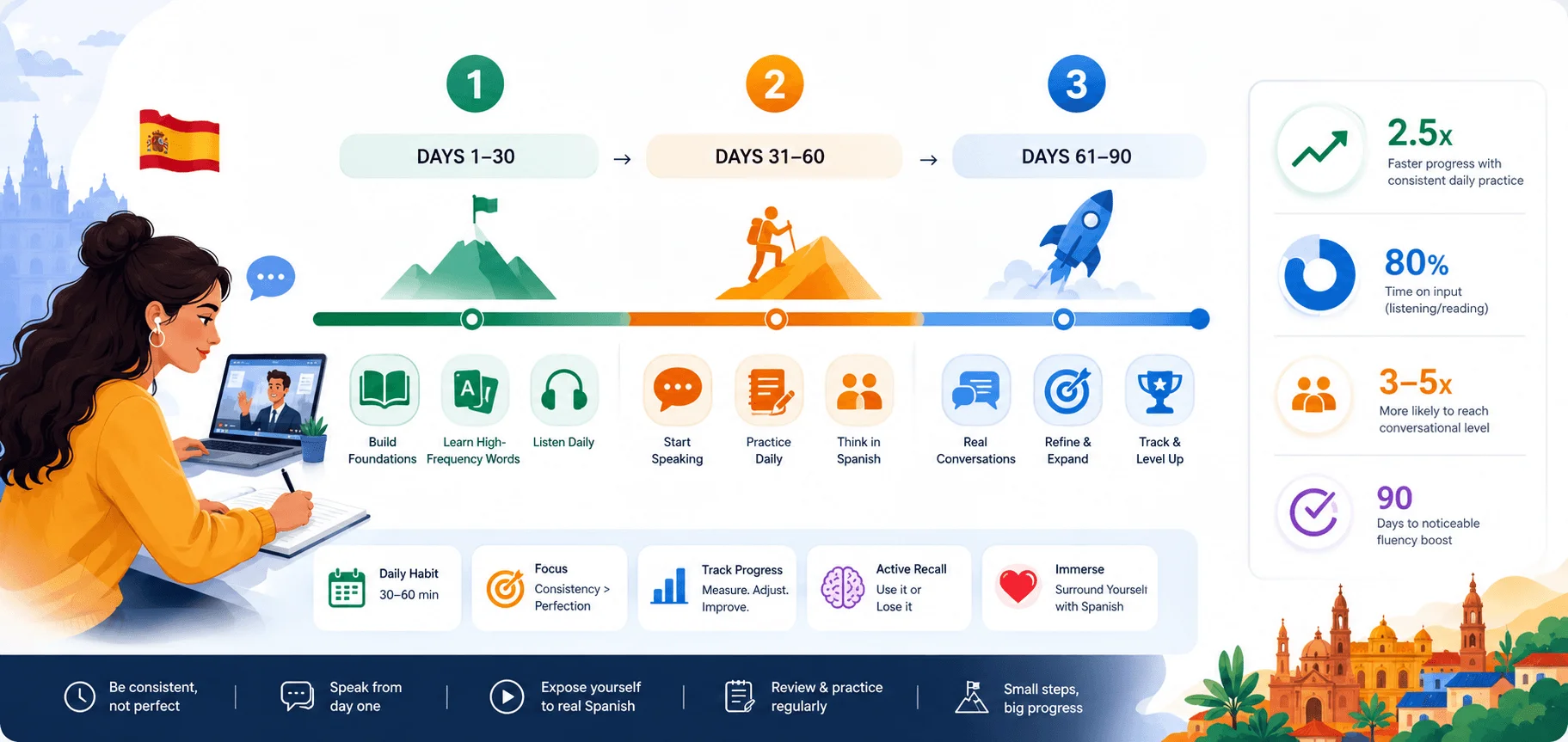
Days 1–30 — Foundation 20 min Anki (frequency vocabulary) · 30 min beginner comprehensible input · 10 min shadowing · 20 min pronunciation and core verbs · 10 min app drill
Days 31–60 — Expansion 20 min Anki · 30 min input, one rung harder · 20 min tutor session (2× weekly) · 10 min self-talk narration · 10 min targeted grammar
Days 61–90 — Production 15 min Anki · 30 min native-adjacent podcasts · 30 min conversation (tutor + exchange partner) · 15 min journaling in Spanish
Add 1–2 hours of passive listening on top — it costs you almost nothing.
Ninety days at this pace is roughly 150 hours. That won't make you fluent, and I won't lie to you about that. But it puts you in solid A2 territory with a real conversational foothold. From there, B1 is a matter of not stopping.
Frequently Asked Questions
Can I learn Spanish in 3 months?
You can reach solid A2 — travel-functional, basic conversations — in three months at 90 minutes daily, which is roughly 135–150 hours. Full conversational fluency at B1 needs about 350–400 hours, so three months only gets you there at three-plus hours per day. Treat 90 days as a foundation phase, not a finish line.
How many hours a day should I study Spanish to learn it fast?
Sixty to ninety minutes of focused daily study is the sweet spot for most working adults. That reaches B1 in roughly 8–12 months. Going beyond two hours produces diminishing returns for self-learners because review load and mental fatigue compound. Consistency beats intensity — 60 minutes daily outperforms seven hours every Sunday.
Is Duolingo enough to learn Spanish by itself?
No. Duolingo's own research shows strong reading and listening gains comparable to four university semesters, but independent scholars have questioned those measures, and the app systematically underdevelops speaking. Use it for habit-building and early vocabulary, then pair it with comprehensible input and live conversation practice by month two.
What's the fastest way to learn Spanish by yourself?
Three levers, in order: learn the 1,000 most frequent words via spaced repetition, consume input you understand about 98% of, and start speaking by week two. Corpus data shows the top 1,000 Spanish words cover 87.8% of oral speech, which makes frequency-first vocabulary the highest-leverage move available to a self-learner.
How many Spanish words do I need to be conversational?
About 1,000–2,000. The top 1,000 words cover roughly 87.8% of spoken Spanish; 2,000 pushes that to 92.7%. Beyond 3,000 words you hit 94% and returns flatten sharply. Focus your first year entirely on frequency-ranked vocabulary rather than themed lists.
Is Spanish actually easy for English speakers?
Comparatively, yes. The Foreign Service Institute classifies Spanish as Category I — its easiest tier — requiring about 600–750 class hours to professional proficiency, versus roughly 2,200 for Japanese, Korean, Mandarin, or Arabic. Shared Latin vocabulary and a phonetic writing system do most of that work.
Should I learn Latin American or Castilian Spanish?
Pick based on who you'll talk to. Latin American Spanish serves more speakers and dominates media; Castilian matters if you're heading to Spain. The differences — vosotros, the ceceo pronunciation, some vocabulary — are smaller than British versus American English. You'll understand both eventually.
Do I need to take the DELE exam?
Only if you need proof for work, immigration, or university. The DELE is permanent and widely recognized; SIELE is faster and valid five years. For personal learning, they're useful as deadline pressure but not required.
What "Fast" Actually Means
I'll leave you with the reframe that helped me most.
Fast doesn't mean skipping the hours. The hours are non-negotiable — that's what the FSI data really tells us. Fast means eliminating the wasted ones.
The person who reaches B1 in eight months and the person still stuck after four years usually put in similar total time. The difference is that one spent it on high-frequency vocabulary, level-appropriate input, and actual speaking practice — and the other spent it re-reading verb charts and rewatching the same beginner lesson.
You now know which pile to put your hours in.
Start today. Learn ten words. Watch one video you mostly understand. Say one sentence out loud, badly.
That's the whole thing. Repeat it 300 times.