

A contingency plan is a predefined "Plan B" strategy that outlines exactly what your team should do if a specific risk event actually happens — think supplier failure, IT outage, or key employee departure. Unlike a broad business continuity plan, it's narrow, actionable, and triggered by a specific scenario. Below, I'll show you exactly how to build one, step by step.
Let me ask you something.
What happens to your business the moment everything goes wrong?
Server crashes. Key employee quits. Supplier goes bankrupt overnight.
If you don't have an answer ready, you're not alone — but you are exposed. In fact, research from FEMA and business continuity studies consistently shows that a large share of businesses without a contingency plan struggle to reopen after a major disruption.
That's exactly why I'm writing this guide.
Let's dive in.
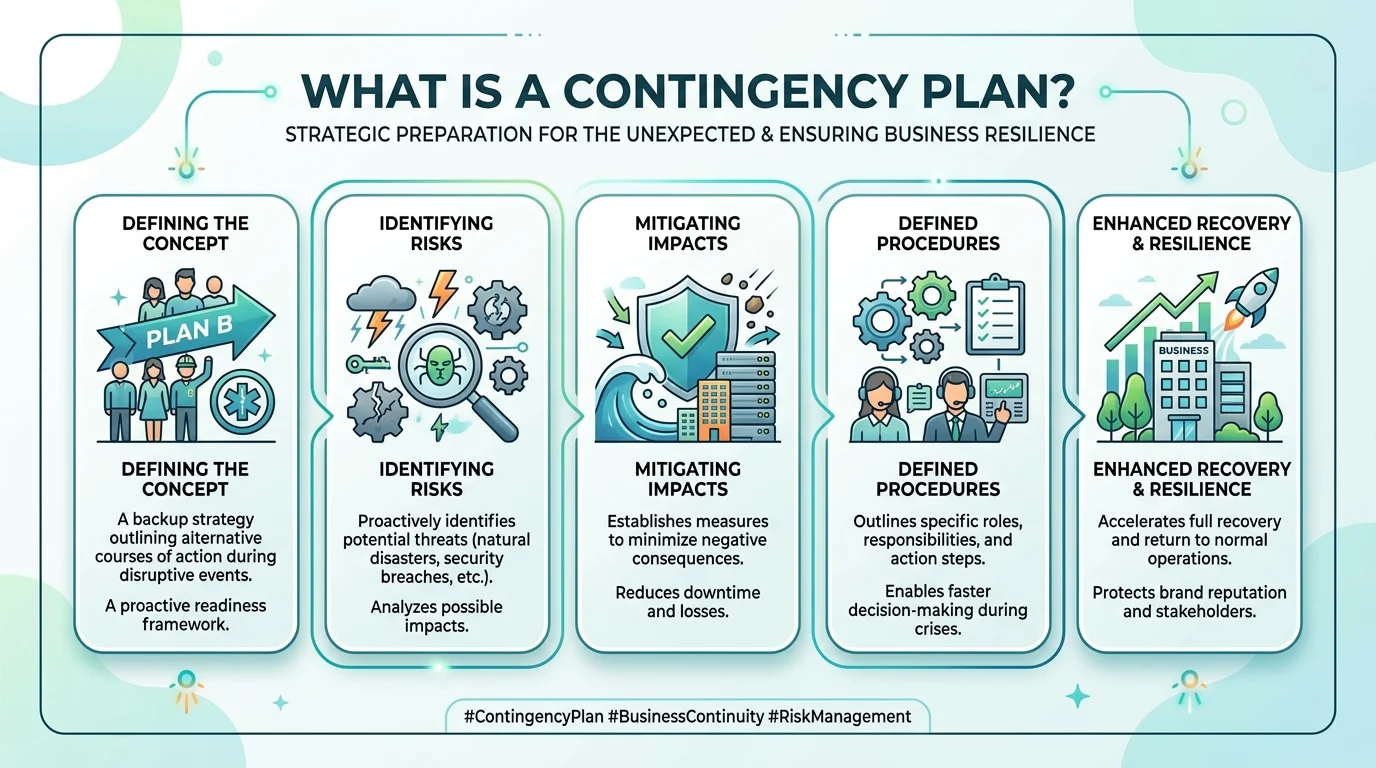
What Is a Contingency Plan, Really?
Here's the thing: most people think a contingency plan is just a fancy way of saying "backup plan." And honestly? They're not wrong.
According to Merriam-Webster, a contingency plan is simply a plan you follow when your original plan falls apart.
But there's more nuance to it than that.
IBM describes it as a scenario-specific strategy — one that gives your team clear instructions for how to respond to and recover from a specific, predefined event. Not a vague "we'll figure it out" approach. A real, actionable playbook.
Think of it as your organization's Plan B.
You hope you never need it. But if you do, you'll be so glad it exists.
Contingency Plan vs. Business Continuity Plan vs. Disaster Recovery Plan
Quick pause here — these terms get thrown around like they're interchangeable. They're not. Here's a table to make it crystal clear.
Plan Type | Focus | Timing | Scope | Example |
|---|---|---|---|---|
Contingency Plan | One specific risk event | Prepared before, activated when triggered | Narrow | Supplier goes bankrupt |
Business Continuity Plan (BCP) | Keeping the whole organization running | Active during and after disruption | Broad, org-wide | Office becomes unusable |
Disaster Recovery Plan (DRP) | Restoring IT systems and data | Activated after the disaster | Narrow, IT-focused | Ransomware attack |
Simple way to remember it: contingency planning answers "what if," business continuity keeps the ship afloat, and disaster recovery fixes the tech once the storm passes.
If you haven't built your standard operating procedures yet, that's a great foundation to pair with your contingency plan — SOPs keep your day-to-day consistent, while contingency plans handle the exceptions.
Why You Actually Need a Contingency Plan
Remember COVID-19? Companies with solid contingency plans reacted faster and pivoted quicker. The ones without a plan? Many scrambled — some never recovered.
A contingency plan isn't pessimism. It's risk management in action.
It's the difference between panicking when your main supplier goes under, versus calmly activating your pre-built backup vendor list.
Building a contingency plan actually starts the same way any good decision does — by identifying the problem clearly. If you want to sharpen that muscle first, check out this guide on the first step in the decision-making process before you map out your risks.
Types of Contingency Plans You Should Know About
Not every contingency plan looks the same. Here's a quick breakdown by category.
IT & Cybersecurity Contingency Plans
Covers server outages, ransomware, and data breaches. Usually includes backup servers and a communication protocol.
Financial Contingency Plans
Covers cash flow shortfalls, sudden loss of major clients, or economic downturns. Often includes emergency credit lines or reserve funds.
HR & Personnel Contingency Plans
Covers sudden departures of key staff. Cross-training and documented processes are the backbone here.
Natural Disaster Contingency Plans
Covers floods, fires, and severe weather. Usually ties directly into your business continuity plan.
How to Build a Contingency Plan (Step-by-Step)
Here's exactly how you build one, based on the NIST SP 800-34 framework and standard project management practice from PMI.
Step 1: Organize Your Planning Team
Pull together people from operations, IT, HR, and leadership. Different perspectives catch different blind spots.
Step 2: Assess the Scope of the Problem
Be specific. Don't just write "cyberattack" — ask what kind. This is where a proper risk assessment and business impact analysis come in.
Step 3: Develop the Plan
For each identified risk, outline the trigger, the response steps, and the recovery goal. This is your contingency measures document.
Step 4: Test the Plan
An untested plan is just a hopeful guess. Run drills before real life tests it for you.
Step 5: Keep It Updated
Set a recurring reminder — quarterly, ideally — to revisit and refresh your contingency plan.
Tip: grab a basic contingency plan checklist template so you're not starting from a blank page.
Real-World Examples of Contingency Plans in Action
IT outage: Automatic failover to a backup alternate facility, with pre-assigned IT roles and a ready customer communication script.
Supply chain: A vetted secondary vendor already on standby, avoiding weeks of scrambling.
Key personnel: Cross-training means someone else steps in without missing a beat.
Frequently Asked Questions
How often should you update a contingency plan?
Review it at least quarterly, and immediately after any major operational change — new vendors, new systems, or new leadership.
What's the difference between a contingency plan and a mitigation plan?
A mitigation plan reduces the likelihood of a risk happening. A contingency plan tells you what to do once it happens anyway.
Do small businesses need a contingency plan?
Yes. Smaller businesses often have less financial cushion, making a contingency plan even more critical than for large enterprises.
Is a contingency plan the same as insurance?
No. Insurance covers financial loss. A contingency plan covers operational response what your team actually does during the disruption.
The Bottom Line
The businesses that survive disruption aren't the luckiest ones. They're the prepared ones.
A solid contingency plan protects your operational resilience, keeps your team calm under pressure, and lets you sleep better at night.
So don't wait for the crisis to force your hand. Start small. Pick your biggest risk. Write down what you'd do if it happened tomorrow.
That's your first contingency plan.
Read More: Self-Management: What It Is + 6 Steps to Master It