
Ice breaker questions are short, low-pressure prompts used at the start of a meeting to get people talking before the agenda begins. They build what psychologists call psychological safety — an environment where team members feel comfortable speaking up, disagreeing, or asking questions without fear of judgment. Teams that use them consistently report faster participation, stronger trust, and smoother collaboration, according to Atlassian's research on team psychological safety.
Quick Takeaways
Icebreakers work because silence early in a meeting tends to predict silence for the rest of it
They're linked to lower stress hormones and better team cohesion, not just "nice to have" fun
The right icebreaker depends on group size, time available, and how well the team already knows each other
You'll find a ready-to-use question bank, a comparison table, and an FAQ section below
I used to roll my eyes at ice breaker questions. They felt corny — like something a summer camp counselor would make you do.
Then I started paying attention to what actually happens in meetings that skip them: silence, blank stares, everyone waiting for someone else to talk first.
So here's everything you need to know about team meeting icebreakers — why they work, how to pick the right ones, and a step-by-step approach you can use starting with your next call.
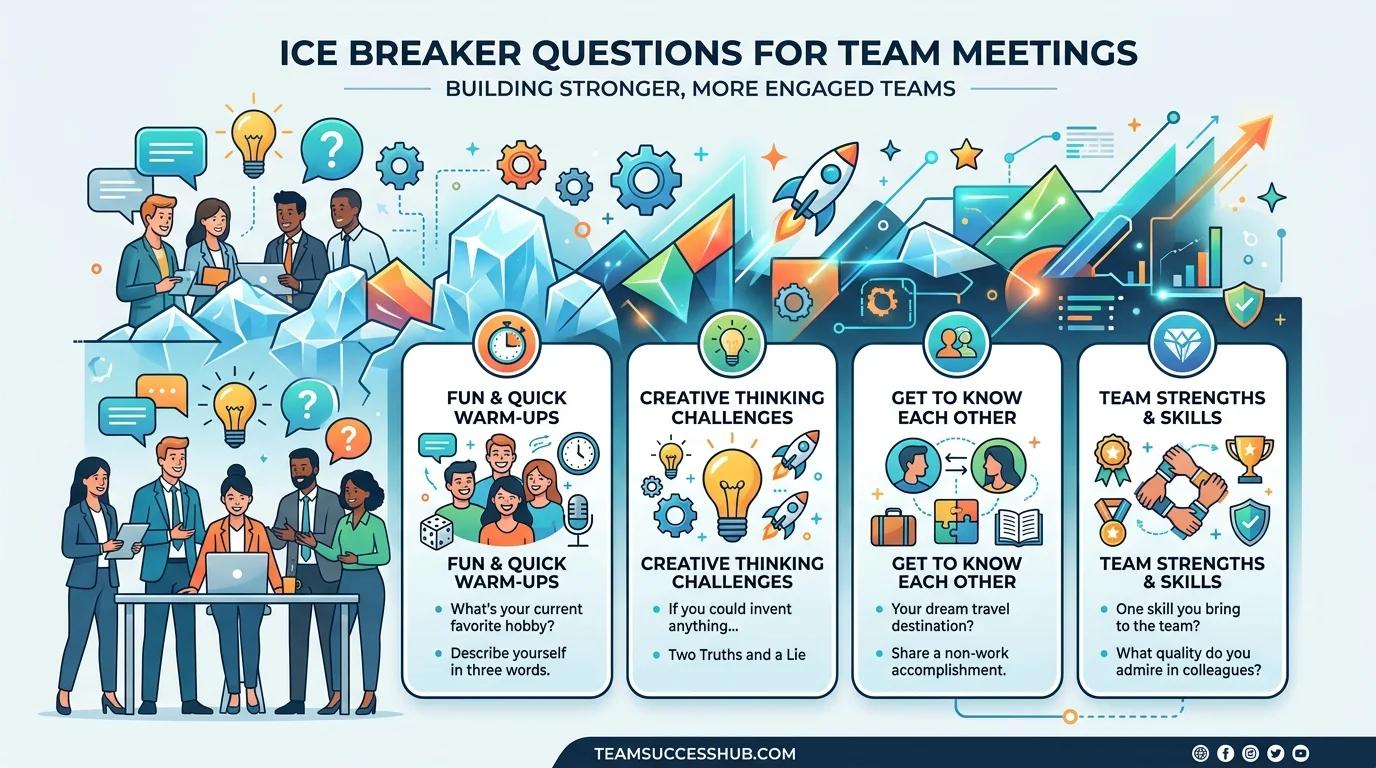
What Are Ice Breaker Questions, Really?
Ice breaker questions are short conversation starters used at the beginning of a meeting to warm the group up before diving into work. Think of them as a warm-up lap before the real race begins.
They're not about extracting deep secrets from coworkers. They're about creating a small moment of human connection before everyone switches into "work mode." This matters just as much when you're welcoming a new hire to the team as it does in a routine weekly sync.
According to Atlassian's team playbook, icebreakers help build psychological safety — an atmosphere where people feel safe enough to speak up, disagree, or ask a "dumb" question without fear of judgment. That's the foundation of every high-performing team, and it connects directly to broader employee engagement strategies your team may already be using.
Why Ice Breakers Actually Matter (Backed by Research)
According to Psych Safety, if people don't speak up in the first few minutes of a meeting, they're statistically less likely to speak at all. One awkward silence at the start can quietly kill the whole conversation.
According to BreakNice's summary of team-building meta-analysis research, structured team building activities — the category icebreakers fall under — show a positive moderate effect across nearly every team outcome measured, especially emotional and process-based ones (how people feel about working together).
According to Neurolaunch, lighthearted team bonding activities can lower cortisol (a stress hormone) while raising oxytocin (a bonding-related neurochemical). A two-minute question can shift your team's chemistry before the real meeting even starts.
According to McKinsey research cited by Teamout, only 26% of leaders currently display behaviors that instill psychological safety at work — which is exactly the gap icebreakers are designed to help close.
Types of Ice Breakers: Comparison Table
Not every icebreaker fits every meeting. Use this table to quickly match a format to your situation.
Icebreaker Type | Best For | Time Needed | Example Question |
|---|---|---|---|
Quick & Easy | Daily standups, remote team icebreakers | 1–2 min | "One word for your energy today?" |
This-or-That | Zoom/Teams calls, large groups | 2–3 min | "Coffee or tea?" |
Deep/Reflective | Small groups, established teams | 5–10 min | "Who's a mentor that shaped how you work?" |
Professional | Onboarding icebreaker questions, new hires | 3–5 min | "What skill are you hoping to build this year?" |
Seasonal | Holidays, quarterly kickoffs | 2–4 min | "What's one goal for this quarter?" |
15 Ready-to-Use Ice Breaker Questions by Category
Quick & Easy (great for standups)
One word to describe your energy today?
What's one thing on your desk right now?
Tea, coffee, or neither?
This-or-That 4. Morning person or night owl? 5. Work from home or work from office? 6. Early meetings or late meetings?
Deep/Reflective 7. What's a mentor who shaped how you work today? 8. What's one habit that's positively changed how you work? 9. What's something you've learned about yourself recently?
Professional/Onboarding 10. What skill are you hoping to build this year? 11. What's one piece of advice you'd give someone new to your role? 12. What's a project you're proud of, and why?
Fun/Seasonal 13. What's the weirdest thing currently in your fridge? 14. If your week was a weather forecast, what would it be? 15. What's one goal for this quarter, work or personal?
For an even larger library, Parabol's 330+ question list and Asana's 150+ question guide are excellent supplements. If your team is still figuring out reporting lines and roles, pairing icebreakers with a clear team organization structure can make meetings feel even more cohesive.
How to Pick the Right Icebreaker: Step-by-Step
Step 1: Know your group. New team? Keep it light. Long-standing team? You can go deeper.
Step 2: Match the format to your time. Five minutes → one-word or this-or-that. Twenty minutes → something reflective.
Step 3: Avoid anything divisive. Atlassian's guidance is clear — steer away from hot-button topics. The goal is connection, not conflict.
Step 4: Explain the "why." Tell your team briefly why you're doing this. It removes the awkwardness of "wait, why are we doing this?"
Step 5: Keep it optional. According to Parabol, the best icebreakers have no wrong answer — that alone makes people more willing to jump in.
Step 6: Rotate your questions. Reusing the same icebreaker every week gets stale fast. Keep a running list (like the one above) and mix it up.
Common Mistakes to Avoid
Making it mandatory in a scary way. Forced fun is still forced.
Choosing overly personal questions too early. Trust builds gradually.
Ignoring cultural differences. What's a "normal" question in one culture can feel invasive in another — Vibe's guide covers this for international teams.
Skipping it because "there's no time." Even 90 seconds counts.
Frequently Asked Questions
What are good icebreaker questions for remote teams?
Quick, low-effort prompts work best for remote and virtual meetings — one-word check-ins or this-or-that questions keep energy up without eating into meeting time.
How long should an icebreaker take?
Most effective icebreakers take between 1 and 5 minutes. Reflective questions for smaller, established teams can run up to 10 minutes.
Do icebreakers actually improve team performance?
Research summarized by BreakNice shows team-building activities like icebreakers have a positive moderate effect on team outcomes, particularly trust and communication rather than raw output.
What's a good icebreaker for new employees?
Professional, low-pressure questions work well — for example, "What's one skill you're hoping to build this year?" These double as onboarding conversation starters and light team-development tools.
Should icebreaker questions ever be mandatory?
No. The most effective icebreakers, according to Parabol, are ones with no wrong answer that anyone can choose to answer — participation should feel optional, not forced.
My Honest Take
Icebreaker questions aren't magic. They won't fix a dysfunctional team overnight, and they're not a substitute for real leadership or clear communication.
But used consistently, they remind your team that they're people first, coworkers second. That shift shows up in how openly people talk, how quickly they raise concerns, and how much they actually enjoy showing up to your meetings.
Next time you're staring at a blank meeting agenda, don't skip the icebreaker. Open with a question. Give people two minutes to just be human. You might be surprised how much smoother the rest of the meeting goes.
Read Also: Team Quotes for Work That Actually Motivate