


Quick Answer: WFH stands for "Work From Home" — a work arrangement where you complete your job duties from your personal residence instead of commuting to an office, using digital tools like video calls and cloud software to stay connected with your team. In 2026, WFH has evolved from a pandemic-era exception into a structured, permanent part of most knowledge-work jobs.
Now let's get into the details — because there's a lot more nuance here than that one-line definition suggests.
If you've ever seen "WFH" in a Slack status, an email signature, or a job posting and thought, "wait, what does that actually mean?" — you're not alone. I get this question all the time. It's a bit like when people ask what "ONB" means in a text — workplace shorthand is everywhere, and it's easy to feel lost in the acronyms.
So today, I'm going to break down exactly what WFH means, why it matters more than ever, and how you can make the most of it — whether you're an employee, a manager, or someone hunting for their next remote job (check out our remote job board guide for current listings).
Let's dive in.
What Does WFH Mean?
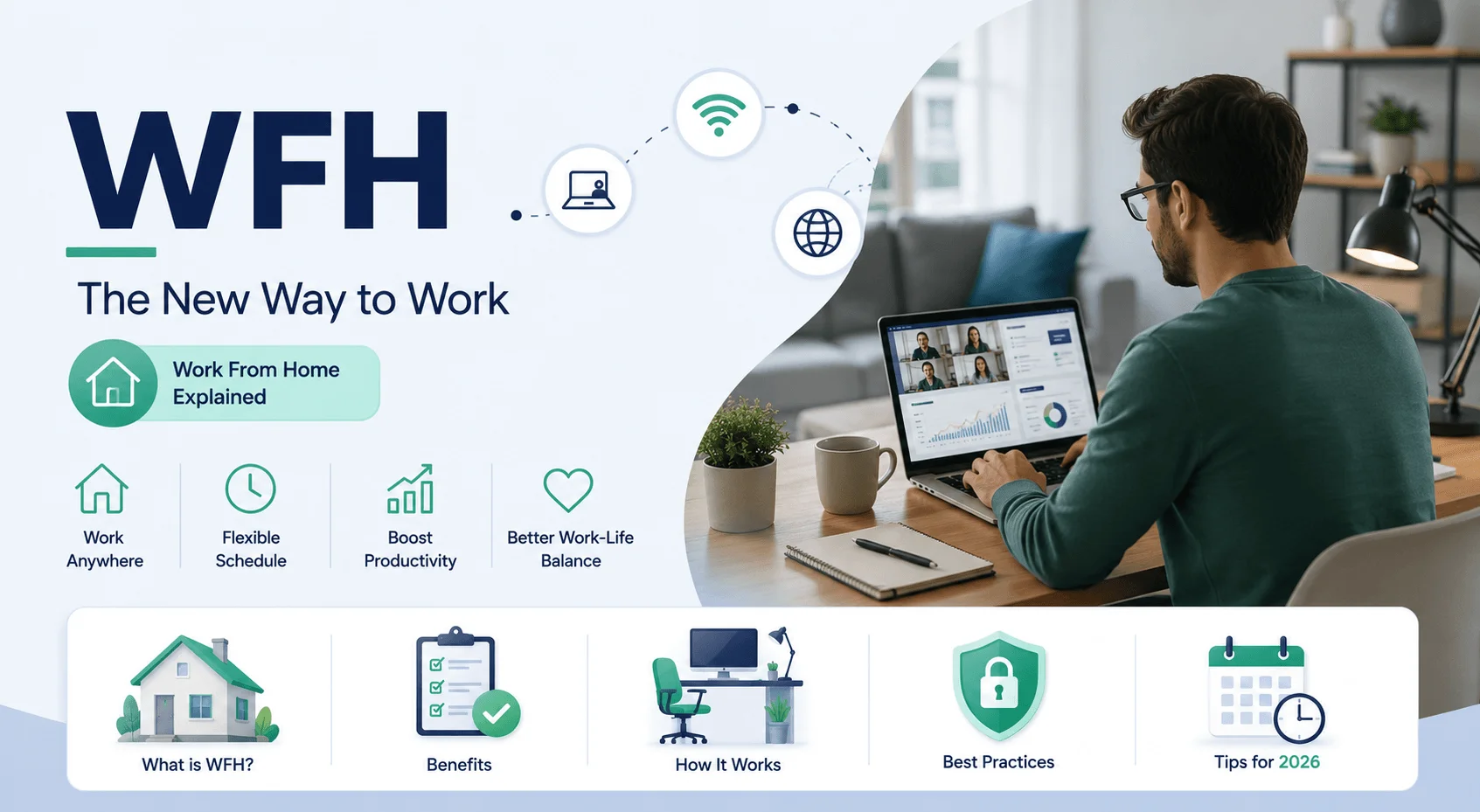
WFH means performing your job responsibilities from home rather than an office. But there's more to unpack — where the term came from, how it differs from similar terms, and why it stuck around.
WFH is not a new concept. WFH existed long before COVID-19 — it just wasn't the default. It used to be a rare perk you'd request case-by-case. COVID changed that overnight, and it stuck for millions of knowledge workers.
Today, WFH is a normal part of many employment contracts, with clear expectations around availability, output, and boundaries.
WFH vs. Remote Work vs. Hybrid Work vs. WFA
I know — there are a lot of acronyms flying around. Let me clear this up with a simple comparison.
Term | What It Means | Location Flexibility | Common Use Case |
|---|---|---|---|
WFH (Work From Home) | Working specifically from your home office, kitchen table, or another space inside your home | Low — home only | Full-time or hybrid employees with a fixed remote day |
Remote Work | The broad umbrella term for any work done outside a traditional office | Medium — home, co-working space, etc. | General term used in job listings |
Hybrid Work | Splitting time between home and the office on a set schedule | Medium — fixed split | Companies requiring 2–3 office days/week |
WFA (Work From Anywhere) | Working from multiple locations, including while traveling | High — anywhere with internet | Digital nomads, travel-flexible roles |
Here's why this distinction matters: the difference between "remote" and "WFH" affects SEO and business strategy, because job seekers and companies use these terms very differently. If you're job hunting, pay attention to which word a company uses — it signals a lot about their actual policy. (See our guide to decoding remote job postings for more on this.)
Why WFH Became the New Normal
Let's look at the numbers, because vague claims don't help anybody.
By 2025, 25% of all paid workdays in the US were completed from home — more than three times the pre-pandemic rate of 5–7%.
This isn't just a US trend. Researchers at the University of Chicago's Becker Friedman Institute confirm WFH accounts for a quarter of paid workdays among American adults aged 20–64 — with rates seven percentage points higher for parents of young kids.
And nearly 80% of employees whose jobs can be done remotely are now working hybrid or fully remote. That's not a niche trend. That's the majority.
Does WFH Actually Hurt Productivity?
You've probably heard someone claim WFH kills productivity. I want to push back on that.
Stanford research shows remote workers are 13% more productive than office-based peers, largely due to fewer interruptions and no commute fatigue.
But there's a trust gap worth knowing about — it's called "productivity paranoia." 87% of employees feel productive working remotely, but only 15% of leaders feel confident in that output.
That gap is part of why return to office (RTO) mandates keep making headlines.
The Business Case for WFH (And Why Some Companies Are Pulling Back)
The Cost Savings Side
For employers, WFH can cut real estate costs by 30–60% depending on how aggressively they downsize office space. Companies like Dropbox, REI, and Yelp saved millions this way.
Beyond rent, costs shrink across:
Utility bills
Office supplies
On-site catering
Janitorial services
There's also a retention angle worth flagging. A 2024 SHRM study found companies offering WFH had 25% lower turnover than fully office-based companies. And 46% of employees say they're unlikely to stay at a job that removes remote flexibility.
The Pushback Side
To be fair, not everyone is sold on WFH. 30% of companies plan to require full five-day office attendance in 2026, up slightly from 28% the prior year. Only 10% of companies allow employees to fully choose their remote arrangement.
Average WFH days per week have also been declining — from 1.6 days in 2022 to around 1.27 days in 2024/2025. We're not at pandemic-peak remote work anymore, but we're not back to strict office culture either. We've landed in the middle: hybrid work.
Who Actually Gets to Work From Home?
This part surprised me. Managers and executives are more likely to WFH than junior employees — about 60% of middle managers and 57% of executives, compared to only 48% of junior staff.
Why? Junior employees often need more mentorship and face-to-face learning early on, while leaders have already built their networks and have more autonomy over where they work.
If you're early-career, don't assume WFH is automatically on the table just because your manager gets it.
How to Make WFH Actually Work for You: A Step-by-Step Guide
Step 1: Build a Dedicated Home Office Setup
You don't need a fancy studio — just a consistent spot with a desk, decent chair, and good lighting. Your brain needs a physical cue that says "work mode."
Step 2: Get Your Digital Collaboration Tools Sorted
Get comfortable with your team's video conferencing platform and cloud collaboration tools before you need them mid-meeting. Fumbling with tech is a credibility hit you don't need.
Step 3: Set Clear Availability Boundaries
Tell your team when you're online and offline. This protects your work-life balance and prevents WFH from quietly becoming "always on." A lot of this comes down to self-management — without a manager physically checking in, your ability to structure your own day becomes the thing that makes or breaks WFH.
Step 4: Combat Zoom Fatigue
Not every conversation needs video. Sometimes a quick message or phone call gets the job done without the mental drain of back-to-back calls.
Step 5: Track Your Wins, Not Just Your Hours
Given the productivity paranoia gap mentioned earlier, proactively document what you're accomplishing — a weekly summary email or shared doc builds trust without waiting to be asked.
The Real Perks of WFH
The average American commute is 55 minutes round-trip. Cut that five days a week and you get back roughly 230 hours a year — nearly six full 40-hour work weeks.
Financially, remote workers save $4,000–$6,000 annually on commuting, work clothes, and lunches out. And beyond the numbers, there's something harder to quantify: control over your environment, schedule, and focus.
Frequently Asked Questions About WFH
Does WFH mean the same thing as remote work?
Not exactly. WFH specifically means working from inside your home. Remote work is the broader term that can include co-working spaces or cafes.
Is WFH still relevant in 2026?
Yes. It's evolved into structured hybrid arrangements rather than fully remote setups for most companies.
What's the difference between WFH and WFA?
WFH means home specifically. WFA (work from anywhere) means you can work from multiple locations, including while traveling.
How many days a week do most people work from home in 2026?
On average, around 1.27 days per week, according to recent data — down from a peak of 1.6 days in 2022 but still a permanent fixture of most hybrid schedules.
Final Thoughts
So, what does WFH mean? At the simplest level, it's working from home instead of an office. But as you've seen, it's become a shift in how companies think about talent, trust, cost, and culture.
Whether you're negotiating your next job offer or convincing your boss to let you skip the commute twice a week, understanding this term — and the data behind it — puts you in a stronger position.
Now you know exactly what WFH means, why it matters, and how to make it work for you.
Read more: How to Raise Hand in Zoom: Complete Guide (2026)


![What Is a Telephoto Lens? The Complete 2026 Guide | [Brand]](https://contiocdn.com/efdc9a99-5ac4-4f75-be3a-ed43de859d76/blog-covers/1787138653893-ru50banq-what-is-a-telephoto-lens--the-complete-2026-guide-.webp)