
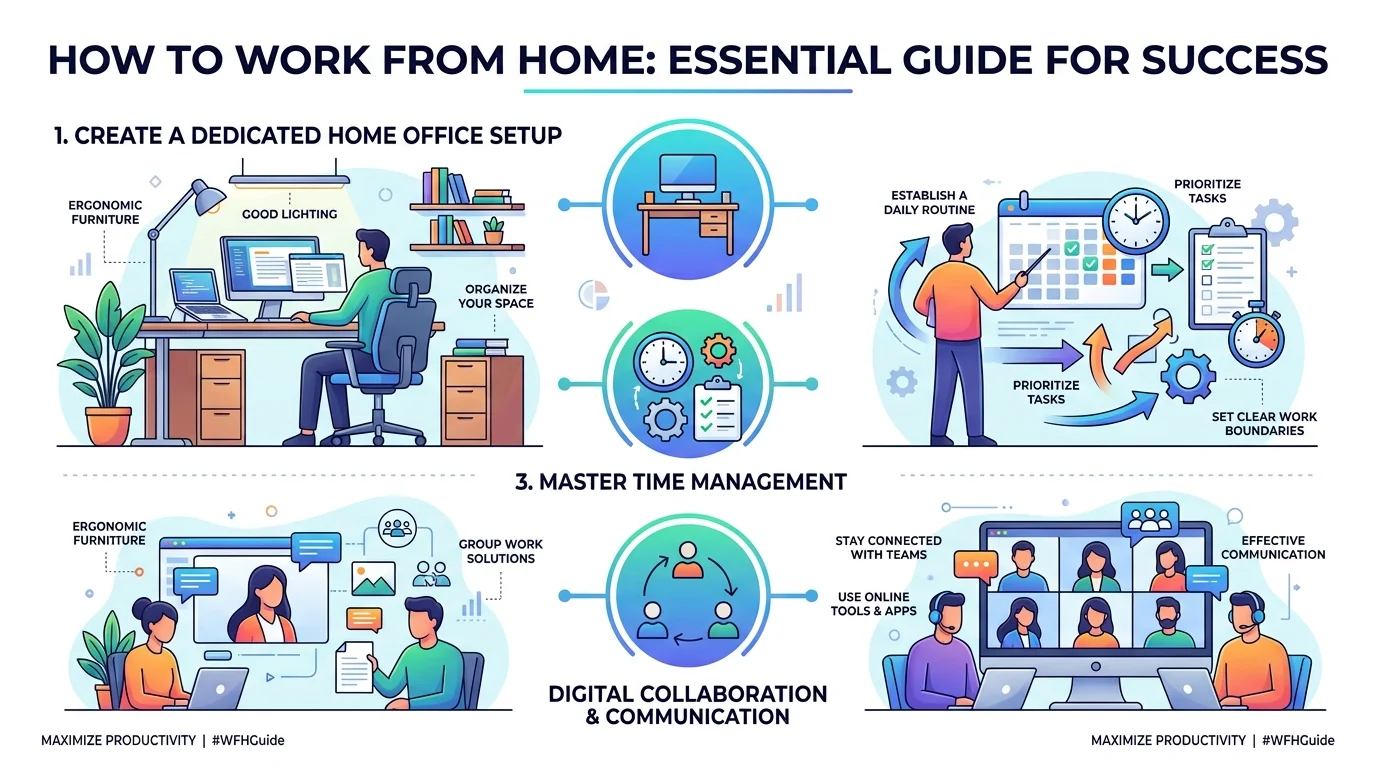
Working from home successfully comes down to four things — an ergonomic workspace that won't wreck your body, hard boundaries around when you stop, deliberate social contact, and a verified legitimate job. A randomized controlled trial published in Nature found hybrid workers matched office productivity exactly while resigning 33% less often. Below, I'll walk you through How to Work From Home is set up each piece, step by step.
Now, the honest part.
I've been writing about remote work for years, and most "how to work from home" advice was written by someone who's never done it for more than a week.
They tell you to "get dressed" and "make a to-do list."
That's not a strategy. That's a fortune cookie.
So I went digging through peer-reviewed research, government ergonomics guidance, and multi-year survey data. What follows is what actually moves the needle — with sources you can check yourself.
What Working From Home Actually Looks Like Right Now
Before you optimize anything, you need an accurate map of the terrain. And the terrain shifted hard in 2026. The popular narrative says remote work is dead — killed off by return-to-office mandates. The data tells a messier, more useful story. What's really happening is a split: fully remote jobs are getting scarcer and far more competitive, while hybrid work has quietly become the default for knowledge workers. Understanding which side of that split you're on changes everything.
Quick note before we go further — if the acronym soup is new to you, here's what WFH actually means and where the term came from.
Here's the breakdown, according to Stanford's WFH Research: roughly 26% of all U.S. paid workdays are now performed remotely.
But Robert Half's analysis found fully in-office job postings jumped from 65% in Q4 2025 to 87% in Q2 2026.
Remote vs. Hybrid vs. On-Site: The 2026 Picture
Fully Remote | Hybrid | Fully On-Site | |
|---|---|---|---|
Share of remote-capable workers | 27% | 53% | 20% |
Productivity vs. office | Comparable | Statistically identical (Nature RCT) | Baseline |
Retention impact | Positive | 33% fewer resignations | Baseline |
Job availability (Q2 2026 postings) | 3% | 10% | 87% |
Main challenge | Isolation, boundary erosion | Schedule coordination | Commute, inflexibility |
Translation? If you already have a work from home arrangement, protect it like a rare artifact. If you're hunting one, you need to be sharper than everyone else applying.
Does Working From Home Actually Work? The Research Says Yes
I get skeptical when people make big productivity claims without evidence. So let me hand you the strongest study that exists, because it's genuinely excellent and almost nobody in this niche cites it properly. It's a randomized controlled trial — the gold standard of research design — which means the findings aren't correlation or vibes. They're causal. And the results should end the "people slack off at home" argument permanently.
The study, published in Nature by Stanford economist Nicholas Bloom with Ruobing Han and James Liang, followed 1,612 employees at Trip.com over six months.
Half worked from home two days a week. Half stayed in the office five days.
The results, summarized by Stanford SIEPR:
Zero difference in productivity
Zero difference in promotion rates
Resignations dropped 33%
Employees valued those home days as much as a 10% pay raise.
Two nuances most write-ups skip, though.
First, resignations only fell among non-managers — managers quit at the same rate either way. Second, and this one matters for you personally: employees worked slightly fewer minutes on home days, then made up the difference on office days and weekends.
That last finding is the trap. We'll fix it shortly.
Step 1: Build a Workspace That Doesn't Wreck Your Body
I'll be blunt, because I learned this the expensive way. Your kitchen table is not a desk. Your couch is not a chair. And the slow-motion neck and wrist damage from a bad home office setup doesn't announce itself — it accumulates quietly until one morning you can't turn your head properly. Ergonomics isn't a luxury purchase. It's injury prevention, and the guidance is free and specific.
Follow Mayo Clinic's ergonomics guide, which draws from OSHA's Computer Workstations eTool.
Your Chair
Adjust the height so your feet rest flat on the floor and your thighs sit parallel to it. Need lumbar support? A rolled towel in the small of your back works today, for free.
Your Monitor
Place it about an arm's length away, directly behind your keyboard. The top of the screen should sit at or slightly below eye level. Wear bifocals? Drop it another 1–2 inches. A monitor arm makes this trivially adjustable.
While you're at it, it's worth learning how to calibrate a monitor — badly tuned brightness and colour temperature cause more eye fatigue than most people realise.
Your Keyboard and Desk
Wrists and forearms in a straight line, shoulders relaxed. If your desk is too tall, raise your chair and add a footrest. Considering a standing desk? Alternate — don't stand all day.
What I'd Actually Buy First
Here's my honest ranking, and I'm not going to pretend everything is essential.
Buy first: a genuinely adjustable ergonomic chair. You'll spend more hours in it than in your bed, and cheap seating costs more in physiotherapy than you saved at checkout.
Buy second: a monitor arm. Cheap, and it fixes neck posture permanently.
Buy later: standing desk, second monitor, better lighting.
Skip: most "productivity gadgets." They're solving a problem you don't have.
Step 2: Defend Your Boundaries Ruthlessly
Now we get to the part that quietly destroys people. Everyone assumes the hard part of working remotely is staying focused. It isn't. The hard part is stopping. When your office is twelve feet from your bed, the workday expands until it swallows your evenings, your weekends, and eventually your work-life balance entirely. The survey data here is genuinely alarming.
Buffer's State of Remote Work found that while 71% say boundaries are very important:
81% check work email outside hours
63% do it on weekends
34% do it on vacation
So here's your fix, and it's embarrassingly simple.
Create a shutdown ritual. Same time daily. Close the laptop physically. Say "day's done" out loud. Your brain needs a hard stop signal, because the commute that used to provide one is gone.
Kill notifications after hours. Slack has Do Not Disturb. Use it without apology.
Separate your spaces. No dedicated room? A dedicated corner still works. Just never work where you sleep.
Step 3: Build a Productivity System That Survives Bad Days
Motivation is unreliable, so stop building around it. What actually holds up on a bad Tuesday is structure — a repeatable daily routine that decides things in advance so you're not negotiating with yourself at 10 a.m. The good news is you only need two or three techniques, not a whole productivity philosophy. Underneath all of them sits one skill: self-management, which is the actual thing remote work demands of you.
Time blocking — assign work to specific calendar slots instead of keeping an open to-do list. Ambiguity is what kills remote days.
Deep work — protect one 90-minute distraction-free block daily for your hardest task. Phone in another room.
The Pomodoro technique — 25 minutes on, 5 off. Best on low-motivation days when starting is the whole battle.
Asynchronous work habits — write things down properly so colleagues aren't blocked waiting on you. This is the skill that separates good remote workers from mediocre ones.
Movement breaks — stand every 30–60 minutes. Non-negotiable, and it protects the ergonomics work from Step 1.
Step 4: Solve the Loneliness Problem Before It Solves You
This section exists because almost every guide skips it, and it's the reason people quit remote work entirely. Nobody warns you that the biggest challenge won't be technical — it'll be social. The hallway conversations, the coffee runs, the ambient sense of being around humans? Gone. And the effect creeps up slowly enough that you'll blame your job before you blame the isolation.
In Buffer's survey, the single most-selected struggle was "I stay home too often because I don't have a reason to leave" — a full 33% of respondents. Loneliness came second at 23%.
What actually helps:
Schedule one out-of-house anchor daily. Gym, walk, coffee shop. Give yourself a reason to leave the building.
Work from a coworking space once or twice weekly. Even ambient human presence helps enormously.
Over-communicate deliberately. Send the good-morning message. Turn your camera on in virtual meetings. If your team calls feel flat, a few ice breaker questions for team meetings do more for remote morale than most managers expect. Remote relationships need maintenance that office ones get for free.
Step 5: Stay Visible So You Don't Get Passed Over
Proximity bias is real, and it's the quiet career risk of working from home. When promotion decisions get made, the people who are physically present come to mind first — not because they're better, but because they're visible. On a distributed team, visibility has to be manufactured on purpose. This isn't politics. It's making sure your work is legible to people who can't see you doing it.
Ship visible summaries. A short weekly update to your manager beats a year of silent competence.
Protect time zone overlap. Guard the hours you share with colleagues for live conversation.
Speak up in meetings. Something as small as knowing how to raise your hand in Zoom keeps you from being talked over on a twelve-person call.
Volunteer for remote onboarding. Helping new hires is the fastest way to become known across a company.
Turn the camera on for anything that matters. Faces build trust that text can't.
Step 6: Find Real Remote Jobs and Dodge the Fakes
If you're still job-hunting, this section could save you thousands. Work from home job scams have exploded alongside remote work's popularity, specifically targeting people who badly want flexible work. The scammers are sophisticated now — polished sites, AI-written descriptions, fake recruiter profiles. You need a verification process, not just good instincts.
According to the FTC, job scam reports tripled from 2020 to 2024, with losses climbing from $90 million to $501 million.
Red flags worth memorizing:
They ask you for money. Any money. Ever.
Communication moves to WhatsApp or Telegram
A paycheck arrives before you've done any work
They want passwords or your Social Security number pre-hire
No skills or experience required, unusually high pay
The FTC's own test is the simplest available: search the company name plus "scam" or "complaint." Thirty seconds. Do it every single time.
For legitimate listings, stick to curated remote job boards — We Work Remotely, FlexJobs, and Remote OK screen their postings. And check the company's own careers page before applying anywhere else.
When you do land interviews, prepare properly. Role-specific question banks like these project manager interview questions are a far better use of an evening than rewriting your resume for the ninth time.
One more thing worth knowing: the home office tax deduction generally applies to self-employed people, not W-2 employees. Check your local rules before assuming.
Frequently Asked Questions
Short, direct answers to what people ask most.
Is working from home actually productive?
Yes. A randomized controlled trial of 1,612 employees published in Nature found hybrid workers were exactly as productive and equally likely to be promoted as fully office-based colleagues, while resignations fell 33%.
How do I set up a home office cheaply?
Start with chair height — feet flat, thighs parallel to the floor. Use books to raise your monitor to eye level and a rolled towel for lumbar support. That costs nothing. Upgrade to a proper ergonomic chair when budget allows.
Why do I feel lonely working from home?
Because remote work removes casual daily social contact. In Buffer's survey, 33% cited "staying home too often because I don't have a reason to leave" as their biggest struggle, and 23% cited loneliness. A daily out-of-house anchor is the most effective fix.
How do I stop working at night?
Build a shutdown ritual at a fixed time and enable Do Not Disturb. It matters: 81% of remote workers check email outside hours and 63% do so on weekends.
How do I spot a fake remote job?
Legitimate employers never ask for money, passwords, or your Social Security number before hiring. If communication moves to WhatsApp or Telegram, walk away — and search the company name plus "scam."
Is remote work going away in 2026?
No, but it's consolidating. Fully remote roles now make up about 3% of postings while hybrid holds at roughly 53% of remote-capable workers.
The Bottom Line
Working from home isn't a personality trait — it's a set of systems you build deliberately. Get the ergonomics right so your body lasts. Build boundaries so the job doesn't eat your evenings. Manufacture the social contact and visibility that an office used to hand you for free. And verify every opportunity before you hand over a single detail.
The research is genuinely on your side here. You just have to set the conditions up properly.
Start with the chair. Then fix your monitor height this afternoon. Everything else builds from there.