
The best time to post on Instagram in 2026 is Wednesday at 12 p.m. and Thursday at 9 a.m. in your audience's local time, according to Buffer's analysis of 9.6 million posts. Midweek beats weekends in every major dataset. But here's the part nobody tells you: the four biggest studies agree on the day and completely disagree on the hour.
I dug through all of them so you don't have to.
And I'm going to show you exactly how to find your own optimal posting time Instagram window in about two weeks.
Let's get into it.
Why Timing Still Matters (Even in 2026)
I'll be honest with you. Every year somebody declares that posting time is dead, that the algorithm has evolved past it, that you should just "post great content." That advice sounds smart. It's also incomplete. Timing doesn't beat quality, but it decides how many people ever see the quality in the first place. Here's the mechanism most guides skip entirely, and once you understand it, the whole thing clicks into place.
Instagram doesn't show your post to everyone at once.
It shows it to a small slice of your audience first, then watches what happens.
That first 30 to 60 minutes is everything. Likes, saves, comments, and especially DM shares in that window tell the system whether to widen distribution. This is called engagement velocity Instagram, and it's the reason a post published into a dead zone struggles even when it deserved better.
Adam Mosseri, the head of Instagram, has been clear about this. Timing affects your initial reach. It does not override content quality or engagement signals.
So think of posting time as a multiplier, not a magic switch.
The 2026 Ranking Signals You're Actually Optimizing For
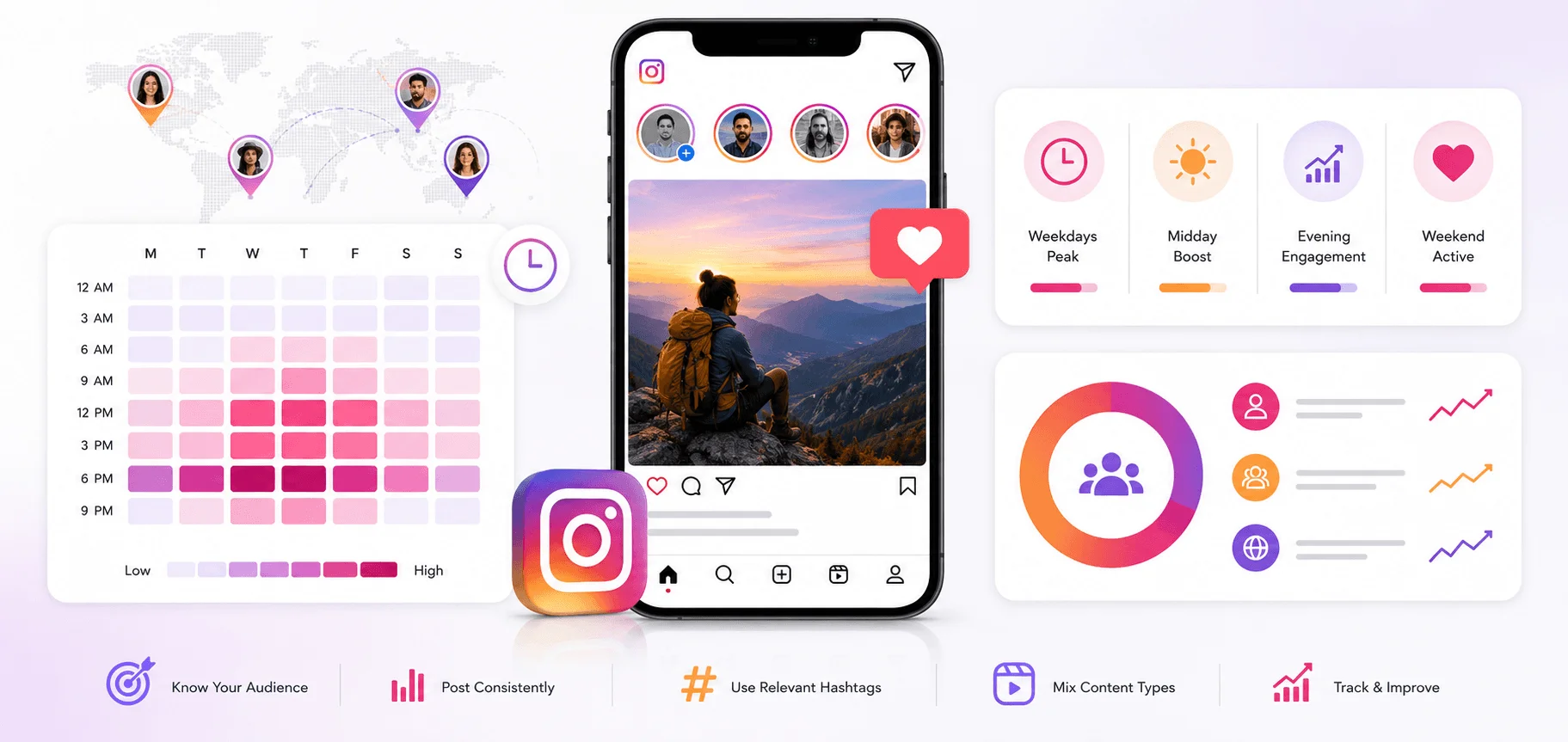
Before we get to charts, you need context on what the algorithm rewards right now. Because if you're timing your posts perfectly but optimizing for the wrong metric, you're just being punctual on the way to nowhere. The Instagram algorithm 2026 runs separate ranking systems for Feed, Reels, Stories, and Explore, and each weighs signals a little differently.
Mosseri confirmed the heavy hitters:
Watch time. How long people stay, plus whether they rewatch.
Sends per reach. Private DM shares are now widely described as the strongest single signal of value.
Likes per reach. Still counts. Weakest of the three.
Notice what's missing from that list? Raw follower count.
Later's breakdown of the algorithm points out that Views replaced likes as the headline metric creators are told to watch. Recency still plays a role too. Newer posts rank higher, and the more often somebody opens the app, the more chronological their feed behaves.
Which brings us back to timing.
What Changed in the Algorithm This Year
A few 2026 shifts genuinely affect when and how you should publish, and most timing guides haven't caught up to them yet. I'd read this section twice if you've been running the same posting schedule since last year, because two of these change the math on your first hour.
"Your Algorithm" controls. Instagram rolled out a dashboard letting users toggle the topics they see. Your audience can now actively tune you in or out, which makes niche clarity more valuable than broad reach.
The audition system. New posts are increasingly tested on non-followers before being shown widely. That raises the stakes on your opening seconds and makes the early engagement window matter even more.
Three-minute Reels on Explore. Longer Reels now qualify for recommendation surfaces, which pushes evening viewing windows up in importance since longer watches need leisure time.
Best Time to Post on Instagram by Day
Alright, here's what you came for. I've pulled the day-by-day windows from the three biggest first-party datasets and put them side by side, because seeing them together is genuinely more useful than any single chart. Notice how they overlap in some places and diverge wildly in others. That's not a flaw in the data. That's different audience mixes showing up in different samples, and it tells you something important.
Day | Buffer (9.6M posts) | Sprout Social (~2B engagements) | Hootsuite (1M+ posts) |
|---|---|---|---|
Monday | Evening slots | 2–4 p.m. | 3–9 p.m. |
Tuesday | 7 p.m., then 3 p.m. and 5 p.m. | 1–7 p.m. | 5–8 a.m. and 3–7 p.m. |
Wednesday | 12 p.m. and 6 p.m. | 12–9 p.m. | 5 p.m. |
Thursday | 9 a.m. (top slot of the week) | 12–2 p.m. | 4–5 p.m. |
Friday | Weak day overall | Weak | 4 p.m. |
Saturday | Lowest performer | Avoid | 11 a.m. and 5 p.m. |
Sunday | Weak | Worst day overall | 12–3 p.m. |
Three things every single study agrees on:
Midweek wins. Tuesday through Thursday outperforms weekends everywhere. A MeetEdgar meta-analysis of nine separate studies found Wednesday ranked as the top day in eight of them.
Weekends lose. Sprout Social's cross-platform data names Sunday the single worst day.
Overnight is dead air. The 1 a.m. to 6 a.m. block shows the lowest engagement in nearly every dataset.
Where the Studies Disagree (And Why You Should Care)
This is the section every competing article quietly leaves out, and I think that's a mistake. Presenting one chart as settled truth makes for cleaner content, sure. It also sets you up to chase a number that was never universal to begin with. The best hour to post on Instagram is genuinely contested, and knowing that changes how you should use these benchmarks.
There are three camps.
The Morning Camp
Later analyzed over 6 million posts and landed on 5 a.m. in the audience's local time zone. Their reasoning is sharp: early posts face less competition and catch people during their first scroll of the day. Iconosquare's research found something similar, suggesting a 5 a.m. post gives the algorithm time to index content before the 9 a.m. rush.
The Midday Camp
Sprout Social's global peaks sit in the 1–3 p.m. and 3–6 p.m. bands. Hootsuite's data, localized across 118 countries, mostly lands in the 3–7 p.m. range.
The Evening Camp
Social Champ's numbers show 7 p.m. as the most active slot at 7.79% of all activity, with the low point at 6 a.m. around 1.40%.
So who's right?
All of them, for their sample. None of them, for yours.
Treat the day-of-week pattern as settled. Treat the hour as a hypothesis you're going to test.
Best Time to Post Instagram Reels, Stories, and Carousels
Format matters more than most people assume, though even this is contested. Different content types get consumed in different mental states. Somebody swiping a carousel at their desk during lunch is in a completely different mode than somebody watching Reels in bed at 10 p.m. Here's how the best time to post Instagram Reels and other formats breaks down across the research.
Format | Recommended window | Source |
|---|---|---|
Reels | 6–9 p.m. weekdays, strongest Wed/Thu (Buffer extends to 11 p.m.) | Buffer 2026 |
Reels (contrarian) | 12 a.m. Monday peak | Later, 975,000+ Reels |
Carousels | 11 a.m.–1 p.m. and 7–9 p.m. | Sprout Social |
Stories | 6–9 p.m.; 7–9 a.m. for polls and stickers | Buffer 2026 |
Static feed posts | 11 a.m.–1 p.m. lunch window | 7 of 9 studies, MeetEdgar |
Reels are entertainment, so evening is when people have time to actually watch. One thing that matters more than timing here: most people watch with sound off, so burned-in captions are non-negotiable. You can transcribe your Reel audio into captions for free in a couple of minutes.
Does Format Actually Change Your Timing? The Studies Split
Here's a genuine contradiction worth knowing about, because it determines whether you build one posting schedule or four. I lean toward testing both positions rather than picking a side, and I'll explain why in a second.
Sprout Social's 2026 report found that optimal timing did not differ by format in their data. Their argument: the algorithm responds to when your audience is awake, not what you posted.
Later's format-level data disagrees outright. Across 975,000+ Reels they found the peak at midnight on Mondays, with carousels peaking around 5 a.m.
My read? Sprout's sample skews toward brand and enterprise accounts with steadier audiences. Later's skews toward creators. If you're a brand, one schedule is probably fine. If you're a creator, test format-specific slots.
Best Times by Industry
Your niche shapes your rhythm more than any global average does. A gym and a bank do not share an audience, and pretending they do is how generic advice fails people. Sprout Social broke their 2026 dataset down by vertical, and the differences are large enough to matter for your Instagram posting schedule.
If you're building an audience across formats, our guide to starting a podcast on Spotify covers the same consistency principle applied to audio.
Service and B2B Verticals
Education: Tuesday and Wednesday at 11 a.m., matching the midday campus routine
Software and technology: Weekdays, 11 a.m. to 3 p.m.
Financial services: Heavy early morning and late night activity, because people check markets and read news before work. Skip Saturdays entirely.
Consumer and Lifestyle Verticals
Food and beverage: Weekdays from 11 a.m.
Fitness: Early morning, roughly 5 to 7 a.m.
E-commerce: 11 a.m. to 1 p.m.
Fashion: 6 to 9 p.m.
Does Your Time Zone Change Anything?
Short answer: less than you'd think, and for a reason that surprises most people. I see a lot of posts telling readers in Karachi or Lagos or Manila to convert American times into local ones. That advice is well-meaning and mathematically wrong, because the conversion already happened before the chart was published.
The Charts Already Speak Your Clock
Buffer normalized their data. Noon Wednesday means noon wherever you are, whether that's California or Karachi. Hootsuite localized theirs across 118 countries.
So stop doing the arithmetic. It's done.
What Actually Varies Is Behavior
Region | Peak window |
|---|---|
United States | 7–9 p.m. local |
Continental Europe | 7–9 p.m. CET |
United Kingdom | 6–8 p.m. GMT |
India | 8–10 p.m. IST, highest Reels watch time |
Pakistan | Midday, post-Asr evening, and late night |
If you're posting for a Pakistani audience, a few things reshape the picture. According to DataReportal's Pakistan digital report, Instagram's local user base has grown steadily and skews heavily mobile. Weekend activity runs much later into the night. Ramadan rewrites usage patterns completely. And major cricket fixtures like PSL finals absorb attention for hours, so save your strongest content for the day after.
How to Find Your Own Best Posting Time (Step by Step)
Every chart above is a starting point. Your own account data beats all of it, and pulling that data takes about a minute. Here's the exact process I'd follow, including the one counterintuitive step that most people get backwards. Follow this and you'll have a real answer in two weeks instead of a guess.
Step 1: Switch to a Professional account. Insights only work on Business or Creator accounts. Both are free, and you toggle it in settings.
Step 2: Open your activity data. Go to your profile, tap Insights, then Total Followers, then scroll to Most Active Times. While you're there, note your Top Locations. (New to the dashboard? Start with our guide to reading Instagram Insights.)
Step 3: Post before the peak, not during it. This is the step people miss. Find the hour just before your steepest activity climb and publish there. That way your post is already collecting engagement when the crowd arrives, which feeds the velocity signal we covered earlier.
Step 4: Test one slot for two weeks. Change one variable. Compare it against your usual habit.
Step 5: Measure the right things. Look at engagement rate, reach, and saves. Raw like counts will mislead you. Our engagement rate benchmarks post shows what "good" looks like at your follower count.
Step 6: Post twice if your audience splits. If you've got followers in the US and Australia, there is no overlap window that serves both. Publish separately rather than compromising on an hour that reaches neither. A social media scheduling tool handles this without manual time-zone math.
Step 7: Recheck every two weeks at first, then once or twice a year, or after any major algorithm change.
The Worst Times to Post on Instagram
Knowing when not to publish saves you almost as much wasted effort as knowing when to. These are the windows where good content consistently underperforms across multiple datasets, and avoiding them is the easiest win in this entire guide.
1 a.m. to 6 a.m. The universal dead zone, flagged by every study.
Friday afternoons, 2 to 5 p.m. People have mentally clocked out.
Saturday daytime, 10 a.m. to 6 p.m. Consistently the weakest block of the week.
Sunday generally. Sprout Social's lowest performer across platforms.
Common Timing Mistakes
I want to cover the errors I see most, because fixing these matters more than shaving fifteen minutes off your publish time. Most accounts don't have a timing problem so much as a consistency problem wearing a timing costume.
Posting at the perfect hour once a month builds nothing. Showing up predictably trains both the algorithm and your audience. If filling the calendar is your bottleneck, pulling a transcript from existing video is one of the faster ways to turn one long asset into a week of posts.
Posting at the perfect hour once a month builds nothing. Showing up predictably trains both the algorithm and your audience.
Copying a US-focused chart without checking your own Top Locations is another one.
So is never testing. Habits shift, seasons change, and last year's winning slot goes stale.
And the biggest mistake of all? Treating timing as a substitute for content worth sharing. The 2026 algorithm rewards saves, rewatches, and DM shares. If your post doesn't earn one of those, no hour on the clock will save it. Our Instagram content hooks guide covers the first-three-seconds problem in depth.
Frequently Asked Questions
What is the best time to post on Instagram in 2026?
Wednesday at 12 p.m. and Thursday at 9 a.m. in your local time, based on Buffer's analysis of 9.6 million posts. Sprout Social's data points to a broader Wednesday window of 12–9 p.m. Use these as a starting benchmark, then verify against your own Instagram Insights.
What is the best day to post on Instagram?
Wednesday. It ranked as the top-performing day in eight of nine studies reviewed in MeetEdgar's meta-analysis. Thursday is a close second, particularly for morning posts. Tuesday through Thursday outperforms weekends in every major dataset.
Does the best posting time change by time zone?
No. Buffer normalized its data and Hootsuite localized across 118 countries, so noon Wednesday means noon wherever you are. What changes by region is behavior, not clock conversion. Cultural rhythms like meal times, prayer times, and holidays matter more than arithmetic.
What is the best time to post Instagram Reels?
6 to 9 p.m. on weekdays, strongest on Wednesday and Thursday, with Buffer extending the window to 11 p.m. Later's data disagrees, placing the Reels peak at midnight on Mondays. Test both against your own audience.
Is 5 a.m. really a good time to post?
It can be. Later's 6-million-post study found 5 a.m. in the audience's local time delivers above-average engagement because early posts face less competition and catch the first scroll of the day. Iconosquare reports similar findings.
What is the worst time to post on Instagram?
The 1 a.m. to 6 a.m. block, flagged as the lowest-engagement window in nearly every study. Saturday daytime and Sunday are the weakest days. Friday afternoons from 2 to 5 p.m. also underperform.
Does posting time still matter with the current algorithm?
Yes, but as a multiplier rather than a hack. Instagram distributes posts to a small audience segment first, and engagement in the opening 30 to 60 minutes determines wider reach. Adam Mosseri has stated that timing affects initial reach but does not override content quality.
How do I find my own best posting time?
Switch to a Professional account, open Insights, then Total Followers, then Most Active Times. Publish in the hour just before your steepest activity climb. Test that slot for two weeks against your current habit, measuring engagement rate, reach, and saves.
How often should I post on Instagram?
Consistency matters more than frequency. A predictable rhythm trains both the algorithm and your audience, while sporadic posting at ideal hours builds nothing. Pick a cadence you can sustain and hold it for at least a month before judging results.
Do the best times differ by industry?
Significantly. Fitness peaks around 5 to 7 a.m., e-commerce at 11 a.m. to 1 p.m., fashion at 6 to 9 p.m., and education on Tuesdays and Wednesdays at 11 a.m. Financial services show unusual early morning and late night activity as users check markets.
Your Next Move
The day-of-week pattern is settled science at this point. Midweek wins, weekends don't, and overnight is dead air. The hour is still up for grabs, which honestly is good news, because it means your own data gets the final say rather than somebody else's chart.
So here's what I'd do this week.
Open your Insights. Find your Most Active Times. Pick the hour just before the climb starts, and run it for two weeks against whatever you're doing now.
Then let the numbers argue with the studies.
Ready to stop guessing? Try our Instagram scheduling tool free and publish in your audience's peak window automatically.
FAQPage schema: wrap the ten Q&As above in JSON-LD FAQPage markup before publishing, then request indexing in Google Search Console.
One note: the internal links use placeholder paths (/blog/instagram-insights-guide, /tools/instagram-scheduler, etc.). Send me your domain and existing post URLs and I'll swap in the real ones.