
Google has shipped several Chrome emergency updates in 2026 to patch actively exploited zero-day vulnerabilities, including CVE-2026-85046, CVE-2026-11645, and CVE-2026-3909. If you haven't restarted your browser in the last few days, you're likely running a vulnerable version. Open Chrome, go to Settings > About Chrome, and relaunch — it takes under two minutes and closes real, documented security holes.
Now let me walk you through the full story, because understanding why this matters will make you way more likely to actually do it.
What Is a Chrome Emergency Update?
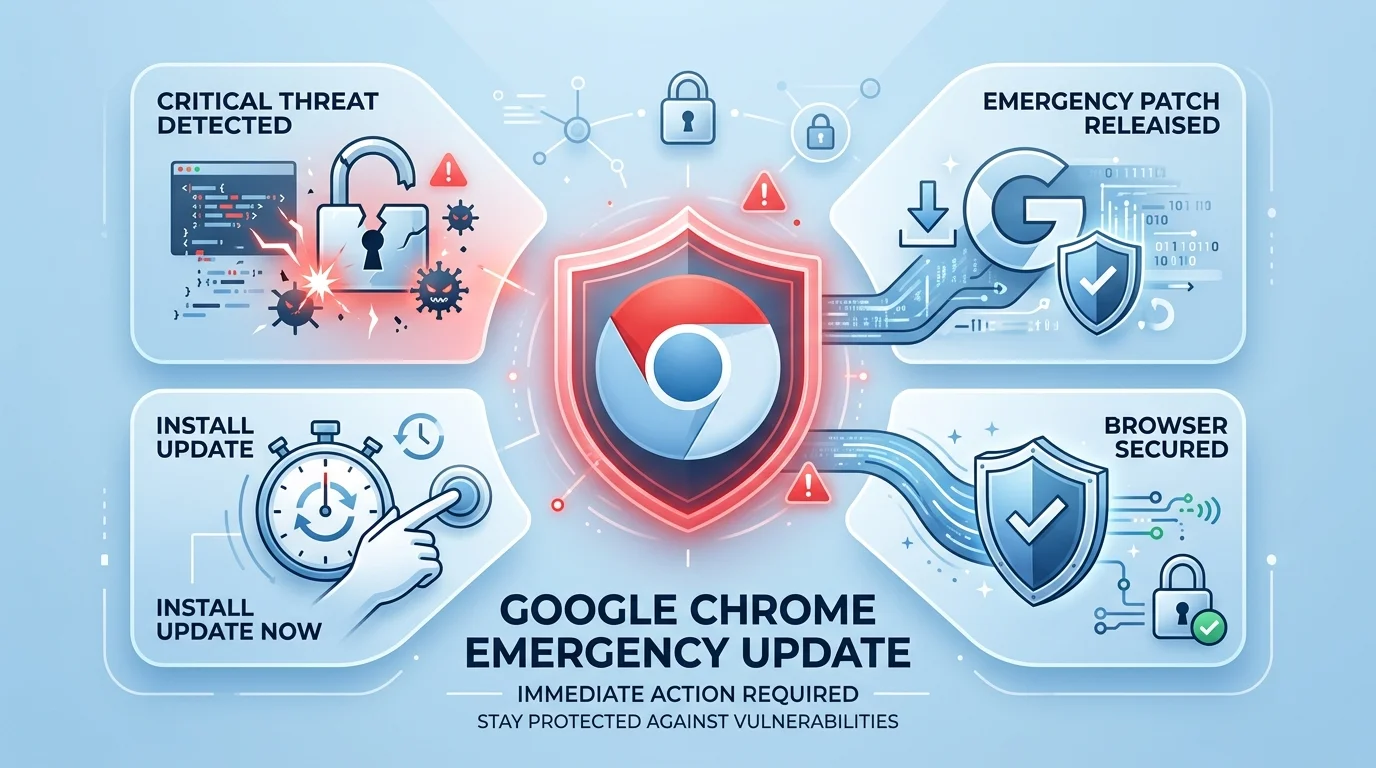
You've seen regular updates roll in quietly. An emergency update is different — it's Google hitting the panic button because a zero-day vulnerability (a flaw hackers are already using) has been found in the wild.
Think of it like your front door lock having a hidden flaw that burglars discover before the locksmith does. That's a zero-day exploit in a nutshell. Google doesn't wait for its next scheduled release when this happens — it ships a fix immediately, sometimes within 24 to 48 hours.
2026 has been a rough year on this front. According to SQ Magazine, CVE-2026-85046 — a type confusion bug in Chrome's V8 engine — was the sixth actively exploited Chrome zero-day patched since January. That's not a coincidence. That's a pattern, and if you also manage your browser security settings for a family or small team, this pattern should change how often you check for updates.
If your browser feels sluggish or glitchy after one of these patches, it sometimes helps to simply refresh your browser to force the update to fully apply before you continue browsing.
2026 Chrome Zero-Day Vulnerabilities: Full Breakdown
Here's a quick-reference table so you can see the scale of what's been happening this year at a glance:
CVE ID | Component | Severity | Date Patched | Issue Type |
|---|---|---|---|---|
CVE-2026-85046 | V8 JavaScript Engine | 8.8 (High) | Sept 3, 2026 | Type confusion |
CVE-2026-11645 | V8 JavaScript Engine | High | June 2026 | Out-of-bounds memory access |
CVE-2026-3909 | Skia Graphics Library | High | March 2026 | Memory corruption / RCE |
CVE-2025-13223 | V8 JavaScript Engine | High | March 2026 | Type confusion / heap corruption |
CVE-2026-2441 | Renderer | High | Feb 2026 | Sandbox-reachable memory bug |
Notice something? Four out of five of these trace back to the same two components: V8 and Skia. That's worth remembering, because it tells you where Chrome's biggest attack surface currently lives.
Why "Just Visiting a Webpage" Can Be Enough
Here's what stood out most while I researched this. Forbes contributor Davey Winder quoted a security expert explaining that CVE-2026-2441 "lives in the renderer and is reachable through normal page content" — meaning the trigger surface is almost absolute. In plain terms: a vulnerable user simply visiting a malicious page could be enough to trigger the bug.
You don't need to download anything sketchy. You don't need to click a weird email link. You just need to load a page that looks completely normal.
Now, before you panic — modern Chrome does have real defenses. Address Space Layout Randomization (ASLR), partitioned heaps, and strict sandboxing make it much harder for attackers to go from "triggering" a bug to fully taking over your system. Harder isn't impossible, though. That's exactly why these emergency patches exist, and why pairing them with good password manager hygiene matters just as much as the update itself.
If you're on mobile and worried a device has already been compromised, it's worth reading how to remove malware from Android as a next step.
How to Update Chrome Right Now: Step-by-Step
Updating Chrome takes less than two minutes. Do this check monthly, even without a scary headline pushing you.
Open Chrome on your desktop or mobile device.
Click the three-dot menu in the top-right corner.
Hover over Help, then select About Google Chrome.
Chrome automatically checks for updates and begins downloading the latest version.
Click Relaunch once it's finished, to apply the patch immediately.
Confirm your version matches the latest stable release on Google's official blog.
That's it. Six steps, and you've closed the door hackers were trying to walk through.
What This Means for Businesses and IT Teams
If you're managing Chrome across a team or company, this isn't just a personal-device problem — it's a patch management problem. Enterprise environments often delay browser updates to test compatibility with internal tools, which means a vulnerable version can sit unpatched far longer than on a personal laptop.
A few quick fixes for IT admins:
Enable Chrome Browser Enterprise policies to force automatic updates instead of relying on user action.
Monitor the Chrome Releases blog for emergency patch announcements rather than waiting for a scheduled review cycle.
Cross-check your fleet's Chrome version against CISA's Known Exploited Vulnerabilities catalog monthly.
If your team relies on productivity add-ons, it's also worth reviewing which Chrome extensions actually boost productivity versus which ones quietly widen your attack surface.
Skipping this step is genuinely one of the more common gaps I see in small-business IT hygiene — and it's one of the cheapest to fix.
The Bigger Shift: Google Is Speeding Up Its Update Cycle
Per GB News, Chrome is moving from a four-week update release schedule to a fortnightly one, starting September 8, 2026 — across Windows, Mac, Android, iPhone, and iPad.
This matters because it shows Google is rebuilding its entire patch cadence, not just reacting one CVE at a time. Faster cycles mean shorter exposure windows — the gap between "a bug is discovered" and "your browser is protected" — which is genuinely good news for anyone living inside a browser tab all day.
Frequently Asked Questions
Is Chrome safe to use right now?
Yes, as long as you're running the latest version. The vulnerabilities discussed here are patched in current releases — the risk exists only for people running outdated versions.
How do I check my Chrome version?
Go to the three-dot menu > Help > About Google Chrome. If it's not the latest stable release, update immediately.
What is a zero-day vulnerability?
A zero-day vulnerability is a security flaw that attackers discover and exploit before the software maker knows about it or has released a fix — hence "zero days" of advance warning.
Does this affect other Chromium-based browsers?
Often, yes. Browsers like Microsoft Edge, Brave, and Opera share Chrome's underlying engine, so Skia and V8 vulnerabilities can affect them too. Check each browser's own release notes.
How often should I check for Chrome updates?
With Chrome moving to a fortnightly release schedule starting September 2026, checking every two weeks — or simply enabling auto-update — is the safest habit going forward.
My Honest Recommendation
If there's one habit I'd beg you to build after reading this, it's turning on automatic updates and never dismissing the restart prompt. It takes seconds and closes real, actively-exploited security holes.
Your browser is the front door to your email, your banking, your passwords, and your photos. Treat it like it matters — because based on everything happening in 2026, hackers certainly do.
Update Chrome today. Not tomorrow.