

Constructive criticism is feedback given with the intent to help you improve — it's specific, actionable, and delivered with empathy rather than judgment. Unlike destructive criticism, which attacks who you are, it focuses on what you did and how you can do it better. Below, I'll break down exactly how it works, how to give it, how to receive it, and how to build a team culture around it.
Let me be honest with you for a second.
I used to hate feedback.
Any kind of criticism made my stomach drop — even when it was meant to help me. Sound familiar?
Here's the thing, though. Once I actually understood what constructive criticism really means, everything changed. I stopped dreading feedback and started using it like fuel. This kind of shift is closely tied to sharpening your critical thinking skills — the better you evaluate feedback objectively, the faster you grow from it.
So in this post, I'm going to break down exactly what constructive criticism is, why it matters, and how you can start giving (and receiving) it like a pro.
Let's dive in.
What Does Constructive Criticism Actually Mean?
Okay, first things first.
You've probably heard this term thrown around a hundred times at work. But what does it actually mean?
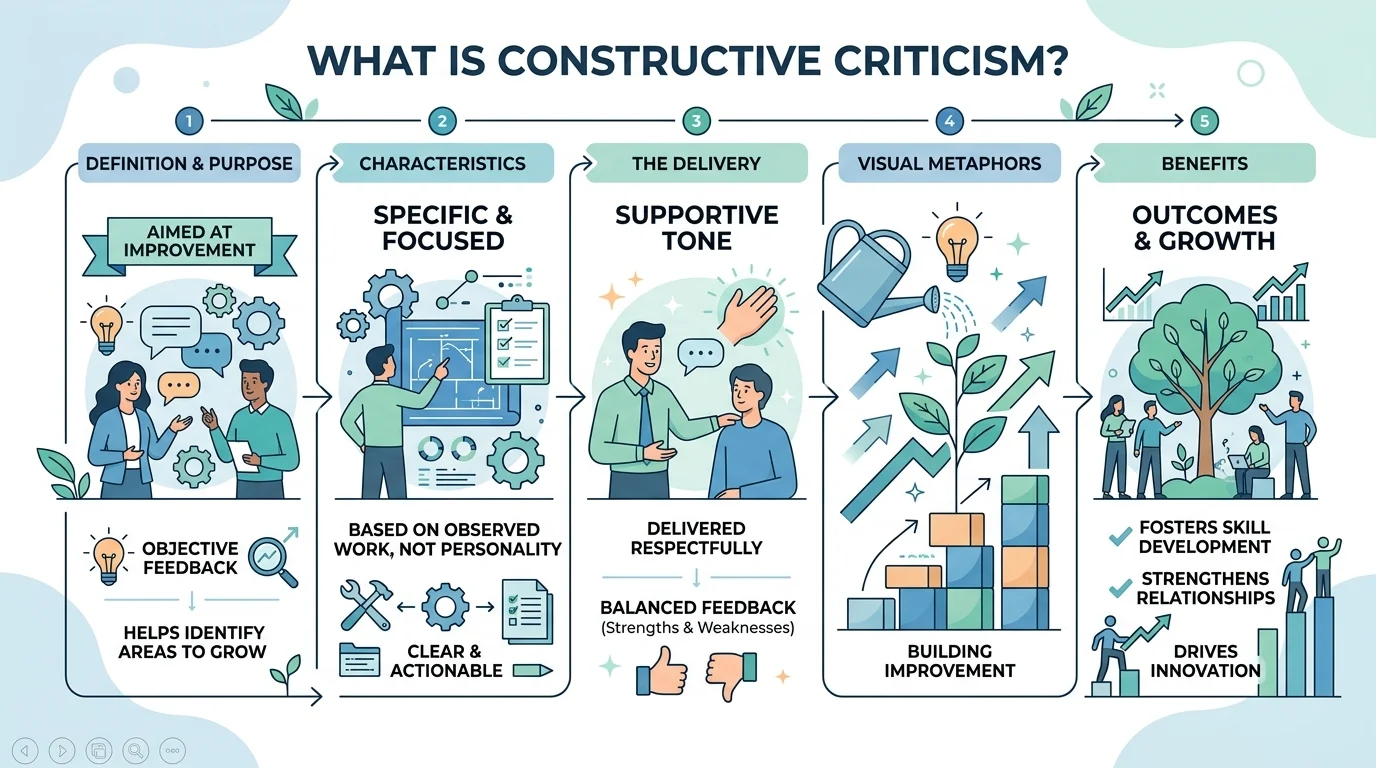
In simple terms, constructive feedback is feedback given with one goal: to help you improve. Not to tear you down. Not to make you feel small. To help you grow.
It's specific. It's actionable. And — this is key — it's delivered with empathy, not judgment.
Compare that to garbage feedback like "this is bad" or "you're not good at this." That's not constructive criticism. That's just... criticism. Useless, vague, and honestly kind of lazy.
Real constructive criticism sounds more like this:
"I noticed your reports have been missing detailed analysis lately. Try adding a section that interprets the data and explains what it means for the team."
See the difference?
One tells you what's wrong. The other tells you what's wrong and how to fix it. That's the whole idea behind a growth mindset — treating every gap as something fixable, not fixed.
Constructive Criticism vs. Destructive Criticism
This part matters a lot, so stay with me.
Not everything that sounds like feedback is actually helping you. Some of it is just destructive criticism wearing a disguise.
Here's a quick side-by-side so you can spot the difference fast:
Situation | Destructive Criticism | Constructive Criticism |
|---|---|---|
Missed deadline | "You're careless." | "This section had a few errors — let's go through it together." |
Miscommunication | "You never listen." | "I felt unheard in that meeting. Can we find a better way to communicate?" |
Sloppy report | "This is bad work." | "The report is missing data analysis — add a section interpreting the numbers." |
Repeated mistake | "You always do this." | "I've noticed this happen twice now — what's getting in the way?" |
You see it, right? One is a personal attack. The other opens a conversation.
If someone's giving you feedback that only makes you feel bad — with zero direction on how to improve — that's a red flag. Real feedback always points forward.
Why Constructive Criticism Actually Works (Backed by Data)
I'm not just saying this because it sounds nice. The numbers back it up too.
In a 2014 Harvard Business Review survey conducted by Zenger/Folkman, 92% of respondents agreed that negative feedback, when delivered appropriately, is effective at improving performance (source).
Separately, a widely-cited HBR finding notes that around 72% of employees believe critical feedback from managers is crucial to their career development (source).
And Francesca Gino, a professor at Harvard Business School, has pointed out that feedback is key to personal growth — and can literally save you from costly mistakes down the road.
Note: these stats are widely cited across secondary sources; if you're using them in a formal report, verify against the original HBR publication for exact figures and dates.
So yeah. Feedback isn't the enemy. Avoiding feedback is the real enemy.
How to Give Constructive Criticism (Step-by-Step)
Alright, let's get practical.
Because knowing what constructive criticism is won't help you if you don't know how to actually deliver it. Here's a simple step-by-step process you can start using today.
Step 1: Check Your Intent First
Before you say anything, ask yourself: am I trying to help this person, or am I just venting?
If it's the latter — pause. Rework your message. Beneficial intent is the foundation of good feedback.
Step 2: Be Specific
Vague feedback is useless feedback. Don't say "this needs work." Say what needs work and why.
Step 3: Focus on Behavior, Not Identity
This one's huge. Talk about the action, not the person. "You missed the deadline" is way better than "you're unreliable."
Step 4: Offer a Solution
Good feedback doesn't just point out problems — it offers a path forward. Where possible, tie it back to SMART goals so the next steps are measurable, not vague.
Step 5: Use a Framework Like SBI
If you want a proven structure, try the SBI feedback model — Situation, Behavior, Impact.
Situation — describe when and where it happened
Behavior — describe the specific action (no assumptions)
Impact — explain how it affected you, the team, or the outcome
Developed by the Center for Creative Leadership, this method takes the guesswork out of tough conversations. Some experts extend it into SBII, adding a fourth step — Intent — where you simply ask what the other person was trying to accomplish (source). This matters a lot when someone's intentions and actual impact don't match up.
If you want a bolder alternative to SBI, look into radical candor — a framework built around "caring personally while challenging directly." It's more direct than SBI, so it works best once trust is already established.
How to Receive Constructive Criticism Without Losing Your Mind
Now let's flip the script. Giving feedback is one thing. Receiving it is a whole different skill — and honestly, it overlaps a lot with good self-management, since staying calm and objective under criticism is really a form of managing your own reactions.
Here's what's helped me personally:
1. Pause before reacting. Your first instinct might be to get defensive. Don't. Just breathe for a second.
2. Separate the message from your ego. Feedback about your work isn't feedback about your worth.
3. Ask clarifying questions. "Can you give me an example?" goes a long way.
4. Say thank you. Even if it stings a little. Especially if it stings a little, honestly.
5. Actually apply it. This is where the real growth happens.
People who master receiving feedback tend to build stronger relationships, grow faster in their careers, and develop more emotional intelligence than those who avoid it altogether.
Building a Feedback Culture That Actually Works
You can't just "introduce" feedback into a team overnight. It has to become part of the culture.
That means:
Encouraging open communication
Creating psychological safety, so people feel safe speaking up
Practicing feedback regularly — not just during performance reviews
Modeling it yourself, as a leader, first
Reinforcing it with trust building exercises, not just formal reviews
When feedback becomes normal — not scary — something shifts. Teams start trusting each other more. People stop hiding mistakes. Growth becomes the default, not the exception.
Frequently Asked Questions
What is an example of constructive criticism?
"I noticed the presentation ran long — try cutting the third slide and tightening the data section for next time." It's specific, focused on the work, and offers a fix.
Is constructive criticism the same as negative feedback?
Not quite. Negative feedback just points out what's wrong. Constructive criticism does that and offers a way to improve — with respect and empathy built in.
How do you ask for constructive criticism?
Be direct and specific: "Can you tell me one thing I could improve in my last report?" Narrow questions get more useful answers than "any feedback?"
What's the SBI model in one sentence?
It's a three-step feedback structure — Situation, Behavior, Impact — that keeps feedback factual and reduces defensiveness.
Can constructive criticism backfire?
Yes, if it's vague, poorly timed, or focused on personality instead of behavior. Framing and intent matter as much as the content itself.
Final Thoughts
Look, constructive criticism isn't always comfortable. Nobody loves hearing what they need to improve. I get it. I've been there.
But here's the truth: the people and teams who grow the fastest are the ones who treat feedback as a gift, not an attack.
So next time someone offers you constructive feedback, don't shut down.
Lean in. Ask questions. Say thank you.
And then go apply it. That's how real growth happens.